
Hallelujah Trial : Tom Roberts and John Canning Yates on tea, talk and the birth of a new project
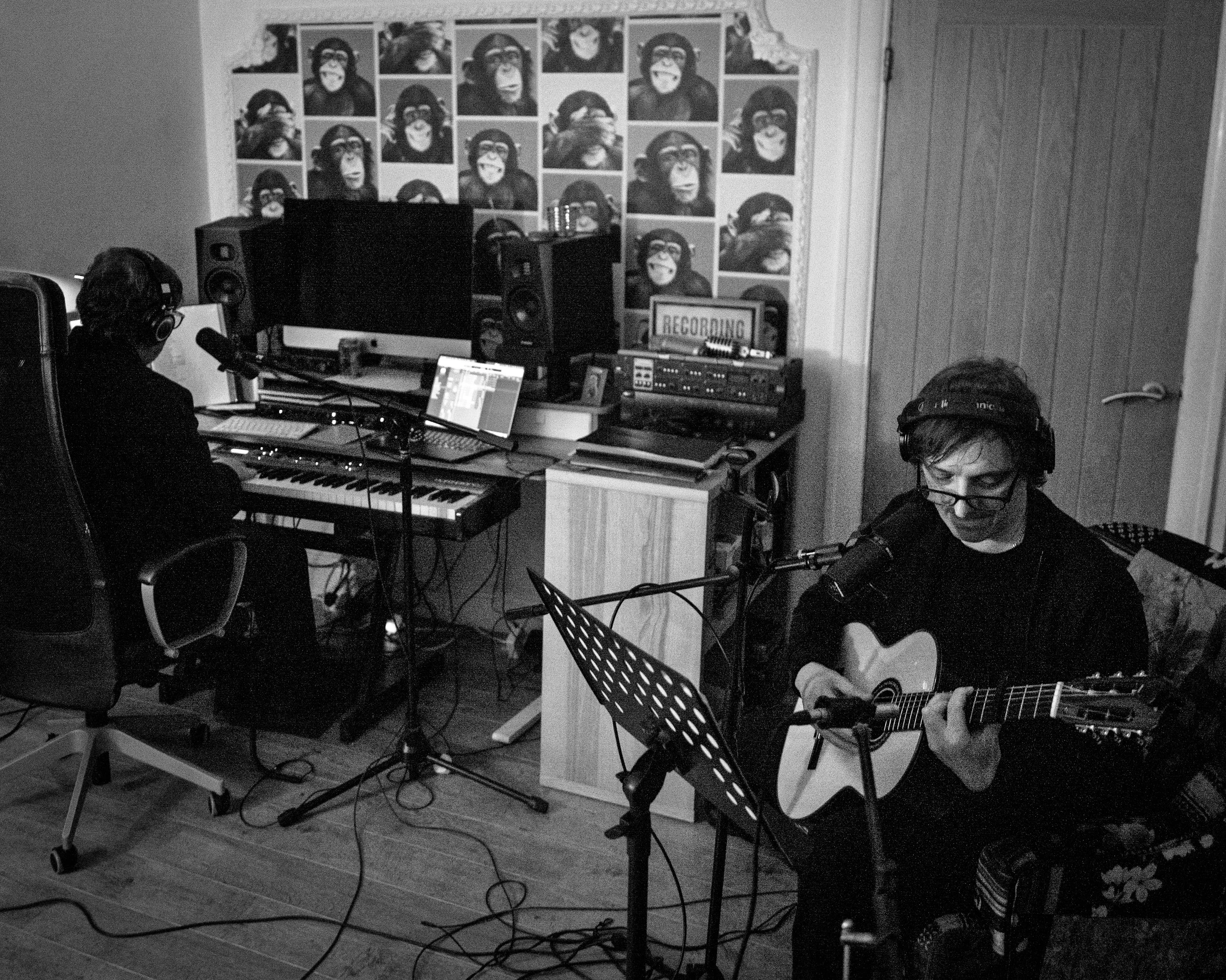
Hallelujah Trial happens when two separate, decades-long musical orbits finally collide in a front room. Tom Roberts (Cranebuilders, Beatowls) and John Canning Yates (Ella Guru) are friends who have known each other for twenty years, but it took a handful of Tom’s new songs and John’s instinctive piano to finally close the loop.
It’s less a project born of any kind of strategy and more a weekly ritual of tea, talk and accidental grace. No agenda, no timeline. It’s just two songwriters knocking ideas into shape until they ring true. The result is spacious, stripped-back and gloriously melodic. Storytelling songs that feel uncovered as written, fully formed during a Tuesday evening conversation. It’s the sound of a friendship finally finding its soundtrack.
We caught up with Tom and John over tea and toast in the front room:
You’ve known each other for more than 20 years. Why was now the moment that gravity finally pulled you into the same room to play together?
Tom: It was attending the Violette nights after COVID that started it all really, and going to gigs together: Beth Gibbons, Bill Callahan, Aldous Harding, Bill Ryder-Jones, Marina Allen, Arab Strap, Kathryn Joseph, Gwenifer Raymond and M. Haiux. I could go on… what can I say, I talk in bands and music.
It all happened very organically over time. We’ve always been supportive of and fans of each other’s music. John asked what I was up to, if I had any recordings he could listen to, and invited me to his studio to play a bit, just hang out and have a bit of fun. We did that for a bit, then we started recording tracks. Then later, PJ asked us if we would like to play the last Violette Società which made it all a bit more real. We’re big fans of the night, the label and the artists involved with it, so we jumped at the chance.
John: It was a bit of serendipity or synchronicity that after twenty years of knowing each other we ended up releasing back to back albums on Violette Records. Tom with Beatowls, and then my album. We’d go to Violette nights together and the chat would inevitably turn to songwriting. I’ve always loved Tom’s songs and, although I know I’m not one to talk, I was always encouraging him to get more of them out there. I think that’s what led us here. I offered to help and we started a regular meet up and it’s been really enjoyable to play together, after all these years. It’s been fun hanging out and figuring out where these songs want to go and how they want to sound.
Tom, you brought the initial song sketches. Can you describe the first time you played one of these songs together?
Tom: There were three songs I originally sent John: 'Together We Lost', 'On Each Branch' and 'Now We Are Less Afraid'. Just guitar vocal home demos. I was keen to hear what they would sound like with piano.
A couple of days later he sent back 'On Each Branch', which is a song I wrote with David McDonnell of The Sand Band. The piano John played brought a new weight and depth of emotion to the song, the feel. I got really excited by it. It was immediately right. The long dark sustained notes and the space really pull you in. It all fit together perfectly.
I couldn’t wait to get into John’s studio and hear it live. It’s the thing I love the most when you’re working on a track together and throwing ideas around, forging the arrangements and everyone’s locked in. It’s the best feeling. You just know instinctively when something’s working and there’s a good energy…everyone’s a bit excited and up. Yeah, right from the off it felt right and a joy to play.
The name “Hallelujah Trial” feels like it holds a bit of weight. Is there a story behind it or did it just feel right for the sound?
Tom: It’s a name I’ve been using and carrying around for a while. It came from a 1960s movie advert that caught my eye called The Hallelujah Trail. I’ve still never actually seen the film. It was an instant eureka type moment where the whole vision of the thing opened before me just by changing the “ai” in “trail” to “trial” and it suddenly felt more human. The combination of the two words instantly made sense to me. The tension between them seemed to have a gospel type poetic structure with struggle and redemption. You go through the trial and the outcome is the hallelujah. Universal, everyday personal experiences and the small victories. It set my imagination reeling and it felt like a world of possibilities opened up in an instant. It felt jubilant but Kafkaesque in a funny kind of way. It had a dry humour to it and to my ears sounded great. It also reminded me of all the great songs that use the hallelujah motif, which again I bought into instantly. It seemed to capture the sound and the spirit of what I was trying to do.
One of the things I like about it is that it lends itself to so many things. One of the ways I’ve been thinking about it is in terms of the creative process. For me the whole thing, like most things I suppose, is full of peaks and troughs, highs and lows. The internal processing that happens, the introspective choices that are made. It’s real light and dark. The feeling like you’re never going to create anything good ever again then out of nowhere something happens and you’re drunk with the flow of it. The joy you get when you finally bring something to life. It’s the thing I love the most, but I also drive those around me insane with it… ha! It all comes from a good place. The heaven and the hell of it all.
Is there a specific record or artist that sits in the Venn diagram overlap of your tastes, someone you both reference as a touchstone for what you want this project to be?
John: The section in the middle of the Venn diagram would be HUGE! I think what we appreciate most is that we have a lot of shared reference points and we always have had. That makes it easy to explain ourselves. Back in the Ella Guru days, our favourite band from around here quickly became Tom’s band Cranebuilders, we played shows together, swapped tapes, found allies/friends... another band from Liverpool who loved the Silver Jews!
I suppose I’d say we’d reference Bill Callahan, Lou Reed, Will Oldham, Lee Hazlewood, Leonard Cohen. But the approach we’re taking is probably closer to the late Johnny Cash period, songs in a room. There’s a shared playlist we dip into regularly but mainly the songs do the work, words and Tom’s voice at the forefront, the atmosphere is created by the feeling in the room and grows from Tom’s lyrics. We’re looking for that little bit of magic. Yeah I know, we had it on take four.
Tom: We’ve always been interested in similar music and traded tapes, records, bands etc as you do. When I first met John, it was really exciting to meet someone in Liverpool at the time who’d heard of Smog, Palace Music, Silver Jews, Sparklehorse and shared a love of the greats: Lou Reed, Leonard Cohen, Neil Young and The Beatles. There’s a playlist I shared with John that I use for reference, inspiration and to keep me focused on where it’s going. It’s got all kinds of amazing new and old stuff in there. The sounds, tone, production, delivery, lyrics and instrumentation all play a part. We tend to use that as our benchmark or touchstone for the direction, a starting point or something to aim for when we start working on a song.
Next week you take these songs out of the safety of the front room and onto a stage for the first time. How does it feel?
Tom: I’m quite excited by the prospect. A little bit nervous… good stress. I try to frame everything in a positive way. For me it’s about getting in the right head space and hoping we get touched by that little bit of magic to make it a special performance for us and everyone else there. I’m hoping the songs will open themselves up to the audience when we play them live. Like I said earlier, I’m really pleased we’ve been given the opportunity to play the last Violette night and to see the Hallelujah Trial name on such an iconic poster is a great feeling. I’m just going to try and enjoy the moment for what it is. But I will be stressing loads before we go on… ha!
John: It's exciting. I often say at the end of a song we’re playing, if anyone was there to hear that, I think they’d be into it. So I’m sure that will be the case. It feels bittersweet that we’re playing our first show together on the last Violette night. So the audience will be great as they always are. Thanks to PJ for asking us to play. And for everything. We’re really going to miss the night. Where do we go now?
You’ve described this as having no agenda. When the songs are eventually out in the world, what’s the ambition for them?
John: I’ve really enjoyed our weekly ritual. It’s been a long time since I played regularly with anyone and it’s been so good to just hang out and play. I’d be happy for it to continue. It’s felt very natural and these songs put you in another place. And we all like to be in another place right now. I think it’s best to have no set agenda. Let the songs do the work. Who knows?
Tom: “Agenda” seems like such a big word. I don’t know if I have an agenda. I try to approach it all from a people first point of view. If we’re not all enjoying it, what would be the point? Yes, definitely keep the ritual alive. That’s why we do it, the connection and engagement, the creativity and elation at being in that special space, being with your mates. The ideas lead the way and action creates the path. In terms of ambition, yeah, no limitations. I want everyone to hear it and love it the way I do. I want to be headlining the Albert Hall, meeting people and travelling, doing shows and playing to bigger audiences. Yes, I want it to be out in the world. I want the songs used in movies and soundtracks. I just hope people feel a bit of what we feel when we’re making them, that mix of light and dark and the little lift you get when something connects. No limitations, manifest biggly. Let’s see what happens.
Halleujah Trail play their debut performance at the La Violette Società's final event in Liverpool on Tuesday 7 April 2026