
Science & Magic | 19

I’ve been thinking about the inevitable moment, a few years from now, when a grandchild looks up from their device and asks with genuine, un-ironic curiosity: "Grandad, what exactly did you do during the Great Plague of 2020?"
It’s a harrowing thought. Not because of the tragedy or the isolation, but because of the crushing banality of the honest answer. I’ll have to look them in the eye and explain that while the world teetered on the brink, I spent a significant portion of my afternoon peering through a gap in the Venetian blinds, recording the arrival of a suspicious sourdough starter at Number 28.
"I was a volunteer for the Micro-Stasi," I’ll tell them. "I maintained a forensic log of exactly how many households were represented in the neighbouring garden. I was a connoisseur of the illegal barbecue. I possessed all the moral authority of a medieval inquisitor and the observational range of a common garden snail."
We became a nation of amateur informants, didn't we? Overnight, our collective sensibility shifted from "live and let live" to "is that a third person from a different bubble I see by the hydrangeas?" We weaponised the Rule of Six with all the enthusiasm of a junior accountant auditing a particularly fraudulent expense claim. We were miserable, terrified, and most disturbingly, completely obsessed with making sure everyone else was as miserable and terrified as we were.
And then there were the Thursdays.
When history asks for our contribution to the front line, we’ll have to mention the pans. Every Thursday at 8pm, we marched to our doorsteps armed with Le Creuset skillets and mismatched wooden spoons, performing a frantic, rhythmic salute to a healthcare system we’d spent the previous three decades effectively voting to dismantle. It was a masterclass in performative guilt, a cacophony of kitchenware that served as a convenient substitute for actually doing anything useful. We banged those pans until the handles came loose, then went back inside to argue with strangers on the internet about the efficacy of wearing a scarf while walking a dog.
And that there was the real war, of course. In the digital trenches. We did battle on social media with the dead-eyed intensity of people who had forgotten how to interact with fellow human beings. We curated our outrage with the same care we applied to our banana bread. We unfollowed friends of twenty years because they expressed a slightly heterodox opinion on the regional tier system. We traded nuance for dopamine hits and human connection for the cold comfort of being "correct" in an echo chamber of Ian Brown’s own design.
It was a life, I suppose. But fuck me.
We’ve emerged from it now, blinking into the light, pretending that those two years were a profound period of collective reflection. But looking at the current state of things - the same old noise, the same shallow ideas, the same desperate need to be seen doing the "right" thing - it seems we didn’t learn a thing. We just got better at peering through the blinds.
Welcome to the latest edition. We’re still here, somehow.
Matt
Ten Questions
by Phil Lewis
Phil Lewis is a man whose life has been measured out in songs. From the radiogram in a Kirkdale living room to the sun-drenched studios of Los Angeles, his journey is a testament to the enduring, transformative power of music. He is a familiar and welcome face at our La Violette Società events, a regular attendee who understands the value of a shared musical moment.
We asked him to share a little of his story:
“My dad played violin, my mum played piano. Saturday night after the pub was always a 'sing-song'. Everything from Cole Porter to Jimmie Rodgers. As the youngest of four kids, I absorbed it all. Our radiogramme belted out my dad's Stephane Grappelli & Django Reinhardt 'Hot Club de Paris’ 78rpm records and early Bing Crosby songs. My much older siblings' collections of Ella Fitzgerald, Nat King Cole, Elvis, Buddy Holly and Little Richard created an eclectic mix.
Growing up in Kirkdale, Liverpool in the '50s, I can't remember a time in my life when I wasn't singing. From 1961 until '67, I sang in the Liverpool Metropolitan Cathedral Choir. Also singing lead soprano occasionally with the Liverpool Operatic Society. For a kid from 'the wrong side of the tracks', it was a much treasured musical experience.
A progression in adolescence from The Beatles, then 'Music from Big Pink' by The Band, through Sam & Dave, Otis, Aretha and other Stax artists, led me to Steely Dan, Little Feat and many 'West Coast' bands, who'd now be labelled Americana. This was my musical rite of passage. I'd read Rolling Stone magazine reviews and religiously go to the original tiny Probe Records shop in search of new artists.
I sang and played with various outfits in the early '70s, often with local musicians who were survivors of the Merseybeat era. Some great players. Forming the 7-piece 'Streetband' in '74, we performed original material interspersed with interpretational cover versions. As well as residencies in the city centre at the Masonic in Berry St and the Star & Garter in the precinct, we were also surprisingly well received in all the 'Hell-Hole' dives of Speke, Huyton, Kirkby and Scotland Rd. Great places to cut your teeth. Sometimes literally!
A trip to Miami, Florida in '81 resulted in a demo recorded with session men, formerly with the Warren Zevon Band. A contract was on the table. We flew to L.A. for an introduction with The Pointer Sisters, who at the time had just enjoyed success with the single 'Slow Hand' and were looking for songwriters capable of producing similar material. I needed to return home due to a family crisis, fully intending to return and fulfill the offered contract.
But life, booze and personal illness got in the way. I never returned to America.
Sober for the last 22 years, I continue to perform locally in a covers band which pays my bills. Still having an increasingly desperate need to record original material accumulated over 50-something years, before I inevitably join that 'choir in the sky'.
I've attended the monthly La Violette Società nights for a few years now from its inception in Leaf Bold St. to its current home at Ten Streets Social on the dock rd. Im a passionate supporter of these monthly events, the concept of which is to give diverse artists a platform for music, spoken word, poetry and prose in equal measure, with all proceeds going to the artists. I've seen some amazing acts, which I'd otherwise never would have heard of.
When I was a kid you'd buy 'Lucky Bags' from the sweetshop. You had no idea what the assortment was inside until you tore open the bag. That was part of the thrill of buying one. La Violette Società is exactly the same.”
We invited Phil to select ten questions from our archive. His answers chart a course from the genius of a young Stevie Wonder to the "hippie heaven" of Wembley '74, via the sheer joy of an infant's laughter.

● What album would you press into the hands of an 18-year-old today, insisting they listen to it front-to-back right now?
Talking Book - Stevie Wonder. I was about 18 when it was released and it blew me away. Stevie was only 22 years old when he composed, sang and played virtually everything on that album. It still astonishes me considering how ground breaking it was. Jeff Beck's exquisite guitar solos perfectly complimenting Stevie's soulful ballads. I'd recommend it to any 18 year old, if only for them to hear a young genius at work.
● What album would be most likely to bring you out of a coma?
Moondog Matinee - The Band. Rousing renditions of classic Rock n Roll songs. Delivered to perfection. Guaranteed to raise the dead!
● What's your favourite sound that isn't music?
Infants' laughter. Totally unpretentious. Innocence. Sheer joy. Never fails to lift my spirits.
● If you could time-travel to witness one musical moment in history, when and where would you go?
The Victoriana Club, Victoria St. Liverpool, October 1968. Joe Cocker and The Grease Band. Just prior to Woodstock and fame. I was a little too young to attend nightclubs then, but older mates who were there still rave about it to this day.
● What's your go-to song for pure, uncomplicated, turn-it-up-and-dance joy?
'Oh Atlanta' - Little Feat. This song has the lot. Syncopating piano, gliding slide guitar, great vocals. Impossible to keep still to.
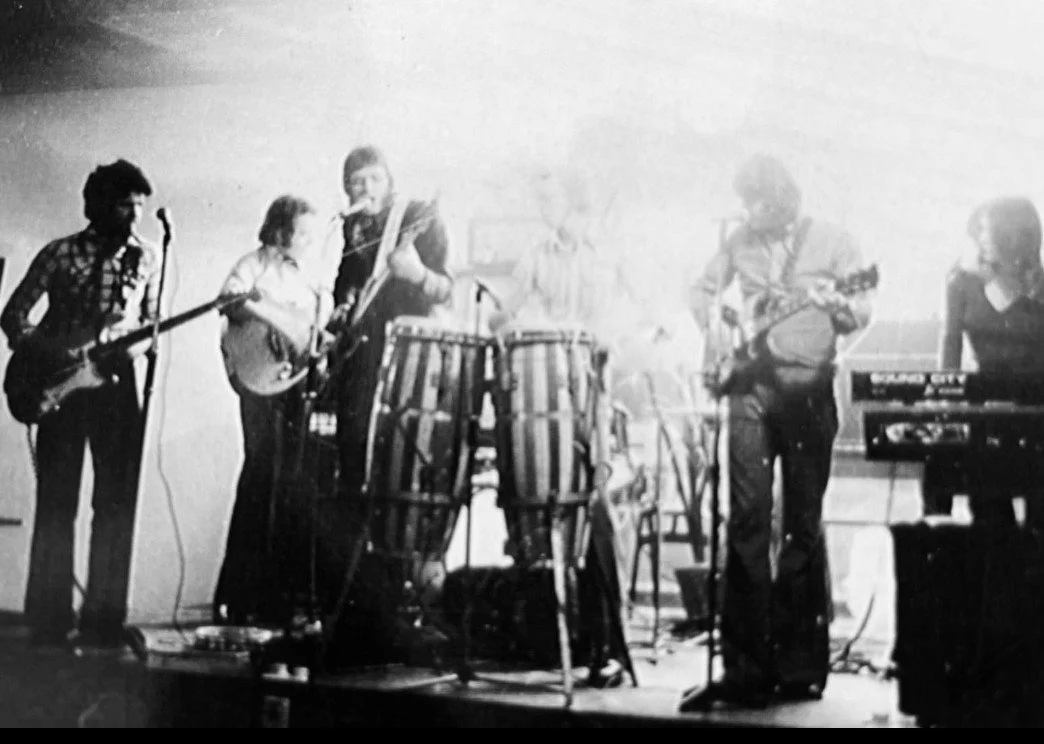
Phil (centre), aged 21 in Star & Garter Liverpool 1973
● What's a single line from a song that has stuck with you like a mantra or piece of life-changing advice?
" Don't it always seem to go, that you don't know what you've got till it's gone". 'Big Yellow Taxi' - Joni Mitchell. I think you need to achieve a certain age to fully appreciate the implications of this line.
● Which song lives in your memory word-for-word that would raise eyebrows if you suddenly performed it flawlessly at karaoke?
'I Want To Go Back To My Little Grass Shack In Kealakakua Hawaii' by Bing Crosby. It was my mother's 'party piece'. She would sing it at family occasions, complete with grass skirt and Hula Hula dance moves. I remember every word.
● What's the best gig you've ever been to?
Wembley Stadium '74. Jesse Colin Young. Joni Mitchell with Tom Scott's L.A. Express. The Band. Crosby Stills Nash & Young. All of my heroes on one stage! The Band opened with the old Motown song, 'Loving You Is Sweeter Than Ever'. Brilliant sunshine, Peace and love man! Five years after Woodstock, it was my 'Hippie Heaven'.
● What instrument do you wish you could play but have never learned?
Saxophone. Piano is my favourite instrument, but I'd have to say saxophone. As a singer, it seems a natural progression of expression.
● What album would you want played at your funeral?
Peace at Last by The Blue Nile. Particularly the first track, 'Happiness'. I want it played as I'm carried into church. Impact and theatre to the end! Also Hymns by Beth Nielsen Chapman. The album contains some of the Latin hymns I sang as a boy.
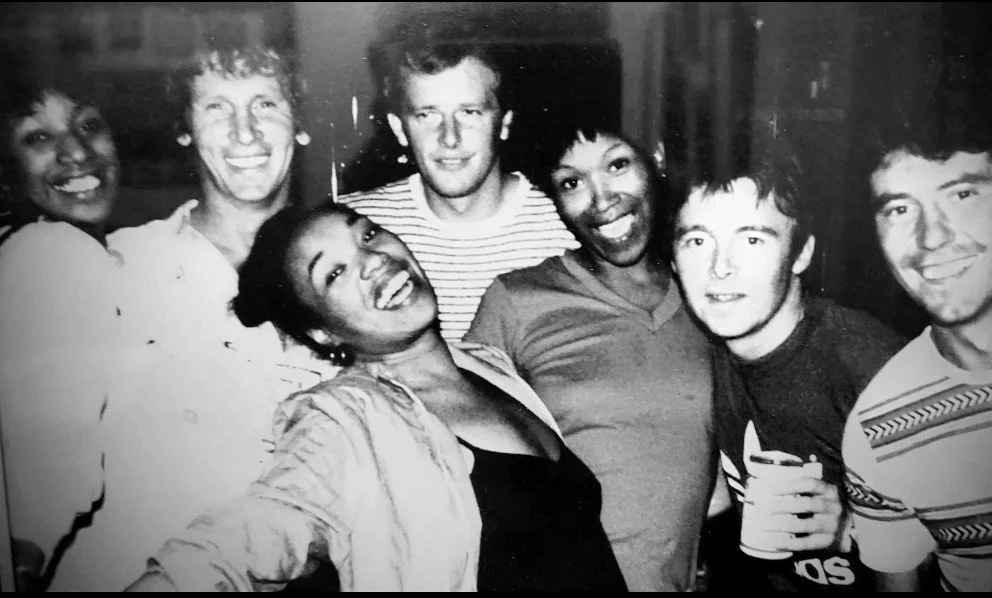
Phil (centre), with The Pointer Sisters. LA. 1981
Magnetic North
by Jeff Young
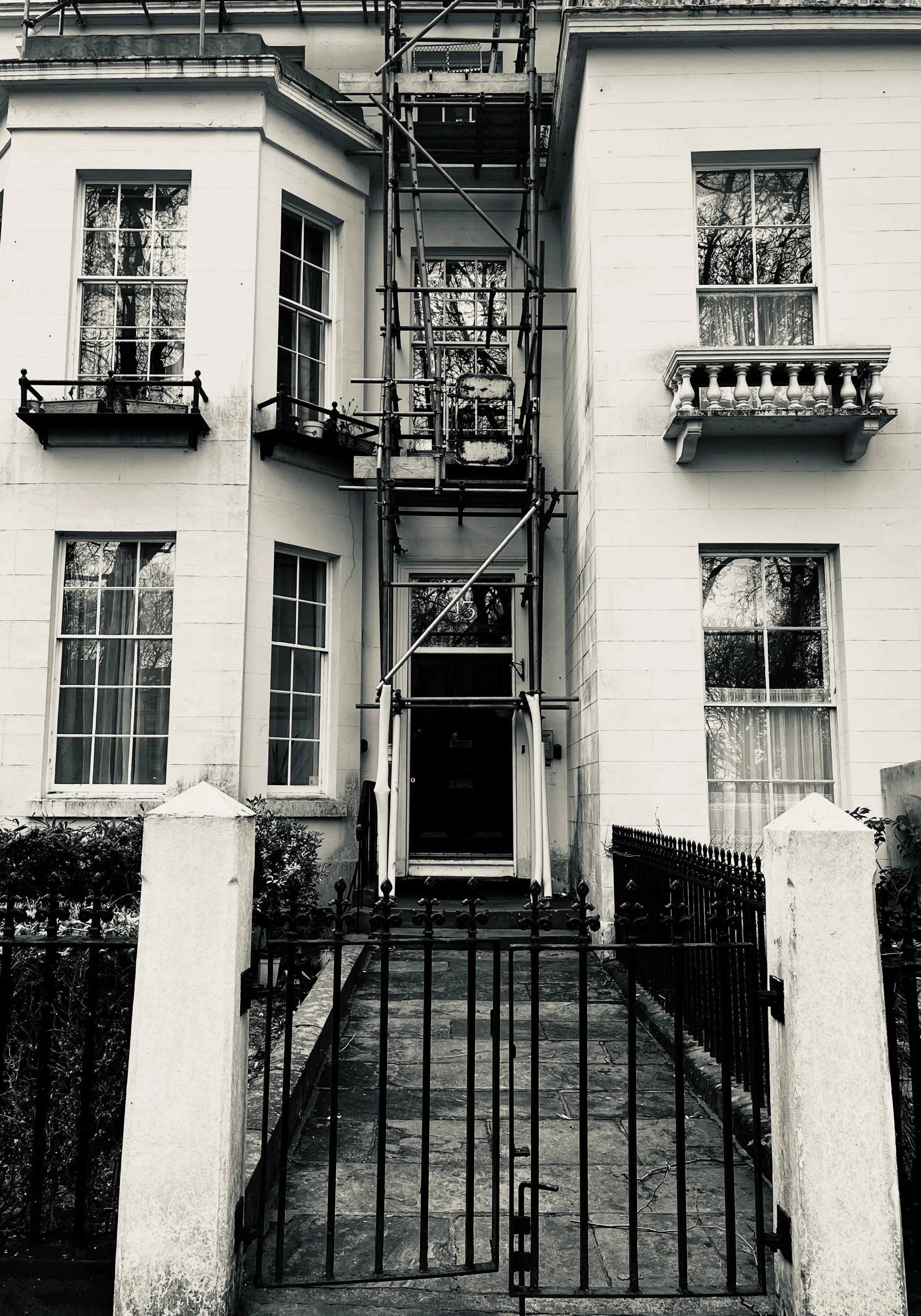
19 : Bohemia
In my dreams I always lived here. I’d wanted a flat in Falkner Square from way back in my teenage years when I used to wander around Liverpool 8 with a head full of bohemia. The books I was reading, the music I was listening to, the paintings I was looking at – and indeed trying to paint – the poems I was reading – and indeed trying to write – all came together in a foggy notion that Liverpool 8 was my Greenwich Village with a smattering of Soho and Harlem. When I finally came to live here in the 1980’s after coming home from Amsterdam my dreams came true and yet, my dreams were broken.
Twelve quid a week rent, two-bar fire in the living room and the rest of the flat like winter even in the summer. I wrote my first few plays here, and stacks of beat poetry. At my first gig in the Irish Centre, I read a poem about Falkner Square called ‘Negativland’, soundtracked by the Neu tune recorded on a cheap cassette. My first play ‘Famous Last Words’ was a self-lacerating autobiographical piece about my hand to mouth existence in this house. So much for the dream...
Standing here this morning, memories flicker: Thunderbird wine and Night Train Express, the drinks of choice bought from Beaver’s off licence on Myrtle Parade; the night the ceiling caved in, the flat filling up with dirty snow because thieves had stripped the roof of lead and slates; chatting with the sex workers hanging around the phone box as they cadge cigarettes on the night they built a snowman; drinking Caribbean Strong Backs in the Gladray, spooning the banana from the bottom of the glass; writing poems on envelopes, hunched in Kavanagh’s thinking I was Rimbaud; the enormous bonfire in the square when they filmed The Magic Toyshop, the square becoming an Angela Carter fairy tale. Did they set the city on fire that night? In my dreams they did, the night aflame, a hallucinatory vision of Liverpool beautifully burning...
When the man who lived upstairs filled his rooms with mattresses and turned the place into a brothel, things began to go downhill. Then the dry rot and the stairs collapsing and the creeping realization that Bohemia was elsewhere. But sometimes, in my dreams, I still live here, scratching out the deadbeat sonnets, the walls of the flat flickering like ghost cinema screens, lit by bonfire glimmer.
Forty years gone but the memories remain. Remember the sparks like tiny shooting stars? This is the house where once I dreamed such dreams.
— Jeff Young, 24 February 2026
—
Jeff Young treats Liverpool as a recurring dream he is constantly trying to wake up from, only to find himself back in the same room, forty years earlier. Jeff believes that Bohemia is not a "foggy notion" constructed from paperback books and cheap cassettes, a state of mind that is perpetually cold, even in summer. He is currently reconstructing his first play from the debris found in the gutters around Falkner Square, convinced that the true script of his life is written in the language of discarded cigarette packets and snow that isn't really snow.
The Paphides Principle
Trashcan Sinatras - ‘The Bitter End’
After 40 years, it still beats working for a living – and so The Trashcan Sinatras, Caledonian masterminds of melancholy, return with the first fruits of an album we’re told will land later in 2026. They’ll never break up now because they’ve met the challenges of debt and diasporic drift in the only way they know how. With the rock-solid belief that Sting was onto something when he wrote ‘Message In A Bottle’. In other words, as long as you throw those messages out into the big blue, one morning you’ll wake up and a hundred thousand bottles will end up washed upon the shore.
Sure, perhaps things might have been different if they’d bent a little to whatever was happening around them at the time. A bit baggier in 1990. A little bit grungier in ’93. A bit cokier in ’97. But this was not the Trashcans’ way. A stopped clock is right at least some of the time and the Trashcans aren’t just any old stopped clock. When people fly across the world to see the 725 year-old Prague Astronomical Clock, they haven’t gone there to find out the time. And similarly, when I rifle through the T section in my record room and pull out a forever classic like ‘I’ve Seen Everything’, ‘A Happy Pocket’ or ‘Weightlifting’, it’s not information I’m after.
I’m here because these songs sound like secular hymns to a spirit that lives and dies with the humans who choose to share it. I’m here because of that magical thing that happens with proper groups forged in the crucible of a shared purpose and, after a few years, you can no longer tell who writes what any more. The lines of demarcation are a hazy as the feeling of profound warmth these songs engender in you.
So these days, Frank’s in California, Paul’s in Tacoma and John’s in Glasgow. But of course, they’ve been living together, rent free in my deepest affections ever since I first pressed play on ‘I’ve Seen Everything’. In that moment 33 year ago, I was in a scene from a musical. The four walls around me flipped 180 degrees to reveal Victorian brickwork while the carpet tiles beneath me gave way to Kilmarnock cobbles.
And so to this new song. What do you want to know? Here’s what I can tell you. It’s called ‘The Bitter End’. It clanks and jangles as sonorously as a milk float in fresh 5am snowfall. It’s a plangent pledge of fidelity in the face of come what will. If there’s a person in your life about whom you feel that way, it’ll remind you of them. But do you know what? It could just as easily apply to a band. A band like The Trashcan Sinatras.
—Pete Paphides, 26 February 2026
Hope Is a Boat That Floats.
by Angie Woolf
If you're looking for land on the horizon as the storm shuts out the light
If you go below deck as the heavens pour turning day to night
If you batten down the hatches
Place buckets and pans to catch the leaks
If you keep your hopes safe in your old leather case
As the waves rise and peak
If you stop the overflow
Not allow water to gather at your feet
By pouring full buckets back overboard however futile this might seem
If you hold steady
With empty buckets and pans back in place
If you curl yourself up in a dry corner knees hugged to chest sat atop of your old leather case
If you can rest as the storm passes over Awakening as light pours through the gaps
Empty your water
Check your old case to find your hope folded up safely like an old treasure map
Then hope itself is never gone
If you survive the night
You're a rider of storms
A floater of boats
You can never be lost
And only will you find
That all of us are sailors
With hopes and dreams divine
And the sea can sink or free us
Inside of our own minds.
—
The eagle-eyed amongst us will have noticed that Angie Woolf has been absent from these pages for a fortnight, having embarked on an unauthorised solo expedition to locate the precise coordinates of "hope." She claims to have found it floating in a flooded basement in Toxteth, disguised as a waterproof suitcase. Her latest poem here is a guide for surviving psychic storms, written entirely during a period of enforced hibernation under a pile of damp coats. She has returned with a new theory: that we are all just "riders of storms" navigating an internal sea that exists only when we close our eyes, and that the only reliable life raft is a bucket with a hole in it. My question is, though: where did she get the buckets?
Atticus Books – The Comforts of the Avant Garde
by Mike Stoddart
We’ve all needed guidance at some time, through an intimidating new world of developing obsession. A record shop, a bookseller, a bar full of the great and the good. Some kind of locus, basically, where we would either find a way in or boil our heads in the effort. Thankfully, the culturally uncertain were well catered to by the Liverpool of my youth.
In 1981 my local library was losing me. There were thousands of ancient educational curios on shelves that went to the ceiling. Some of these had fascinated me in my youth, but now I was 17, and the hippest kid on my block! I was steeping myself in moody French Lit in school, and looking forward to reading Sartre while conducting stuttering love affairs in black and white. I had a yen for a challenge, something that would sit comfortably with my growing pile of nutcase records. What use did I have now for the Stanley Gibbons’ Simplified Stamp Catalogue of 1958?
“Do you have any William Burroughs?”
“I’ll check for you, but I’m not too sure, only I’ve heard he’s a bit racy, y’know. Oh, here’s one, Naked Lunch. Will that do you?”
Er, probably. I was too scared to refuse by this point, and left with a book that I would find entrancingly bizarre, grimly hilarious and nauseatingly scabrous – not to mention a bit racy - all on the same page! Where was it supposed to be taking me? If only there was a place where I could talk about this kind of thing, where neither I nor anybody else would feel daft…
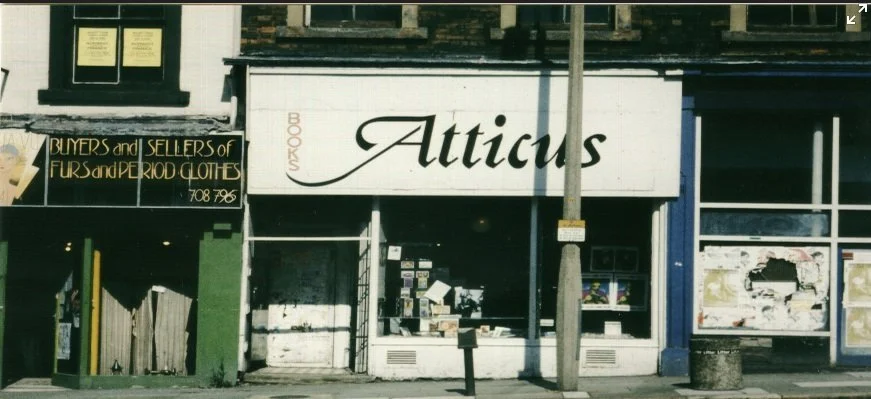
Well, of course there was, the city was an A to Z of opaque road maps for the soul that wanted to get nicely lost. Atticus bookshop sat at the top of Hardman Street in central Liverpool. It was next to the Philharmonic pub, and equidistant from Ye Cracke and the Everyman Bistro, as if sitting on some ley line of cultural magic. In it were all the fascinations a pretentious sixth former could have been dreaming of, and even more that he hadn’t had time to dream of just yet. Absurd drama, Beat writing, the wickedly avant garde, even some stuff I’d heard of. All of human endeavour was sitting on those shelves, coaxing the curious off the main road and into another world of kaleidoscopic perception. But above all, it just felt, well, lovely! Nobody was going to shout at you if you hadn’t thought hard enough about the human condition, and they knew full well that Mr. Burroughs was, indeed, a bit racy.
The place was stocked in glaring defiance of all traditional business wisdom, and could well have been a different beast to everybody who came in. But the mercurial cantors of these maverick publishers wove a perfect counterpoint to my beloved tiny record labels: City Lights, Calder Editions, New Directions, not just sitting on the shelves but actively occupying them, daring you to have a go, in the same way as the old Factory, Zoo or Rough Trade singles would glare at you from the record shop walls, enchanting and forbidding. And if £3.99 seemed a lot to an impecunious teenager, there was always a Kerouac for half the price, or even a Biff postcard for 20p.
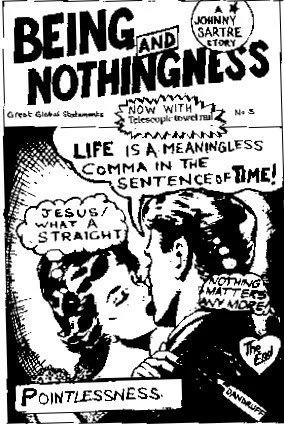
Needless to say, I was led there by the music of the post-punk era, some of which was couching itself in literary allusion. Awkward music and impenetrable books – every day was Christmas! But it swiftly became apparent that many had come down here on a different bus, and that I was browsing alongside people who had long been drawn to rule-breaking art. How was I supposed to know that Adrian Henri, the Jarry-loving Mersey poet and admirer of wild jazz, had never even heard of Pere Ubu? And my French Lit teacher, a shop regular, didn’t even know who Echo and the Bunnymen were, let alone noticing their tribute to Albert Camus in ‘Happy Death Men’. Just how much rule-breaking art was out there to fill their time? What had I been doing with mine? Didn’t I already know everything? What’s that? No? Oh…
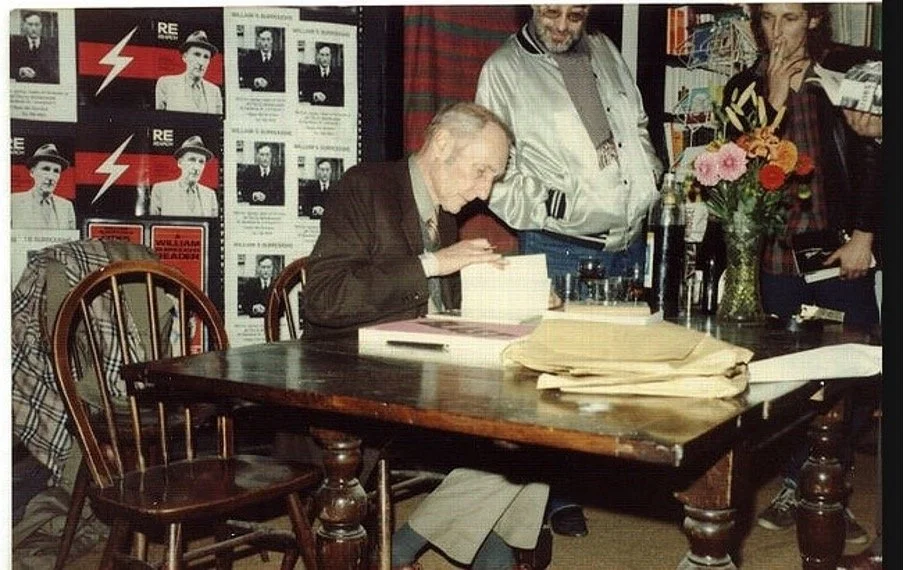
Thank you, Mr. Burroughs, yes, that’s “Henri” with an “i.”
So punk hadn’t been the Year Zero of global awakening after all, and life before it wasn’t just a woolly world of brown rice and red leb. Atticus showed me a wider picture of Liverpool’s milieu, to which it had been and would remain pivotal: old hippies, new hippies, poets, playwrights, mystics and dipsticks and every other stripe of life that might be encompassed and nurtured by such a boggling spectrum of artistic pursuit. Trips to Atticus were a hop over the stile into an uncharted cultural woodland, but soon it fell to me to wend my own path to the most enchanted thickets.
And which of them more fertile than William Burroughs’ instore book signing in 1982, when the maven of the monstrous, the man who had taken an unwavering scalpel to the nightmare excesses of the century, simply breezed in and charmed the pants off everybody in a crowded room? What event more eye-opening than seeing him give a reading that same night, shedding a clear new light upon his intractable work and teaching a gormless teenager to appreciate the cauterisingly avant garde on its own terms.
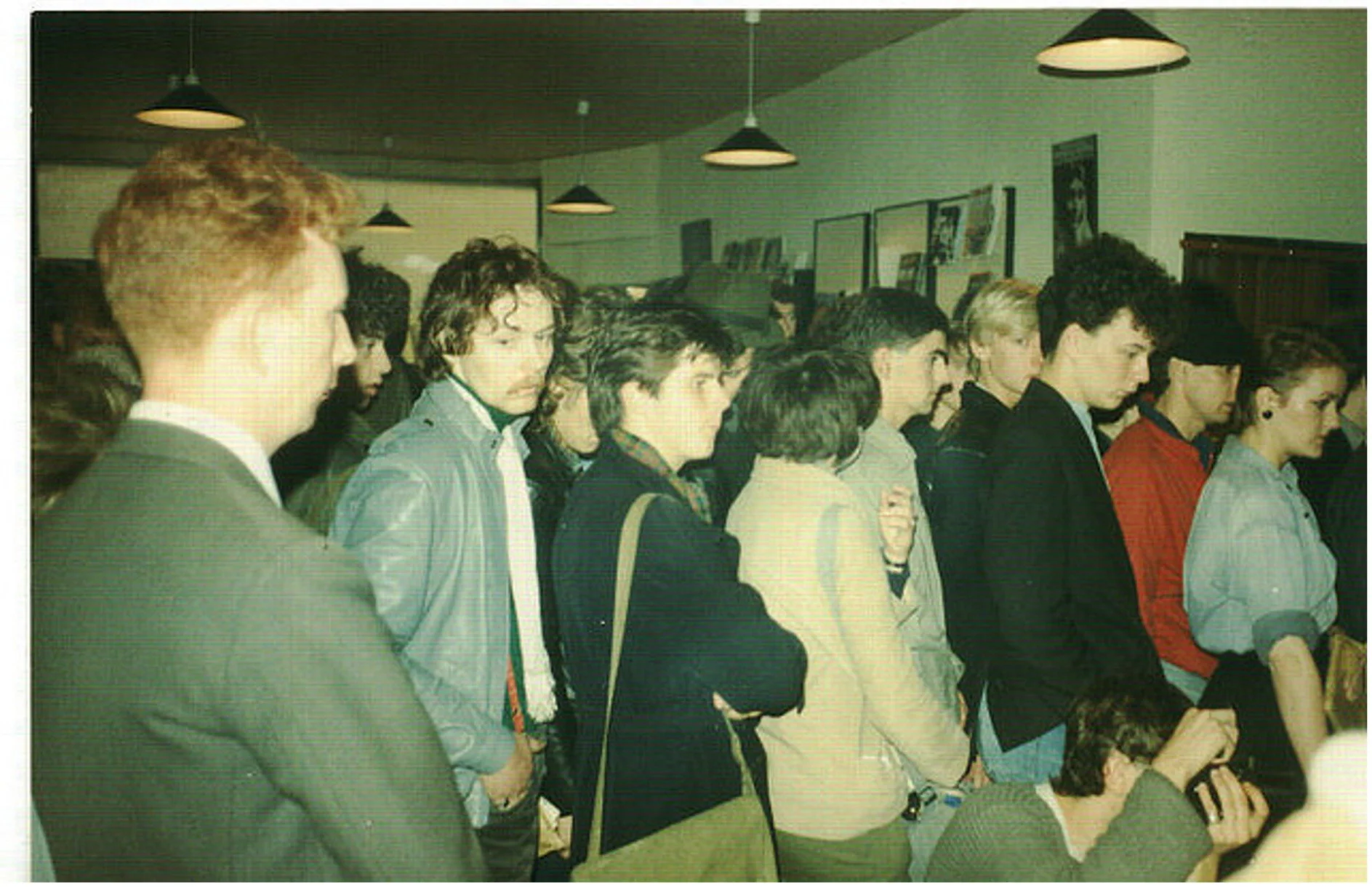
Crowds flock to Atticus to see William S. Burroughs in 1982, a bad hair year.
These and others were life-long lessons, courtesy of a shop that offered an experience even more profound than an hour in a café full of trendies. And, as unlikely as it may seem, it still prevails, on a main drag in Central Lancaster – a real and inviting bookshop with Franz Kafka on the wall, in an online age where everything is always available, but little of it seems quite as much fun.
And yes, of course the old bookish punk era records still sound great. It goes around, it comes around. I never did get round to everything in the shop though, sorry. Some of those tomes looked like a bit of a commitment when all was said and done, and I was never going to find time to conduct stuttering love affairs in grainy monochrome while I was trying to read Finnegans Wake in my spare time. I think I made the right choice…
William S. Burroughs photographs used with the kind permission of Jill McArdle
—
Mike Stoddart navigates our cultural landscape with the wide-eyed enthusiasm of a teenager who has just realised that the library's filing system is actually a treasure map. He treats bookshops as portals to a ‘kaleidoscopic perception’ where William Burroughs and Echo and the Bunnymen exist on the same psychic plane. His writing is the field report from the uncharted cultural woodland of his youth, a place where avant-garde literature and post-punk records served as his only reliable compass. He is currently attempting to re-read Finnegans Wake backwards, believing that this reverse trajectory might finally reveal the secret location of the stuttering, black-and-white love affair he was promised in 1981. He maintains that the only suitable fuel for such high-stakes intellectual exploration is, and always has been, a truly heroic amount of cake.
Dead Air Anthologies
by Matty Loughlin-Day
Enjoy the second mix I've made for Pirate Radio Shipwrecked; it's got some Polish Disco sang by a fictional crime fighting martial arts character called Franek Kimono (no, really), some blues, rockabilly, musings on foghorns, arguably the greatest lost song to come out of Merseyside in the 80s and more x — Matty
What Became Most Visible During a Moment of Intense Clarity?
by Eimear Kavanagh
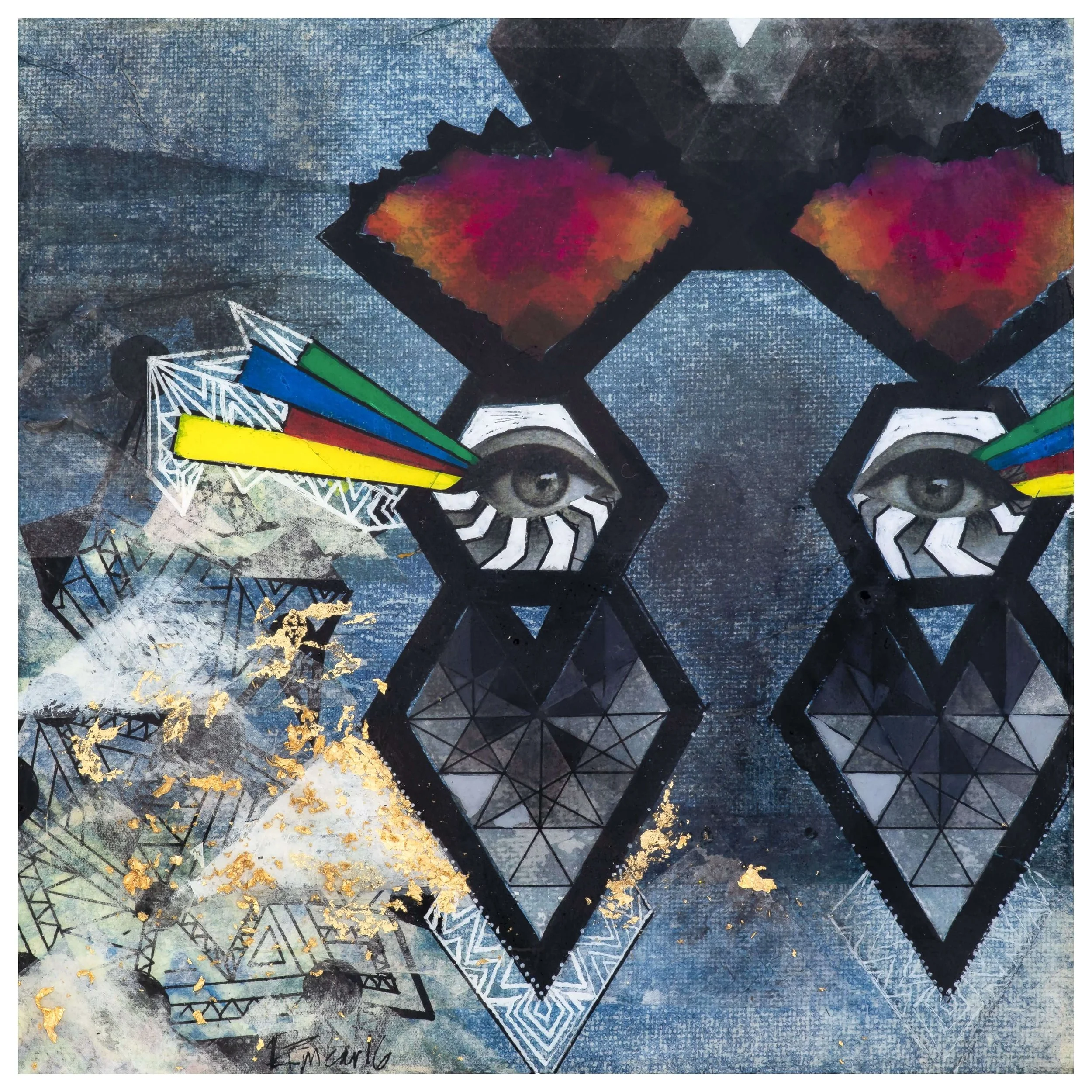
Iridescent light. Falling through the sky had me blinded by clarity.
Love, Eimear
—
Eimear Kavanagh’s been maintaining her busy schedule of appointments with people who do not technically exist. She claims her most fruitful collaborations are with this collective of imaginary friends she has cultivated since childhood, each one a specialist in a field that defies conventional physics. Her current project, conducted in the strictest secrecy, involves transcribing silent debates held by her invisible committee regarding the structural integrity of rainbows. She files the minutes in a locked cabinet that she swears contains the blueprints for five colours that have not yet been invented.
The Well
by Matty Loughlin-Day
“I guess everybody has their own thing that they yell into a well...”
1st January might be my favourite day of the year.
It, and its immediate predecessor, New Year’s Eve, certainly have their detractors; “it’s just another day; it’s a load of enforced fun; all the knobheads come out of the woodwork for their yearly party; Jools bastard Holland!” and so on, and such criticisms certainly have their merits, but for this writer, the strange sense of weightlessness and discombobulation generated by the turning of the year creates a secretive, almost sacred, liminal pocket of the calendar, allowing for simultaneous reflection and projection.
To describe a time or a place as ‘liminal’ has become so commonplace in writing as to verge on parody over recent years, but in the case of New Year’s Day, there feels fewer words more apt. The word itself derives from limen, the Latin word for threshold, automatically conjuring images of the Scottish New Year tradition of ‘first footing’, in which, in order to bring good fortune for the upcoming year, a tall, dark-haired male is invited to cross the threshold of a house soon after midnight on 1st January, ideally carrying coal, food and whisky. More broadly however, ‘liminal’ is often used to describe the strange sense of being neither-here-nor-there and the almost uneasy disorientation that New Year’s Day provides.
The second Bank Holiday in a week, it is another day of obligatory rest, but unlike the gluttonous, over-indulgent, wallow of Boxing Day, is a much more austere one. Most shops and pubs are shut and there is little appetite to carry on the party at home. Any remaining Christmas decorations left up now look irritatingly out of date and out of place, whilst the desire to pour or throw away any leftover booze and chocolate is strong. I quite like it. The symbolic marking of the end of the festive period feels like an opportunity for, yes, a fresh start, and for the last few years, I have tried to mark this with a lengthy walk with my best mate, my French Bulldog, Stanley.
And so it is, as 2025 metamorphosises into 2026.
Keen to throw myself into it all and plan our day, I consult Liza Frank’s book Everyday Folklore to see if there are any traditions or rituals we can recreate and subsequently learn of the Celtic importance of supping the ‘cream of the well’, which is the first pail of water drawn from a well, supposedly carrying the most healing properties, as soon as one can after seeing in the new year. Living just outside the bustling and thoroughly modernised metropolis of Liverpool, the opportunities for guzzling some well-drawn Adam’s Ale are few and far between, however the idea does bring to mind a site of local historical interest, the ancient St. Helen’s Well that I have been intending to locate for several years.
Situated in the historic village of Sefton, a mere 12 minute drive from me, it is a curio that has to date eluded me. Stanley and I have had many explorations of other attractions in the area, such as the Lunt Meadows Nature Reserve and the River Alt, but each time I pass a road sign for the ‘St. Helen’s Medieval Well’ I feel a gnawing sense of duty to track it down.
Struck by the serendipity of it all, Stanley and I jump into the car. To really set the tone, I press play on Bill Callahan’s quasi-surreal opus ‘The Well’, a meditation on the futility of man and a consideration of what to do with the sense of impotence and helplessness when confronted with an indifferent natural world and the perennial scourge of the artist, writer’s block. Set aside an abandoned well, deep in the woods, it is quintessential Callahan and utterly brilliant.
En route, I am aware that St. Helen’s Well has also not been operational for many years, so am not expecting to be able to actually drink some holy water, but am unsure about what to expect, given that most online information (which isn’t exactly voluminous or current) makes reference to its neglect and comparative insignificance compared to its heyday, when it served as a focal point of the village. But still, a well is a well and a New Year’s Day walk is a New Year’s Day walk, so pulling into the car park of The Punchbowl pub, sat immediately next to the hugely impressive St Helen’s church, we disembark and follow the aforementioned road sign that promises our well would be found within 100 yards.
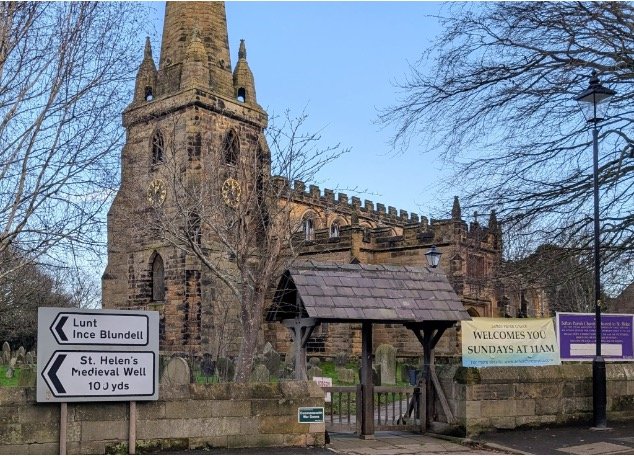
Five minutes after leaving the road via a left turn onto a public footpath, it becomes apparent that our well isn’t where we had anticipated. Momentarily fancying myself as a water diviner, Stanley and I follow St. Helen’s Gutter, a tributary of the River Alt, with the misguided presumption that where there is running water, there will be a place to draw from it. Another five minutes and a cursory check of the maps app on my phone throws cold relief on my newfound and short lived life as a Water Witcher, so new plans are made for our walk; we’ll loop back in a circular route, ending up at The Well, after some much needed reflection and projection. As if we had always planned it thus.
With the villages of Sefton and Lunt to our rear, our modified walk leads us away from the gutter and into the direction of a small, wooded area, whereby we startle a previously unseen heron, hiding in the long grass to our right.
Living near a canal and a designated country park, grey herons are hardly a novelty, but I never fail to be beguiled by their size, grace and sheer indifference when taking flight. Never hurried or flustered, their ascendancy is majestic and monstrous; it cuts through any cloud of thought or distraction and demands immediate attention and awe. Stanley and I stop to admire this trajectory, as our infinitely cooler and desperately unbothered feathered friend drags itself through the air to another patch of grass, with a sense of ennui and boredom. Landing, it doesn’t even feel the need to fully stretch its legs out before settling again, its neck and head peering over the foliage, but of course, never looking in the direction of us beasts so low.
Less than a mile away, at Lunt Meadows, a short eared owl has recently provided entertainment for twitchers and photographers alike, and this, combined with a new car park and promise of a café and facilities has meant that this previously hidden gem has gone somewhat mainstream, with locals inevitably complaining of increased traffic and general NIMBY-ism. As we head into the thicket, several flutterings in the trees and a general sense of movement catch my senses and grabbing my binoculars, I try to locate what I hope to be the local celebrity. On each occasion however, the source of the hubris is a kestrel, either fluttering above its prey, or finding a perfect vantage point in the trees. This is no anticlimax. It is easy to become accustomed to these birds of prey, due to their omnipresence alongside raised roadside verges, motorway intersections and roundabouts, but a true observation of their form, both at rest and while seemingly defying gravity as they hover in mid-air could never become passé. I spend some time simply admiring them, or as much as I can hope to, as the sharp winds fill my eyes with water, shattering my vision of these magnificent hunters into a kaleidoscope of colour and shape.
Wiping my eyes and cheeks, and delving further into the foliage, my attention is again caught by a repeating short, sharp shrill, which the Merlin app on my phone tells me is a goldcrest. Always keen to spot these miniscule birds in the wild, I scour the shrubbery for them and their flame tipped crests, but my efforts are to no avail, and they remain hidden, almost taunting me with their cheeps, seemingly coming from all angles around me.
Stanley is less keen to hang about, dragging me onwards, out of our brief excursion into the woods, and we splutter out onto the banks of the River Alt, whereby a concrete bridge and substation adorned with a depressing ‘White Lives Matter’ scrawl of graffiti snap me out of my brief idyllic, bucolic reverie.
The jolt prompts me to consider the purpose of my walk, a New Year’s Day ponder for reflection and projection, and presented with a a more stark landscape ahead of me, and a deepening grey sky above, a strange, listless sensation threatens to descend upon me as I struggle to locate the spark of inspiration or wonder I had intended to find mid-stroll. I recall how previous New Year excursions have provided me with a much-needed sense of purpose or rejuvenation, yet such an experience seems to be just of reach today, for reasons I cannot quite place my finger on.
Paradoxically, and not dissimilar from my hunt for the medieval well, not to mention the owl and goldcrest, the harder I search, the further away it seems to get. Likewise, in keeping with the day, such sentiments are also echoed in our soundtrack to our destination, ‘The Well’, in which our hero finds himself screaming into the blackness of a well “just to get my voice back”.
I stop to consider the river in front of me, gently surging through the landscape, in the hope it can give me an answer.
The River Alt has, through many centuries, been colloquially known as ‘the troublesome little river’, on account of its propensity for flooding nearby plains and villages, arguably in response to the way its carers and handlers have mistreated it, but today it is relatively sanguine. As a body of water, it has long held a strange fascination for me, being Merseyside’s Other River, an oft-forgotten or overlooked relation of our Great Mother Mersey.
For several years I have yearned to walk as much of it as I can and chart it, writing the Great Alt Essay. I therefore wonder if that is what today hopes to reveal to me, something about my great unwritten ode to the water, but no, that’s not quite it - that’s not what it wants of me today.
A singular angler sits upon its banks, unresponsive to my salutation. Not wanting to disturb him any further, nor the fish he hopes to hook, and also aware of a pack of larger dogs off their leads ahead of us, Stanley and I read between the lines and turn around to rejoin the gutter tributary, heading back towards the general direction of Sefton village.
Ahead of us, two birds scurry through the air and land on a small bunch of reeds. I scope them through my binoculars and ascertain they are a pair of stonechats. I remember how my walk exactly a year ago today involved following two stonechats along the Crosby coast and how I had planned to write an essay about them. Beyond one half-hearted submission, it never materialised, so is this today’s revelation? Their reappearance a reminder of how I should get my creative gears going again? Maybe they are a sign to try harder with the music – my band has a double album’s worth of material ready to record, is this the universe telling me to pursue it and start the whole demo-rehearse-record-promote cycle again? A knot in my stomach and an overwhelming feeling of dizziness at the enormity of it all suggests this isn’t so; today is not the day for this, either. Frustration grows.
I try and cast this all aside; I really should know better. In my day-to-day life, I pay the mortgage by being a Clinical Psychologist, so am all too aware of the fallacy of trying to chase, control or force certain thoughts and the futility of rumination, so trying to practice what I preach, I let my awareness drift away from the folly and allow myself to take in my surroundings again.
Doing this, after a short while, my gaze lands upon a tree, the other side of the tributary. I am not savvy enough in all things arboreal to know what type it is, but its plentiful branches are time and weather bent, and are gently, rhythmically rising and falling with the breeze, at their lowest, threatening to kiss the water.
With my mind occupied purely by this, the heaviness that was creeping in lifts and dissipates, so quickly and effectively as to verge on cliché. Just as solutions to persistent problems often appear during mundane tasks, or lyrics that I have been struggling to complete resolve themselves whilst I am in the shower, with my attention distracted and no longer purely focussed on the tangle, a clarity emerges.
It is stupefyingly and annoyingly simple; rather than spending time reflecting on the last year and poring over what our band’s album did or did not achieve or how good of a person I was or was not, or projecting the same for the coming year, for the rest of this walk at the very least, I don’t need to do anything.
This is enough.
It is, dare I say it, betwixt reflection and projection, liminal.
Just as, by the end of the song, the protagonist in ‘The Well’ realises he doesn’t need to do anything to solve his quandary, but just to simply be, so it is with me.
This serenity carries me and Stanley downstream, and we rejoin the village via the graveyard of the ancient, Grade I listed St. Helen’s Church, guided by the twirring and whistling of a nuthatch hopping from tree to tree above us. The casting off of my struggle to find a clear, singular lightbulb moment has freed me up to feel a connection with the world outside of my head and to absorb the history and stored memory held within the churchyard. It is quite moving. I wander past the final resting places of husbands, wives, soldiers, airmen of The Wars and more and stop by the tombstone of a young boy of six years who died in the 1860s. I begin to reflect on my own two year old son and the wonder and fragility of his life - of all of ours - and in doing so, am not wholly sure if my eyes are solely dampened by the stream of cold air sniping at me any more, or whether this stream of consciousness is also playing a part.
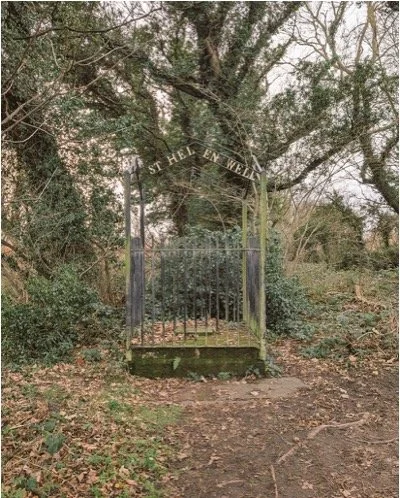
Leaving the grounds, we arrive back at the car park, where glancing across the road, I see a clearing. Maybe no more than twenty steps away from where we started our liminal odyssey, there is a wrought iron structure with wording on it. ‘St. Helen Well’.
Stanley and I cross the road and locate our treasure. The well itself has long been covered with a concrete slab with ‘The Site of St. Helen’s Well’ carved into it, partly entombed by living moss, but this matters not one bit.
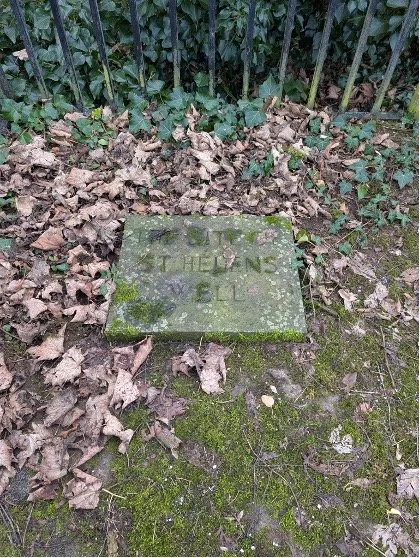
We might not be able to drink the cream of the well, but I reach through the gates and touch the stone. A rain that has been promising to come starts to make landfall, the clouds above promise more. I take one last moment to consider the past – my past, the past of this well, the past of the souls that lie in the graveyard, and the uncertainties and hopes for the year ahead, all the while maintaining contact with the liminal threshold of the present via this well. That might sound trite or saccharine, but it is enough to buoy me back into 2026 with a clearer head.
I guess that everybody has their own thing that they yell into a well.
—
Matty Loughlin-Day, the frontman of The Shipbuilders, understands that the best journeys happen within a twelve-minute drive of your own front door. His dispatch, "The Well," is a New Year's Day walk with his French Bulldog, Stanley, in search of an ancient, hidden spring. Matty is a musician who knows that the most important song is the one you may never write and that true clarity arrives only when you stop looking for it. He is currently working on a double album’s worth of material, but for now, he is content to simply stand by the river and let the world unfold.
The Gen Alpha Lexicography
by Maya Chen
16: 'Matcha Male'
Etymology: Performative male, internet meme culture, TikTok circa 2025. Also known as the 'soft boy,' the 'indie boy,' the 'hipster.' Different era, identical script.
My husband carries a tote bag. He has done since 2019, long before it meant anything. He also owns three Clairo albums and once cried at a David Attenborough documentary in front of our children. He is, by every available metric, a matcha male. When I showed him the term, he was briefly delighted, then immediately suspicious. 'Does this mean I'm not genuine?' he asked. I told him the question itself was very matcha male of him.
The matcha male is the latest iteration of a character who has existed for decades under rotating aliases: the softboy, the hipster, the indie boy. He drinks matcha because coffee is too aggressive. He carries a tote bag because plastic is bad and also because it holds his copy of bell hooks. He listens to Clairo and beabadoobee and will tell you about it. The crucial distinction, and the reason Gen Alpha coined a new term rather than recycling an old one, is self-awareness.
Where the softboy performed sensitivity accidentally, the matcha male knows exactly what he's doing. He has studied the aesthetic, adopted the props, and deployed them with the precision of a marketing campaign targeting progressive women. The tote bag is not a bag. It is a values statement. The matcha isn’t a drink. It’s a personality. What makes this genuinely fascinating, and slightly uncomfortable, is the impossibility of the trap it sets. Authentic men who genuinely love matcha and feminist literature are now indistinguishable from men performing the love of matcha and feminist literature. The costume has consumed the person. And the cruelest irony? The moment a man discovers the term 'matcha male' and worries he might be one, he has already become one.
Next time: 'Understood the Assignment' - when competence becomes a compliment and mediocrity becomes the baseline
—
Maya Chen has abandoned linguistics to become a creature of pure, unthreatening texture. She spent the weekend attempting to measure the "emotional porosity" of a hand-thrown ceramic mug, convinced it held the secret to modern vulnerability. She has replaced her entire vocabulary with a series of gentle, non-committal nods and is currently weaving a shelter out of unbleached cotton and good intentions, where she plans to live until the vibe shifts again.
The Guilt Mirror
by Victoria Raftery
The frame is cracked and chipped, the attempt at its restoration amateurish and obvious, the result of a badly-matched pot of gilt purchased from the local craft shop. The glass, grainy and mottled, reflects a face. I want it to be mine, will it to be mine, but it isn’t; it is Margaret’s. I put my hands up to my hair and pat at it, at Margaret’s hair, pale and fuzzy, unbrushed and knotted, sticking out at right-angles in all directions like the thick spirals of an untamed poodle. I press cold fingertips to my face. Margaret’s face. The cast-iron frown. The narrow, mistrustful little eyes. The droopy, mottled cheeks. The thin lips and brownish, brackish tongue darting in and out like a poisonous, suspicious little viper. Margaret’s face and mine have melded in the mirror and the mirror never lies. Or is that the camera?
‘Are you ready to go down?’
‘Downstairs?’
‘What other down is there?’
Idiot.
‘Hand me that lipstick. No, not that one. The darker one. I want to wear the darker one today.’
‘Course, Nana. Put it on and we’ll go down, shall we?
‘Wait. I’m a little shaky. I’m not as young as I used to be.’
‘Come on, Nana! They’re waiting. Mum’s waiting. There’s a cake and everything. Time to go down.’
The boy gets on my nerves, calling me Nana when he knows full well my name is Valerie. And Mum died years ago, why doesn’t he know that? I want my dark lipstick. I told him that already.
Idiot.
My name is Valerie. But the face staring back at me is Margaret’s. It’s disconcerting, having Margaret’s face. I’m Margaret at six. We were six, weren’t we?
‘Powder paint for orange juice.’
‘What did you say, Nana?’
‘Nothing. Where’s that lipstick?’
There were many different colours, all in white pots, all kept on the window-sill above the painting table. Pots and brushes and jamjars for the water. Red and bright blue and yellow and green. And orange. We loved the orange; we used orange the most. On Margaret. When Mrs Hancock wasn’t looking.
‘Quick, quick! She’s gone. We’ve got five minutes! Quick!’
We spooned three scoopfuls of bright orange powder into a jar of clean water and stirred it with the wrong end of a paintbrush.
‘Come on, Margaret; time for your lovely fresh orange juice: come on, drink up, there’s a good girl..come on, it tastes lovely!’
She stank. The stink was in everything about her. In her hair, her cardigan, her breath. Our mothers warned us against her. We lived on the new estate so we had a mortgage; not like Margaret down the other end of the village, her family paying rent till the day they died. A mortgage was the way to go, Mum said.
Unless you were Gran.
‘Two thousand pounds! You’re in hock to the bank for two thousand pounds?! Beatles money, that is. Except you’re not the bloody Beatles, are you? And what happens when the roof falls in? That’s when you need a landlord, my girl; that’s what they’re there for.’
Never be beholden. Neither a lender nor a borrower be. More money than sense. Heading for a fall.
Gran had lived in her terrace since she’d married Grandpa in 1932. It had an outside privy and coal fires in every room, even the bedrooms, which Patricia and I would jab at with heavy iron pokers until we were chastised for nearly setting the place alight or for almost taking someone’s eye out. We suffered the curled-up edges of her egg sandwiches and viscosity of her pea-and-ham soup, our reward for eating every scrap and leaving no waste being a Twinkle for me and a Bunty for Patricia plus a white paper bag each filled with a painfully drawn out (“Will you two girls hurry up!”) selection of fruit salads, blackjacks, white mice, chocolate logs, gobstoppers and sherbert dips from Noggins News where Grandpa went for his paper, pools coupon and cigarettes while Gran savoured her five minutes peace and quiet.
After Grandpa died, Gran dutifully continued to pay her rent to a landlord who pocketed it month-after-month, year-after-year, never fixing anything without an argument - not least the roof - but at least she died unbeholden.
I didn’t like getting too close to Margaret because of her smell. She stank. Like Gran did sometimes. The stench of inefficient washing. Of underarm sweat. Of scrubbing the stoop. Of scratching old food off the front of her cardigan because she didn’t know what a napkin was, or if she did, she thought it some posh thing of which she was unworthy. She smelt. They both did. They shared the stench of the unwashed, two generations apart. So why did I love my Granny with all my heart and hate Margaret so? Why did I love my gravy-smelling gran and hate the gravy-smelling Margaret?
‘Nana, come on, it’s time.’
The boy is insufferable.
‘Come on, Margaret. Drink up. Drink up your lovely orange juice, there’s a good girl.’
Three scoopfuls of powder-paint tipped into a jar of water and stirred with the wrong end of a paintbrush. And she did. She drank it. So we kept doing it. She kept drinking and we kept giving it to her, for that whole first year of primary school. It was a joke and we all found it funny. Margaret drinks powder paint, she thinks it’s orange juice! She’s so stupid!
I stare into the grainy, mottled mirror. The face staring back at me from the dull glass of the chipped gilt frame is not mine, it is Margaret’s. I put my knotted hands up to pat my pale, fuzzy, poodle hair. And then, just like that, it’s me again. Margaret has disappeared and there I am: the face of a million black-tie dos and charity galas and theatre premieres and cruises and weddings and christenings and anniversaries; the face of a lifetime drinking many a freshly-squeezed orange juice with my five-star breakfasts, many an early-dawn bucks fizz.
‘Nana! Come on! They’re waiting! We bought a cake!’
Will someone please shut that boy up?
My face stares back at me, crumpled and sad. It was mean. It was mean what we did. What I did. Making Margaret think that powder paint was orange juice all those years ago. Mean.
‘Nana!’
‘You, boy,’ I bark but my voice doesn’t come out like a bark, it sounds thin and reedy and whispery. ‘Whoever you are, my name is not Nana, it is Valerie. Now leave my room! Leave me alone! I’m tired. I want to go to sleep. Nurse! Nurse! Shout the nurse for me boy! I want to go back to bed!’
Nurse helps me and the boy makes for the door, turning back to look at me, his expression stricken. Bed is safe, warm and snug. Nurse leans down towards me. I like her cast-iron furrow: a sign of strength.
‘Here,’ she says. ‘Drink this.’
Her eyes, wide and trusting, hold mine. Her cheeks are pert and rosy, her mouth is full and red and smells of strawberries, not brownish or brackish or snakey at all.
‘Drink up,’ she says. ‘There’s a good girl, Valerie. Lovely fresh orange juice.’
She tips it into my mouth.
‘Lovely fresh orange juice.’
And then her face changes. Her eyes narrow, her cheeks droop and mottle, her lips become thin, a brownish, brackish tongue darting in and out of them like a poisonous, suspicious little viper. The juice makes its way down my gullet. It coagulates, becomes viscous and pea-and-hammy, forming nasty thick globules of orange-coloured pus constricting my throat. I can’t breathe! My gullet fills with something that feels like talc but it’s not white. Or red. Or bright blue. Or yellow. Or green. It is orange.
I can’t breathe.
Nurse’s eyes hold mine.
‘Come on, Valerie, love,’ she says. ‘Another sip now, one more little sip.’
I swallow lumps, thick hard orange lumps, fighting for breath, inhaling hard through my nostrils. I can smell it. The smell of me. I smell of gravy. Nurse smells of oranges and lemons like the bells of St Clement’s. She owes me five farthings but I’ll let her off.
The gilt mirror, the only thing I have left of Gran, consigned for all of my glory years to a gloomy alcove in one of my spare bedrooms, stares at me, the glass milky and rheumy like the eyes of my mother’s mother.
I’m sorry, Margaret.
We were six years old.
I’m sorry.
—
Victoria Raftery operates on the principle that the past is a room in your own house that you have locked and tried to forget. Her story, ‘The Guilt Mirror,’ is a terrifying exploration of what happens when the door to that room creaks open. The specific, haunting quality of childhood cruelty, the way a small, mean act committed at age six can echo through a lifetime until it becomes the defining feature of old age. Victoria writes from a desk cluttered with objects she claims are "haunted by regret" - a chipped mirror, a pot of orange paint, a single, unspent farthing - believing that documenting these artefacts, she exorcises the ghosts they contain. Her family have learned to tread carefully around these items, understanding that in Victoria's world, even a glass of orange juice can be a loaded weapon.
Shadow Songs
by John Canning Yates
Elliott Smith - Twilight
Elliott Smith’s writing has always meant a lot to me. I recently found an old gig ticket from Manchester, late ’90s - a reminder of an alchemical time, and the realisation that the quietest sound in a room could feel the loudest.
‘Twilight,’ from his posthumous album From a Basement on the Hill, carries that same fragile weight. It’s one I return to now and again, usually late at night.
Here’s one such occasion.
— JCY
The Lost Genius of Kirkby
by Fiona Bird
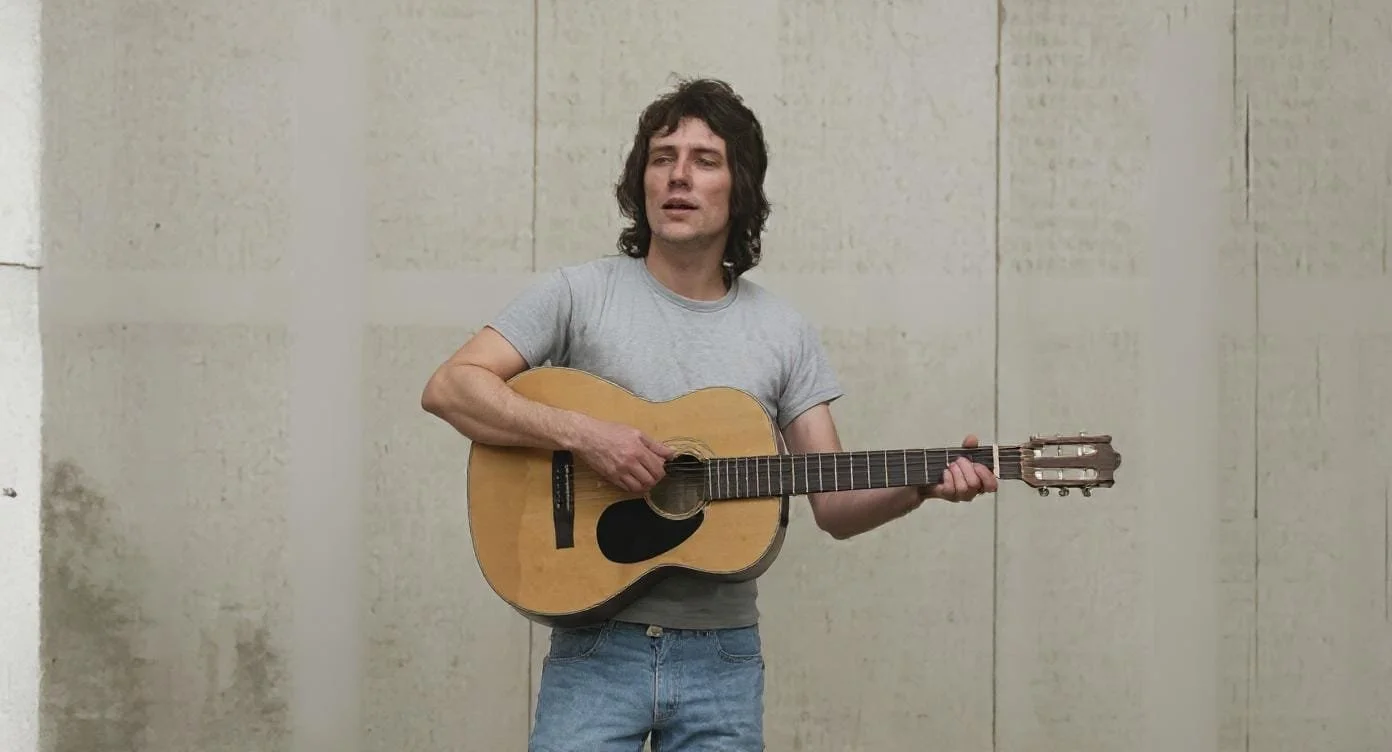
Jimmy Campbell was a failure, which wouldn't be particularly interesting except that he was spectacularly good at it. Twenty years of making brilliant records nobody bought, four different labels who all gave up on him and a drinking problem that made him unreliable even by musician standards. When he died in 2007, aged 63 and broke, the obituaries called him "under-appreciated," which is journalist code for "we never really bothered writing about him when he was alive."
The stories about Campbell were consistent: a man perpetually baffled by his own commercial irrelevance. He'd complain to anyone who'd listen about Billy Fury covering one of his songs. "Billy Fury recorded a song about me wanting to burn my possessions," he told one interviewer with genuine bewilderment. "I don't think he understood what it was about." Neither, apparently, did anyone else. His gigs were legendary for the wrong reasons - half-empty rooms, technical problems, the occasional cancellation when ticket sales dipped into single digits.
The problem with Campbell wasn't lack of talent. He could write songs that made you stop whatever you were doing and pay attention. The problem was that he seemed constitutionally incapable of pretending his life was anything other than a series of small disappointments. This is not a commercially viable position.
He'd started in the early sixties with The Panthers, supporting The Beatles at some suburban hall in 1962. John Lennon allegedly stood at the front, sizing up the competition. Whatever he saw posed no threat. Campbell spent the next decade proving Lennon's instincts correct.
The career trajectory was a masterclass in how to avoid success. The Panthers became The Kirkbys after a Cavern Club DJ's mistake, then The 23rd Turnoff, named after the M6 junction that led home to Liverpool, which tells you everything about their level of ambition. Each band was more obscure than the last, each album more critically praised and commercially ignored.
Take ‘Michelangelo,’ his masterpiece from The 23rd Turnoff period. Over lo-fi guitar and what sounds like a kazoo being played underwater, Campbell delivers lyrics that manage to be both surreal and painfully specific. It should have been covered by everyone from The Kinks to your local pub band. Instead, it vanished without trace.
Campbell's songs were cries for help disguised as pop music, though he was never quite desperate enough to disguise them properly. 'In My Room' catalogued his possessions with forensic accuracy, posters of Hitler and John Lennon, various personal items of unspecified sadness, before concluding that setting fire to everything might solve the problem. Billy Fury covering this was either an act of profound misunderstanding or inadvertent comedy.
The drinking didn't help, though it's hard to say whether Campbell drank because he was unsuccessful or was unsuccessful because he drank. Either way, he became unreliable, missing gigs, alienating what few supporters he had. He quit music several times, always returning to smaller venues and diminishing audiences.
"A lot of my songs are cries for help," he once told me with the sort of self-awareness that explained everything about his commercial prospects. "I suppose that's why they didn't make the grade." While his contemporaries learned to package neurosis as product, Campbell remained stubbornly, catastrophically honest. "I wish I got my act together and opened a songwriting school in Liverpool," he said years later. It was pure Campbell, the man who couldn't manage to show up for his own gigs fantasising about teaching others how to succeed in music.
The critics compared him to James Taylor, which was both lazy and completely wrong. Taylor's depression was photogenic; Campbell's was just depressing. Taylor sang about fire and rain with the confidence of someone who knew people would buy records about fire and rain. Campbell sang about working in shops and wondering if anyone would notice if he disappeared.
His final album was recorded in a single day in London as a contractual obligation. It should have been artistic suicide but produced some of the most quietly devastating songs ever committed to vinyl. Campbell had perfected the art of making surrender sound profound rather than merely pathetic.
The music industry moved around him without noticing he'd been left behind. By the seventies, introspective melancholy was commercially toxic. Glam wanted bigger gestures, punk demanded more anger, disco required movement. Campbell offered only the patient documentation of ordinary defeat.
He died working on material for an album that would never be completed. The obituaries were brief and kind, using phrases like "lost potential," which is what people say about artists they ignored while they were alive and feel guilty about afterward.
His records are available now on streaming services, tucked away in the sort of digital corners that attract people who collect disappointment. They're not for everyone, most people prefer their sadness with better production values and more obvious commercial appeal.
But Campbell's songs document something most pop music refuses to acknowledge: that life is mostly small defeats punctuated by moments of unexpected beauty, and that this is both terrible and somehow worth recording. He understood that failing honestly is more interesting than succeeding dishonestly, though it pays considerably less well.
Which probably explains why he drank so much.
—
Fiona Bird views ‘making it’ as a vulgar act of capitulation to a system she despises on principle. She seems to spend her days cataloguing the careers of artists who failed so spectacularly they looped back around to become geniuses, a list topped, inevitably, by Mr Jimmy Campbell. She is currently writing a biography of a musician who released one single in 1974 and then immediately vanished into a hedge. Fiona lives in a house constructed entirely from unsold records, eats only food that has been discontinued by the manufacturer and communicates with the outside world via a series of cryptic messages left in the margins of library books she has absolutely no intention of returning.