
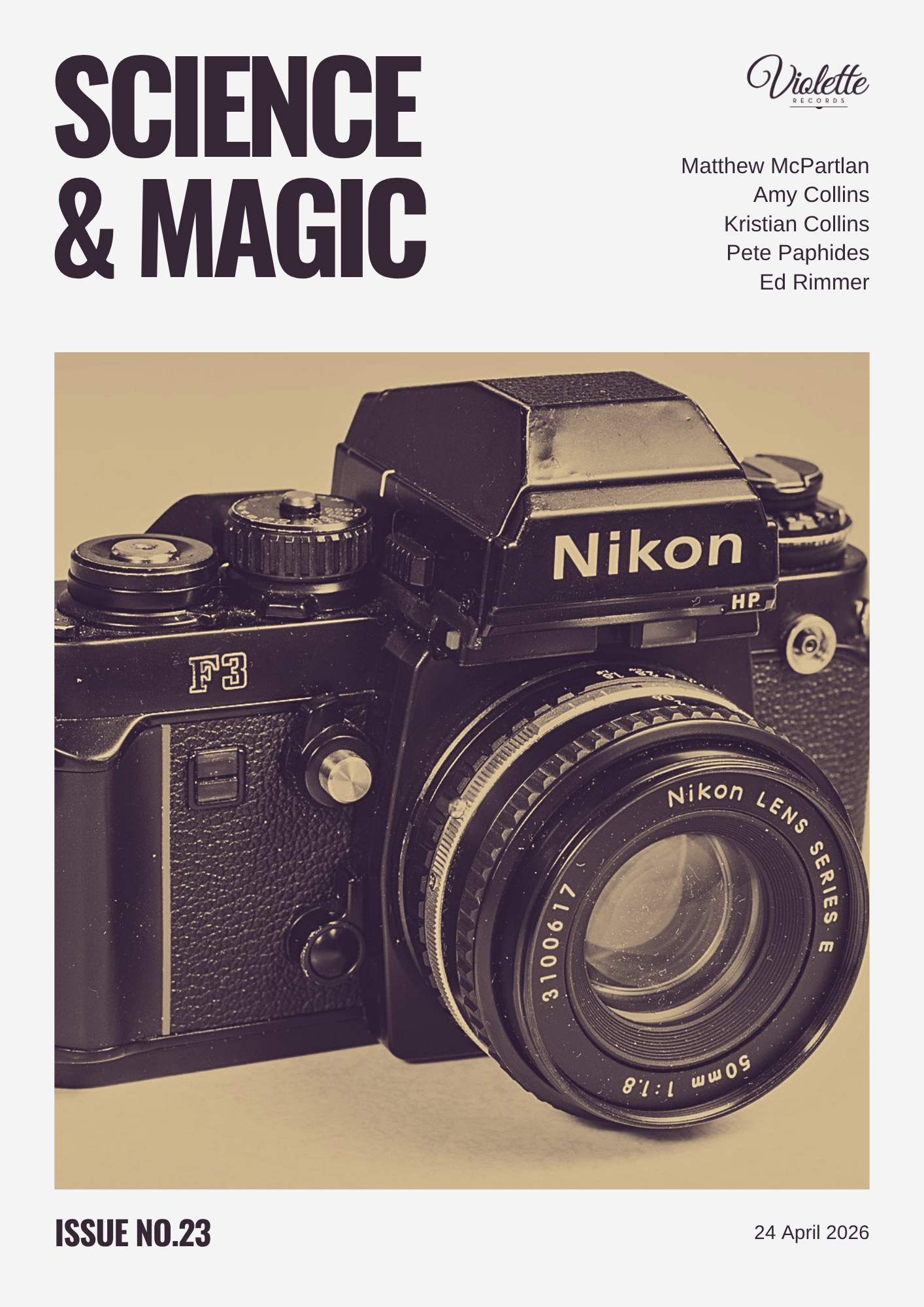
I was holding an old Nikon F3 the other day. It weighs about as much as a small breeze block and serves roughly the same purpose if you drop it on your foot. It’s a dense, cold, mechanical thing smelling faintly of oil and old leather.
There is something reassuring about a machine with a single, dedicated purpose. A phone is a distraction engine that also happens to take pictures. A camera is a box for trapping light.
There’s the physics of a shutter opening for a fraction of a second, allowing photons to burn an image onto a strip of acetate or a sensor. It’s a chemical reaction, a mechanical transaction, a matter of aperture and speed.
But the magic lies in the theft.
Every time I press the shutter, I’m stealing a moment from the relentless, erasing march of time. I’m freezing a specific quality of light, a fleeting expression, or a configuration of people and objects that will never, ever arrange themselves in that precise way again. It’s the only functioning time machine I have.
We live in the age of the infinite and the disposable. We photograph our lunch, our QR code, our bored pets. But the act of looking through a viewfinder, isolating a rectangle of the world and deciding this specific thing matters and remains a radical act of deliberate attention. It turns the chaos of the world into a composition. And it forces you to stop looking at everything and start looking again at something.
It creates the ghost. Long after the building has been pulled down, the friends have drifted apart or the light has faded. An image remains. A stubborn, silent proof that, just for a split second, everything was exactly where it was supposed to be.
Welcome to the latest edition.
Matt
Ten Questions
by Ed Rimmer
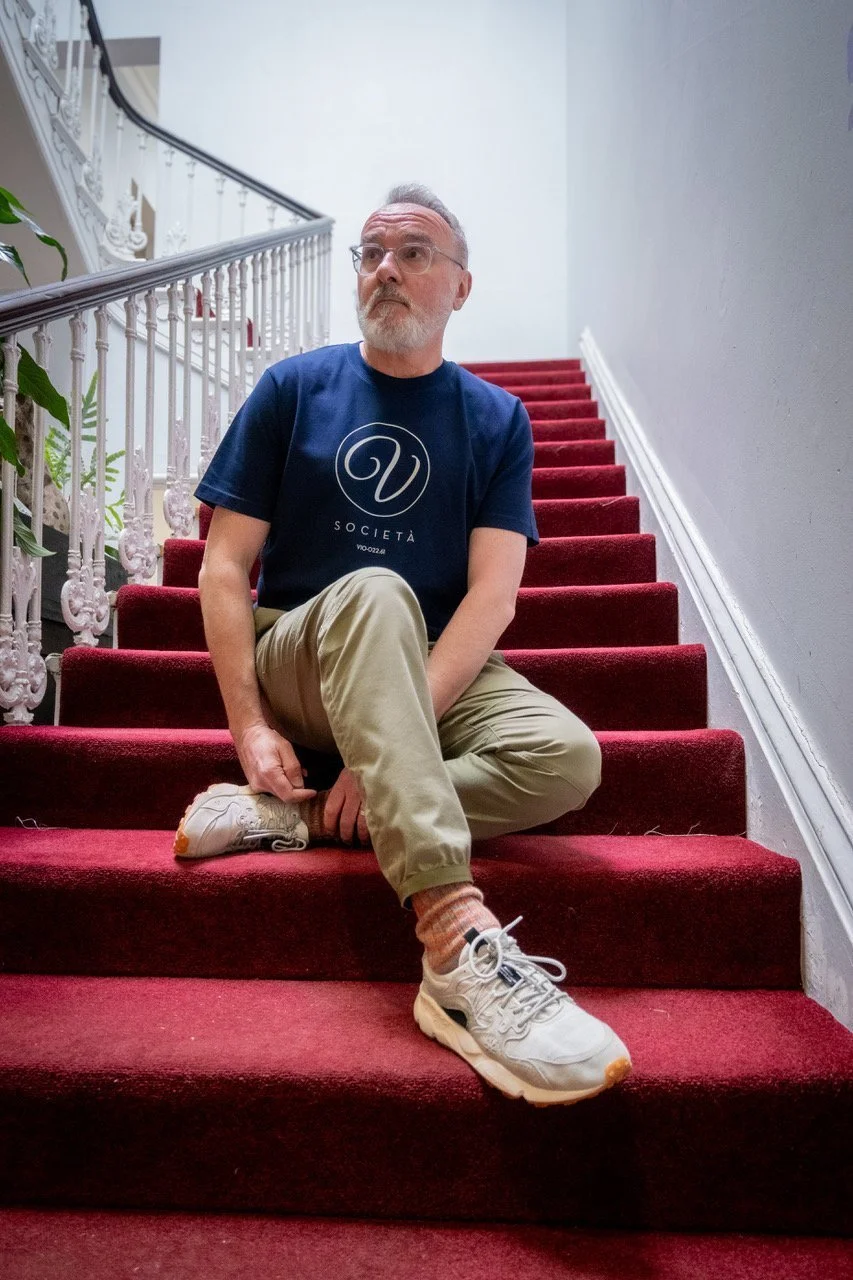
A life filled with design is a quest for the correct alignment of elements: the right typeface, the perfect paper stock, the exact shade of navy. For Ed Rimmer, the instinct for detail bleeds directly into his musical history too. His journey is a map of specific coordinates: a teenage disco at a scout hut in Mossley Hill, the dry ice of The State on Dale Street, and the primal, salt-crusted roar of the Atlantic at the edge of West Cornwall.
Ed has been a steady hand in the Violette story, contributing his eye for detail to everything from artwork to compering. He is a man who understands the science of a two-minute-and-twenty-two-second film edit and the magic of an impromptu acoustic set in a 17th-century preaching pit.
We invited Ed to select ten questions from our archive. His answers reveal a world where pinstripe jeans are a badge of honour, where a lost VHS tape becomes a 'Rosebud' obsession, and where music serves as the ultimate release in the wake of heavy years.
● What song is permanently fused to a specific place or holiday – to the point where hearing it transports you instantly?
I don’t think my love of West Cornwall is any great secret, and every time I hear The Mummers’s 'This Is Heaven' I’m taken straight there, a specific time and a specific place. Tuesday 4th August 2009, I’d married Jane on the Saturday at a place called Trevarno, just off the B3302 between Hayle and Helston. I was driving back to the venue to pick up an unfinished keg of Doombar from the reception. It was a glorious, beautiful summer's day. The song came on, a fanfare of brass to open, uplifting, Raissa Khan-Panni’s sublime, sweet voice capturing my mood. The song knew how I was feeling, where I was and how it was. I could not have been happier. I’d married the girl I’d fell for in school. Family and closest friends had all made the trip, it was idyllic, ‘heavenly’ to be cliched. It was the first time since the wedding that I’d had a minute to myself, the song, the drive, and I was beaming like a fool, breathing it all in.
● What song instantly takes you back to your school disco?
It’s not big and it’s not clever, but I must be honest here. 'True' by Spandau Ballet, Spring 1983. Let’s be straight, I was never a Spandau Ballet fan, but it was number one at the time, so it was always going to be the “slowy” at the end of the night. It wasn’t a school disco, it was a “teenage disco” at the Clearview scout hut in Mossley Hill on a Saturday night. Word travelled in school that people were going, and of course I got word that Jane was going with a few of her friends. My mum had bought me a pair of pinstripe jeans from Great Homer Street Market on the Saturday. I was all set. Jane was there, I asked her to dance, she said yes and I fell head over heels. So, there we have it, Spandau Ballet, pinstripe jeans, I’ve never been one to shy from such confessions. But I’m claiming a victory for the denim.
● What's the best gig you've ever been to?
The Icicle Works Christmas gigs in the late 80’s at the Royal Court were always fantastic, back when I was young enough to be down at the front, pogo’ing to the crowd pleasers. The pick of these gigs was Christmas 1989. Pete de Freitas and Chris McCaffery had both tragically lost their lives that year and the Icicle Works belted out perfect versions of 'Do It Clean' and 'Jeans Not Happening' in their honours. It’ had been a heavy year, I’d been at Hillsborough in the April and had witnessed stuff at a football match that turned life upside down and brought so much pain. The gig that Christmas felt like a release, shaking off a weight, letting go. Music can always be trusted, it will always be there when you need it, whatever mood you are in.
● What's your favourite cover version of someone else's song?
Dodgy covered 'The Age of Not Believing' from Bedknobs & Broomsticks, the original sung by Angela Lansbury. I found a digital copy of the family Super 8 movies from the 70’s, and watching them gave me the same feeling of homesickness you get in the pit of your stomach. When you yearn to be in another place, or in another time. This song represents that, “Where did all the happy endings go, where can all the good times be?” Nostalgia is a double-edged sword, but I think it’s ok to dip your toes in every now and again, and this song always makes me smile. I edited all that old footage down to the two minutes and twenty two seconds duration of the song, and lashed it on as the soundtrack, happy ghosts on celluloid forever.
● What song feels like it knows something about you that you never told anyone?
My wife knows, so I’m cheating a little here, but 'Perfect Blue' by The Wedding Present paints a picture of me when Jane and I found each other again after twenty odd years. Questioning how that one person could, perhaps, actually love you. Is it real, is it really happening? “Tell me why haven’t you had enough of me, How have I manged to make you love me”? I suppose I’m the type that needs reassurance every now and again. Validation, whether it be in love, something I’ve designed, something I’ve written. Is it good enough, am I good enough? “Behave yourself, it’s all good, enjoy the moment” (me talking, not the lyric)… I need to do more of this. That’s the message in the song, stop questioning, live it, good or bad, maybe even perfect at times.
● What's your go-to song for pure, uncomplicated, turn-it-up-and-dance joy?
'Bizarre Love Triangle' by New Order. I grew up in the State on Dale Street in the late 80’s, and this was always a ‘drop what you’re doing, kill your conversation, find your mates’, floor filler. Not that the floor ever needed filling in the State. I’ve got a State play list, each track curated from a memory, the smell of dry ice, trying in vain to catch the eye of a girl, supping from a can of Breaker. It’s the power of music again, what it can do. All you need is to close your eyes, listen and dream of days gone, days to come. Take it, use it for what you need, music doesn’t care, it is always happy to oblige… I’m 57 now, curious to know if I can still dance, if I ever could that is.
● What album cover has had the most profound impact on you—either as art in its own right or as a gateway to the music within?
This has to be Professor Yaffle’s A Brand New Morning. This was the first time I’d worked with Lee Rogers. We were both in the Handyman Brewery to watch Mel Bowen and Lee had heard I was a designer and asked if I wanted to help on Yaffle’s new album. It was one of those “I kind of know, but I don’t exactly know what I want” kind of briefs. It was fantastic working together, bouncing ideas back and forth to come up with something that Lee and the rest of the band loved. Through that collaboration Lee became a good friend, and it was great to see Yaffle’s last album released on Violette. That answer is completely selfish of course, so I must mention Goodbye Jumbo by World Party. The imagery of Karl Wallinger wearing the huge elephant ears and the gas mask as a trunk. Prophetic for how the world was turning, and brilliant record to boot.
● What's the strangest musical tangent you've ever gone down?
The Thrashing Doves and their Albatross. Not a band, well The Thrashing Doves were. They were cursed on Saturday morning children’s TV. The video vote section on Saturday Superstore had the shows guests reviewing four music videos. Thatcher was a guest that day and she chose 'Beautiful Imbalance' by the Thrashing Doves as her favourite. I’d bought the album on the back of seeing a track on No Limits. I‘ve never met another Thrashing Doves fan which probably speaks volumes, but I stand by my opinion and love of the album. When I still lived at home in the 80’s I had a VHS Cassette full of music recordings from the Chart Show, Top of the Pops etc. There was a late night series of live shows called ‘Meltdown’ and I’d managed to record The Thrashing Doves when they were on late one night. That tape became my Rosebud, long lost, never to be recovered. Three years ago, a member of the band contacted me to say he had found a digital recording of the Meltdown appearance. I still have it, it’s a precious thing, I’ve made about twenty copies just in case.
● What's your favourite sound that isn't music?
Laying in the dark at night in a rented cottage, as close as possible to the sea. The window open, waves crashing on the shore, against the rocks. The sea, as if full of anger, unleashing wave after wave in its onslaught. A raging battle of the elements at the end of the land. Roaring violently, ominous at times, eerie when it subsides. It is primal, and full of beauty. It is the song of West Cornwall, wild, mystical, captivating and full of wonder.
● What's the most beautiful piece of music you've ever heard live?
I was lucky enough to see Dave Brubeck live at The Philharmonic and 'Take Five' had me misty eyed. The Bunnymen’s 'Ocean Rain' with full orchestra is pretty magical, and the first time Shack performed 'Meant To Be' took my breath away. But I’m going back to West Cornwall. We took La Violette Società to the Rum & Crab Shack in St Ives back in September 2017. We were flying back from Newquay on the Sunday afternoon and I thought the guys would enjoy a detour to the Gwennap Pit on the way. The Pit is a circular, semi-natural amphitheatre just outside of Redruth. Created by John Wesley as a place to preach in the 1700’s, secluded, peaceful, it’s a magical place. The lads loved it. PJ went and sat on the stone altar, put his earphones in and listened to 'Cornish Town'. Nick Ellis soaked up all the history and folklore, and we all stood in contemplation, taking a moment. Then PJ suggested Nick and Mel Bowen got their guitars from the car. Guitar in hand Mel sat centre stage, scratched his chin, “what should I play”? he asked. “Squaring a Circle”, the obvious answer given the setting. It sounded beautiful. It was a once in a lifetime moment, just the five of us there to see it. I suppose things like this could be recreated, but you wouldn’t want to try, it wouldn’t be the same. I managed to squeeze the last of my phone battery, just long enough to capture it.
Magnetic North
by Jeff Young
23 : Fritillary
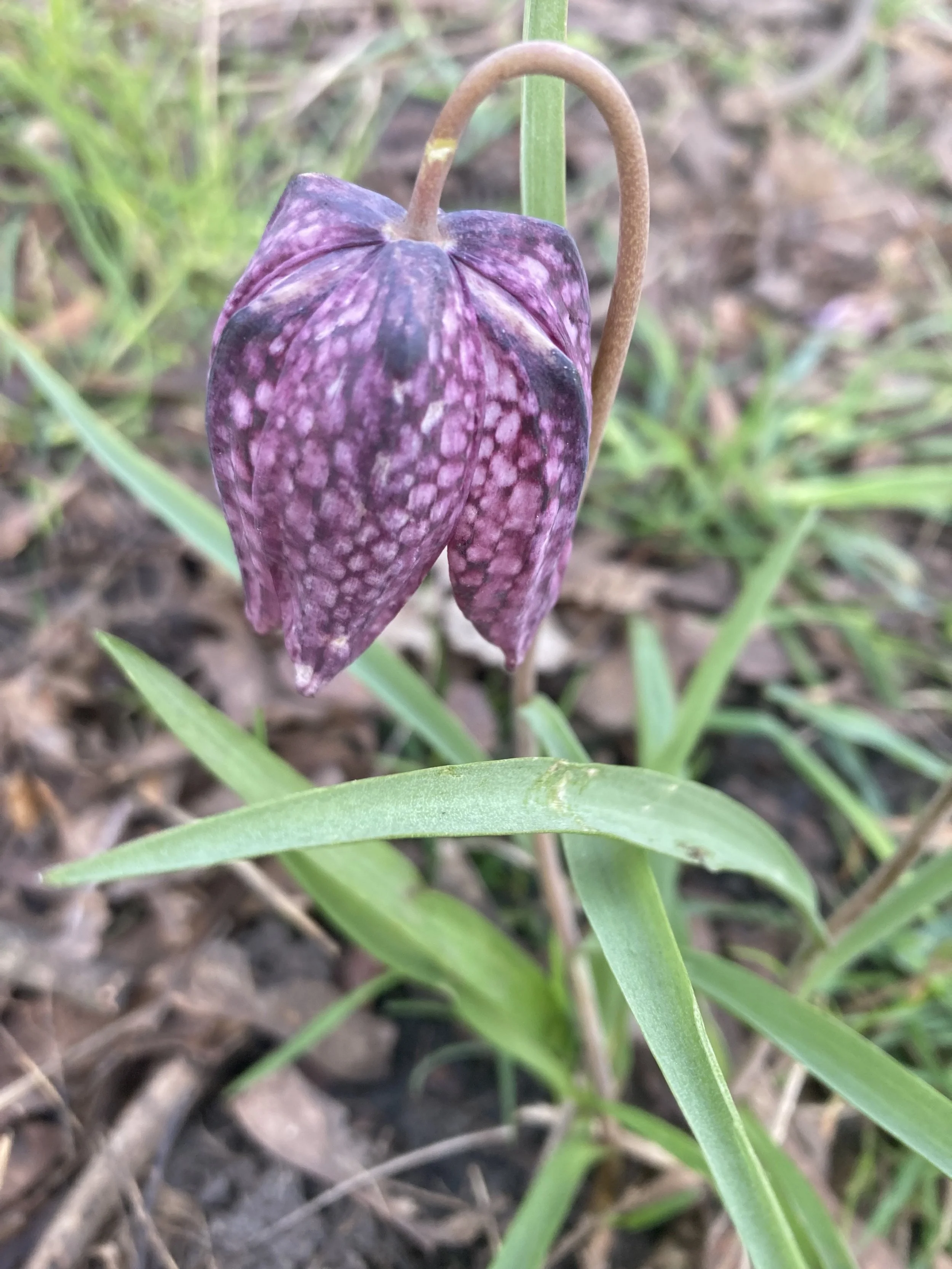
Each year when April comes, I got in search of the Princes Park fritillary. This morning the grass is wet as I search the ground for the flowers, anticipating that breath-catching moment when I see the first fragile ghost.
Last year there were eight of them – a tiny solar system of lantern-planets orbiting a dandelion sun – but this year I can only find two. It’s raining lightly and a dog walker is watching as I kneel on the grass, cupping one bedraggled flower in the palm of my hand, raindrops falling onto my fingers, the petals translucent, the colours washing away.
The moment is like a poem I can live in for a while, or a song, or one of those pauses that seem to slip the confines and demands of time, when you’re right there, in the present, in the now. Nearby there’s a second flower and this one is somehow sinister, serpentlike, living up to its name - the Snakeshead. It’s also known as the Leper’s Bell and it has an air of danger and folklore about it now, coiling out of the grass and reaching for me. The poet Mary Botham Howitt described it as ‘like a widow, dark weeds wearing...’ It takes my breath away.
The night before this visit to the park I hosted a bookshop ‘In Conversation’ for the writer David Keenan whose brilliant new novel ‘Boyhood’ has preoccupied my thoughts for the last few weeks. During our conversation, we talked about language, violence, horses, cities, literature, love songs, magic and so much more. But what comes back to me as I kneel here in Princes Park in the rain is the idea of astonishment. It’s important to be open to astonishment. It’s so easy to forget to sometimes be in awe.
Magnetic North is always shifting. Sometimes it’s a derelict building or a forgotten corner of the city, a collapsing church or haunted water tower, a lost river or dead dog canal, a burnt-out warehouse, a bomb site, a gravestone. This morning it’s a pause, a quiet contemplation of a strange flower about to disappear back into the earth until next April. The fritillary is the city too and I’m kneeling in the rain-wet grass in Princes Park, available for astonishment and awe.
— Jeff Young, 21 April 2026
—
Jeff Young investigates the rhythmic integrity of various Liverpool brick walls, convinced that different bonds - Flemish, English, Header - vibrate at frequencies that can trigger specific, long-forgotten memories in passersby. He spends a significant amount of his spare time attempting to record the sound of moss growing on his favourite derelict warehouse, a process he describes as "the city's slowest and most honest tape loop." Jeff recently petitioned the local council to have "daydreaming" officially listed as a protected architectural feature of the city's alleys, arguing that the space between buildings is as structurally vital as the stone itself. He doesn’t bother with a compass and prefers to navigate the city by the late-afternoon shadow cast by the St John’s Beacon, which he claims is the only truly reliable "psychic north" we have left.
The Paphides Principle
Pete Paphides has a theory that every great song is a small, perfectly constructed argument. It might be arguing for love, for despair or simply for the necessity of standing perfectly still in a noisy world.
In the era of infinite, generated choice, Pete remains a most trusted human re-calibrator. He listens out for the moments where a melody stops just being audio and starts being a life-support system.
Here is his latest find. Rescued from the churn, delivered with the passion of a true believer.
Osian Rhys: ‘When Does A Hill Become A Mountain?’
Some songs are so otherworldly in their perfection that I don’t end up playing them all that much. Why? Perhaps, at some instinctive level, I ration my exposure to them because I want them to floor me the way they floored me on that first listen. Osian Rhys put out one such song seven years ago. It was from an 10-inch EP called Autumn Shades of Gold. Actually, it was all quite astonishing, but ‘The Ballad of Mr Withers’ sounded like the sort of thing you might imagine the woodland animals getting up to in the dying solstice light after the last humans have left. An album was supposed to follow shortly afterwards. And, for the longest time, that was all I knew. Then a month ago, a message landed in my inbox. It was from Osian himself – who, since ‘The Ballad of Mr Withers’, had become a somewhat mythical character to me. But then, when your talent is inversely proportionate to your hunger to promote it, I guess that will happen.
Cool as you like, Osian informed me that his album was finally ready. It was called Never/Whenever and it would be landing in approximately a week. The fact that it hasn’t received a physical release seems entirely apposite. Osian had been in North Wales the whole time, on the periphery of Porthmadog. He was and still is a music teacher, enjoying the response he elicited in his students far too much to hustle on his own behalf. Alone at the piano, his hands formed shapes that seemed perfectly suited to the tiny chapels scattered across the hillsides of Gwynedd. Songs like ‘Give A Little Love’ and ‘A Oes 'na Le (I Oeri Gwres Fy Nghalon)?’ (Translation: ‘Is There Place (To Cool The Heat Of My Heart)?’) pointed me to the conclusion that Osian is a man who finds himself quietly but frequently overwhelmed by his own capacity for sudden rapture.
The song I’ve chosen to share with you here is the opening song on Never/Whenever. It’s called ‘When Does A Hill Become A Mountain?’ It’s a lambent microcosm of an album you can hold up alongside kindred forbears such as Van Morrison’s Veedon Fleece and The Blue Trees by Gorkys Zygotic Mynci. Like the scenery that inspired it, it sounds like there was never a time when it didn’t exist.
— Pete Paphides, 23 April 2026
Les Cinquains
by Angie Woolfall
Attacca ([əˈtæk.ə], begin)
It grew
The seed you sowed
But when it blossomed you
Withdrew from the sun to the shade,
Wilting.
Solo ([só·lo], alone)
You're gone
I did not know-
You'd left your body here
Easy then, to see my mistake-
Farewell.
Divisi ([dɪˈviːzi], divided)
Move on,
Growth from pain comes
As you let go, they say
Player one- all lives recovered,
New game.
Cambiara ([kɑːmˈbjɑːre], change)
I learnt
Growth is a skill
And if you work each day,
You get what you need so you can
Evolve.
Ossia ([osˈsiːa]), alternative)
One soul
To share what's real
With, without guilt or shame,
Sanctuary through confession-
Connect.
—
Angie Cried-Woolf remains a practitioner of the Attacca method, insisting that the most important parts of a life - the seeds sowed in the sun and the shadows retreated into - must begin without a pause. She has recently been investigating the linguistics of the Divisi, concluding that we are all essentially divided between the people we were in 1989 and the players who have finally recovered all their lives in 2026. She operates on the theory that "Woolf" is a musical instruction for a soul in transition, a directive to evolve through the sharpest of changes. She was last seen in a local library attempting to cross-reference her own Ossia against a list of abandoned postcodes, convinced that sanctuary can be found in the precise moment one decides to finally say farewell to a mistake. Она is a Woolf, after all, and the question of the wolf is merely a distraction for those who haven't yet learned to connect.
Dead Air Anthologies
by Matty Loughlin-Day
There is a quotation attributed to the Indian writer and philosopher Jiddu Krishnamurti that posits “the day you teach the child the name of the bird, the child will never see that bird again”, which is wonderfully, annoyingly and mind-bendingly succinct in describing an enormous truth, and is something that I have been musing on a lot lately.
I love that it speaks of that moment of miracle when you encounter something without knowledge, without judgement, and only with openness, wonder and curiosity, something I have written about previously, but that’s not only why it knocks me for six every time I think about it; I also love it for its plainness. Transcendence doesn’t have to happen up on a mountainside with bells, chanting and hallucinogenic cocktails (though all power to those that do so, aligned Shakras and all), it can happen on spotting a sparrow.
But it also heeds a warning. It implies that there is a danger that by trying to bottle or define this experience, you categorise it, sterilise it and deadhead it – once you’ve learned that the bird before you is a sparrow, where is there to go from there? The next time you see a sparrow, you only see it as a sparrow, and not with the fresh eyes and clarity that comes before knowledge. You see it through the lens of its ‘sparrowness’, rather than observing the majesty of its form, colour, shape and sound. A little bit of knowledge is a dangerous thing, after all.
Not that ignorance is a virtue to strive for – Lord knows there’s enough of it about, none of it good, but one of life’s simple pleasures can be found in the act of not knowing, and only enjoying. It’s a balancing act, as after all, the brain always wants to know or be able to work something out – I’m sure we’ve all been infuriated by a cryptic lyric or baffling piece of modern art that just doesn’t “make sense” and we’re left grappling with the question of “yes, but what does it mean?!”, but this can all too easily lead us to take on a fruitless task, as by the end we’re either left none the wiser, or satisfied but no longer mesmerised. What exactly does “the ghost of electricity howls in the bones of her face” mean? I don’t know, but I do know it’s one of my favourite lyrics ever, and I’m not sure I’d ever want Bob Dylan to fully explain it to me. Why does Kandinsky’s Composition X move me so much? Damned if I know, but please don’t tell me, as I know it will only shatter the illusion.
Bringing this back on brand for what I usually bang on about, there are two radio-related examples of this ‘not knowing’ that immediately came to mind when I first contemplated Jiddu Krishnamurti’s quotation, both of which I have weaved into previous mixes of Pirate Radio Shipwrecked.
The first is the hypnotic, soporific broadcasts of the Shipping Forecast that are broadcast on Radio 4 daily, most effectively and romantically at "0048 hours", when the rest of the world is asleep.
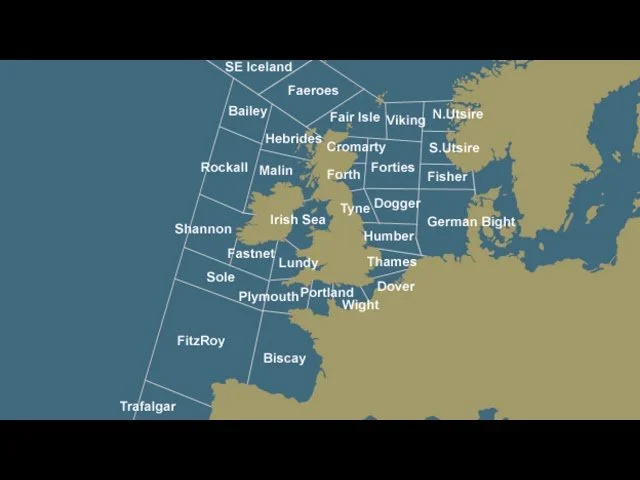
Now I know that by eulogising the Shipping Forecast there is a danger that I career into the all-too-twee ‘British National Treasure’ territory of Stephen Fry, Paddington Bear and village greens, or sound like a book you'd find in a garden centre, and in its 101 year history, there have been countless better writers than myself proclaiming their love for it anyway, but since I first discovered it for myself when I was in my late teens, it has held a fascination and grip on me that many years later still stands firm.
Crucially, after nigh on twenty years, and listening to it more times than I could ever consider, I still haven’t got a clue what it’s all about. Despite reading several books on the topic (Charlie Connelly’s ‘Attention All Shipping’ is strongly recommended) and listening to countless documentaries about it and its beautiful, mellifluous accompanying theme tune, 'Sailing By', the hypnotic, quasi-mystic readings still mean naff all to me. I know of course roughly what it all pertains to; wind speeds, visibility and so on, but I've never concerned myself with the specifics - that's not where the magic lies. The moment I understand the messages, the visions they conjure, the pondering it elicits, the images it creates, all fade away and I am left with the functional, the factual and dare I say it, the mundane.
The thrill hearing something as seemingly nonsensical as "Viking, Northwesternly, 3 to 5, becoming cyclonic later, losing its identity", and knowing that these numbers and phrases, read solemnly and almost chanted hymn-like, mean something to someone, somewhere enchants me. There’s a meaning hidden in the numbers, but not meant for me; I'm eavesdropping on a message sent out to sea, safe, dry and warm. It makes the mind wander and wonder.
An even more clandestine and eerie example of this no-man's-land is the phenomenon known as Number Stations, broadcasts that nestle themselves amongst the bandwaves on shortwave radio. Somewhat elusive, when they burst through the air, they consist of chilling machine-like jingles followed by repeated chains of seemingly random numbers, often in automated or robotic voices that have attracted enigmatic names such as 'The Lincolnshire Poacher', 'Swedish Rhapsody' and '5 Note Version Czech Lady'.
These haunting stations have never been officially acknowledged by any state, but they are widely regarded to be broadcasts sent out to spies out 'in the field', conveying messages that by their very definition are impossible to crack or trace, as they are only intended for the single person at the other end who has the skeleton key that unlocks their message.
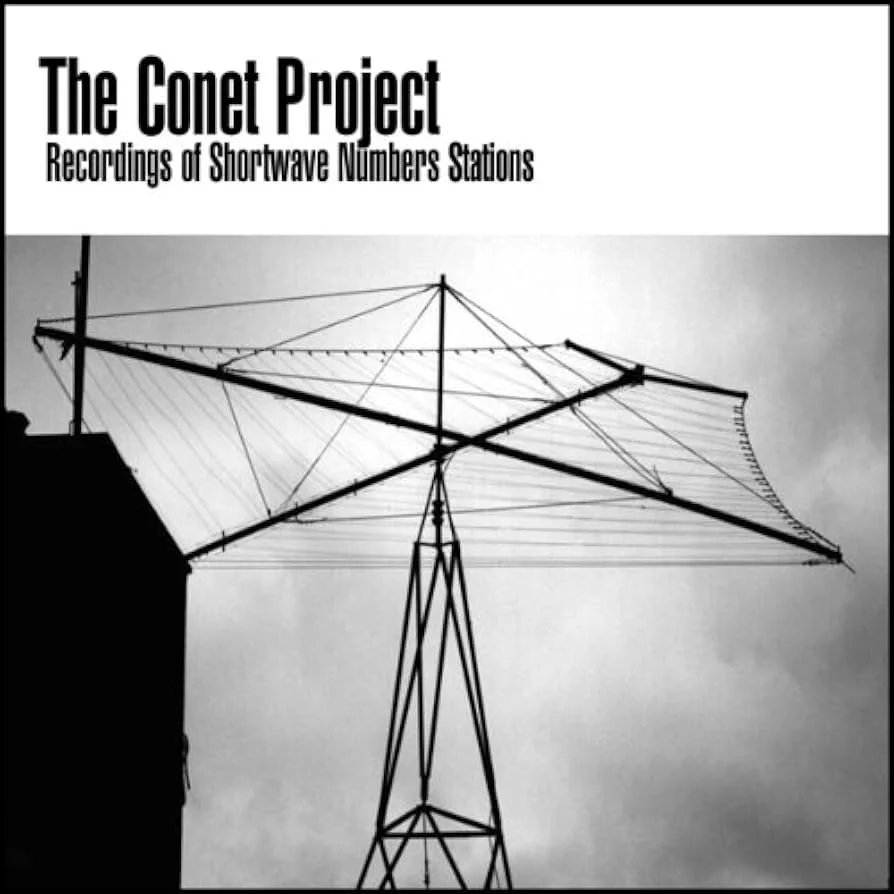
These messages could be relaying anything, us humble prying listeners would never know. They could be ordering hits, urging spies to flee to safety, or simply 'no news today' - and again, the not knowing is what makes these so electrifying.
These Number Stations were obviously more prominent during the Cold War, but only last month, there was much furore amongst the SWL (Shortwave Listening) community when for the first time in years, a 'new' broadcast was picked up, believed to be originating from Iran, likely in response to the freshly escalated war. What are they trying to tell those who need to know? We'll never know, and isn't that a thrill?
There is a fabulous 5-CD box set (I do try my wife's patience, don't I) called The Conet Project and even a cursory dip of the toe into it is like lifting a rock and finding a new world of information you were never meant to see. I can't get enough of it.
I have only ever actually heard a spy station in the wild once. It must have been about 14 or 15 years ago. Whilst most of the people in my circle would likely go to an afterparty once the clubs and pubs shut, engaging in pharmaceutical exploits and other mischief, yours truly would hole up with his radio, excited, as the wee hours provide the best conditions for hearing distant voices. This night, half cut, I trawled the megahertz and froze immediately when I realised what I had stumbled upon. A cold, toneless voice was bleating out a string of numbers.. "45321... 45321..." with intercepts of bleating tones. A chill ran through me and I stumbled and spluttered to grab my phone to grab a recording, but by the time I had done so, and no doubt woken up half the house, the transmission ended and the air faded back to static. A primal surge of fear briefly sped through me as I wondered if I was meddling in things I shouldn't be, before sense reassured me and I drifted off to sleep.
What information was in that message? Who was listening, notepad in hand, radio keenly tuned to the same frequency? What became of them? None of us could ever know and never will - and that's OK. In fact, it's more than OK; it's brilliant. It's what makes art, activity and life colourful, vibrant and worth doing.
To bring this back full circle, another quotation of Jiddu Krishnamurti I like posits that "truth is a pathless land" - so don't get too concerned with finding the right path.
Enjoy this mix, it's the one I've probably worked the hardest on, and is likely the best yet. Although, because I am a contrarian sod, there are no shipping forecasts or number stations in it (there are in past ones and will be in future ones), but there is plenty of stuff to be satisfied not understanding. A Julian Cope song about Einstein, musings on the most impenetrable work of art ever, Finnegans Wake and a reading from the text by the main man, James Joyce himself, alongside some other bangers. Go forth and listen, and don't bother yourself with what it's all about.
— Matty Loughlin-Day, 22 April 2026
The Cult Continuum
with Matthew McPartlan
Our regular contributor Matthew McPartlan recently came to me with an idea that had been bugging him for a while - a limited series called The Cult Continuum. Over the next eight editions, Matthew will be dissecting eight different cultural anchors that have resonated or intrigued him: a musician, a town, a TV programme, a film, a book, a song and an artist.
He begins with Michael Hurley.
Hurley, who passed away in April 2025, was a pioneer of what we now call "freak-folk," though he likely would have just called it "drifting." He was a songwriter, a cartoonist and an outsider who wandered through American music for over sixty years without ever once chasing a trend. As Matthew notes, Hurley made music that seemed to exist before you heard it and will still be there long after you’ve gone.
He is the perfect entry point for this series: an artist who proved that a life lived fully, without compromise, is its own form of greatness.
#1 Michael Hurley
The Shape of a Life in Song
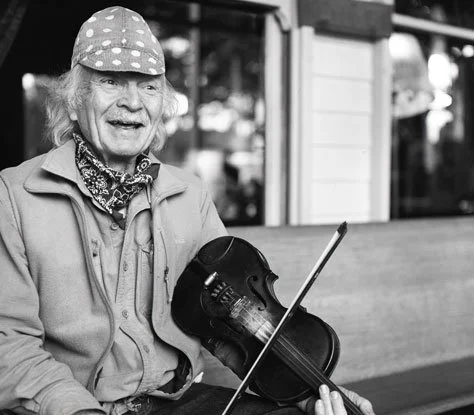
Like most significant artists or musicians in your life, I can remember exactly when I first heard the music of Michael Hurley. It was one of those rare moments of immediate recognition, as if something in the music had always been waiting for me. "Knockandoo" was the gateway: that loose, lopsided guitar playing, hooked me from the first few bars.
And so began a twenty something year long love affair with his music.
For those not already familiar with his work, Michael Hurley was a folk musician only if you take the word "folk" and stretch it into something strange. Often described as a pioneer of freakfolk, his music is playful and dowsed in humour; Hurley drifted at the edges American music for more than six decades. A songwriter, cartoonist, storyteller and singular outsider whose songs carried the warmth of campfire tales and the oddball wisdom of someone who lived life on his own terms. Born in 1941, he emerged from the Greenwich Village scene but never belonged to any movement except the one he made for himself, releasing dozens of albums that wandered between blues, country and folk.
With the exception of his debut album, he illustrated all his album art, featuring reoccurring and central cartoon characters which became inseparable from his music. Figures like his wolf "Snock" created a personal mythology that mirrors the rambling, episodic feel of his songwriting.
He passed away in April 2025 and left a considerable back catalogue so wide and unruly in the best possible way, that exploring it feels like rummaging through a lifetime's worth of journals, sketches, half drawn characters.
Nearly sixty years after his first recordings, the music remains undiminished: warm, eccentric, humane, defiant in its refusal to be anything other than what it is. He made the ordinary feel enchanted. He made imperfection a virtue. He made music that seems to have existed before you heard it and will still be there long after.
When Hurley died at the age of 81, he was still performing live. My social media feed filled with tributes from musicians, writers, artists and fans who seemed to speak in a single collective voice of affection and gratitude. I had imagined him as a fringe musician, a secret known only to a certain type of listener, but the outpouring revealed something truer: he had been quietly central to people's lives for decades. That kind of presence is hard to articulate. A musician who never courted fame, never chased trends but whose influence seeped into the ground like water.
Richard Dawson performed an affectionate rendition of "Wildgeeses" from Ida Con Snock 2009) in the Liverpool Philharmonic Music Room last May. Dawson spoke about Hurley with reverence, honouring him as someone who had lived "a lifetime in song". You could hear the kinship between them; two artists who understood that the voice can carry worlds, that imperfection is a virtue, that sincerity can be rugged, cracked and still soar.
Hurley was never mainstream, but he was never not essential. He belonged to his own constellation, orbiting the edges where authenticity thrives.
Which is why Michael Hurley fits so naturally within the Cult Continuum. His career spans six decades, yet his name rarely appears on the lists of greats. This is not because he lacked brilliance, but because the culture around him shifted, swelled while he simply continued being himself. He is the reminder that a life lived in music, fully and without compromise, is its own form of greatness.
Ten Years
by Kristian Collins
Ten years. Ten years of La Violette Società. I attended the first ‘Violette at The Buyers Club, and whilst I am ten years older, I am also in a very different position from what I was then. Having moved to Liverpool from London (although originally a Sanddancer from South Shields) in 2008, I didn't really have any ‘gig mates’, and I often went to concerts, clubs, and the cinema alone when I wasn’t with my wife. This didn't bother me as I sometimes enjoyed it, and in fact, even today, I still do, and sometimes even prefer going solo.
I knew about Violette via Michael Head, like a few others I’d imagine, so when I saw a post about the Società, I was in. I remember going up the stairs in The Buyers, getting a drink, and hovering by the bar, waiting for the first act. I knew very little about what to expect or about any of the artists, and didn't bother to research who was performing. This is something I've carried forward to every ‘Violette I’ve attended since, which surprises some people: them: “What, you don't know who you’re seeing?” Me: “Yes, exactly”.
It never let that down that night in March 2016. From Paul Birtill’s dark Walton-infused stories to the RnB stomp of The Blue Soul. Oh, and the bonus of a surprise performance by Michael Head, under the pseudonym of Joni O'Shea. Even though I left without speaking to anyone, I made my way home feeling part of something.
Over the next few years, I continued to attend the ‘Violettes, with each one giving me the same feeling and element of surprise. Later, as Violette branched out, I followed and soon found myself sitting in the back room of Cafe Tabac watching a film about the not-so-swinging side of 60’s London. Although still attending alone, PJ was gracious and made me feel welcome, along with the lads from Damien John Kelly House.
As I was attending more Violette events, sometimes with friends from back home or work colleagues, I started to recognise faces who soon became familiar. It was at The Violette Film Club where I met Danny, who seemed to know everyone, and after a return flight from Belfast, where he was sitting next to me, our friendship grew. From that chance meeting, I was invited camping, where I met a group of people, who my family and I now call friends. As a direct result of Violette, I have also ridden around Liverpool on many Friday night rides, curated playlists for said rides, and appeared in a football advert, even though I possess very little footballing talent whatsoever. It’s even prompted me to write this piece.
So, as I arrive for the finale one (ever?) alone again, I am a much changed person from the one at the start of this story. Already said hello to Mark, a person I only ever see at Violette, and I take my seat at the last vacant table. Danny and a few friends arrive, and we settle in for the last time. La Violette Società has given me more than ten years of entertainment; it has given me a sense of belonging in a city I now call home.
—
Kristian Collins is a professional Sanddancer who has spent the last decade perfecting the art of the anonymous arrival. He operates on the principle that the most reliable way to find a community is to stop looking for one and focus instead on the precise vibe of a bar-side hover. He is currently investigating a theory that certain return flights from Belfast act as low-frequency recruitment drives for camping trips and remains convinced that his appearance in a football advert was a glitch in the matrix that no one has seen fit to correct…yet. He continues to navigate Liverpool by the coordinates of Friday night bike rides and is rumoured to be the only man in the city who can correctly identify a "Joni O'Shea" track simply by the specific, low-frequency hum of a room that all knew a poorly-kept secret.
The Gen Alpha Lexicography
by Maya Chen
20: 'Delure' (The Very Mindful Mistake)
Etymology: A linguistic car crash between 'demure' (the 2024 viral trend of performative modesty) and a suspected typo that has since taken on a life of its own.
I recently witnessed my daughter carefully arranging a single, organic sourdough cracker and a glass of room-temperature water on a tray. She was moving with the slow, exaggerated grace of a Victorian ghost. When I asked if she was feeling alright, she whispered, without making eye contact, "I’m just being very delure, Mum. Very mindful. Very cutesy."
I corrected her, of course. "The word is demure, darling."
She didn't flinch. "That was your era, Mum. In my era, we've moved past the 'm'. We're delure now. It’s more... airy."
'Delure' is the sound of a trend beginning to rot. It is the moment a viral aesthetic—in this case, the 'very demure, very mindful' performance of modesty—becomes so saturated that the language itself starts to glitch. To be 'delure' is to perform a version of modesty that is so transparently fake it becomes a meta-commentary on the act of pretending.
It is the final frontier of the 'aesthetic' life. It’s not about being modest; it’s about luring people into noticing how modest you are. It’s a performance of restraint designed specifically for maximum engagement. It turns the quiet life into a loud broadcast. My daughter wasn't just eating a cracker; she was auditioning for the role of 'Girl Who Doesn't Need Attention,' while making sure I was filming the whole thing.
We are living in a world where even our mistakes are now curated. 'Delure' isn't a typo; it's more a pivot. It suggests that in the Gen Alpha universe, accuracy is far less important than the ability to rebrand a failure as a new, more exclusive category.
Next time: 'Aura' - The imaginary points system that has replaced the concept of a soul.
—
Maya Chen has recently decided to become "spiritually delure," a state she achieves by staring at her router until she can feel its individual data packets. She is currently attempting to patent a new form of punctuation that consists entirely of rhythmic blinking, claiming that the written word is too aggressive for a mindful household. She spent yesterday afternoon trying to explain the "vibe" of a 19th-century famine to her children using only interpretive dance and a moist towelette. Her son has responded by filing a formal request for a more "main character" mother, citing her current trajectory as a "severe aura drain."
Tender
by Amy Collins
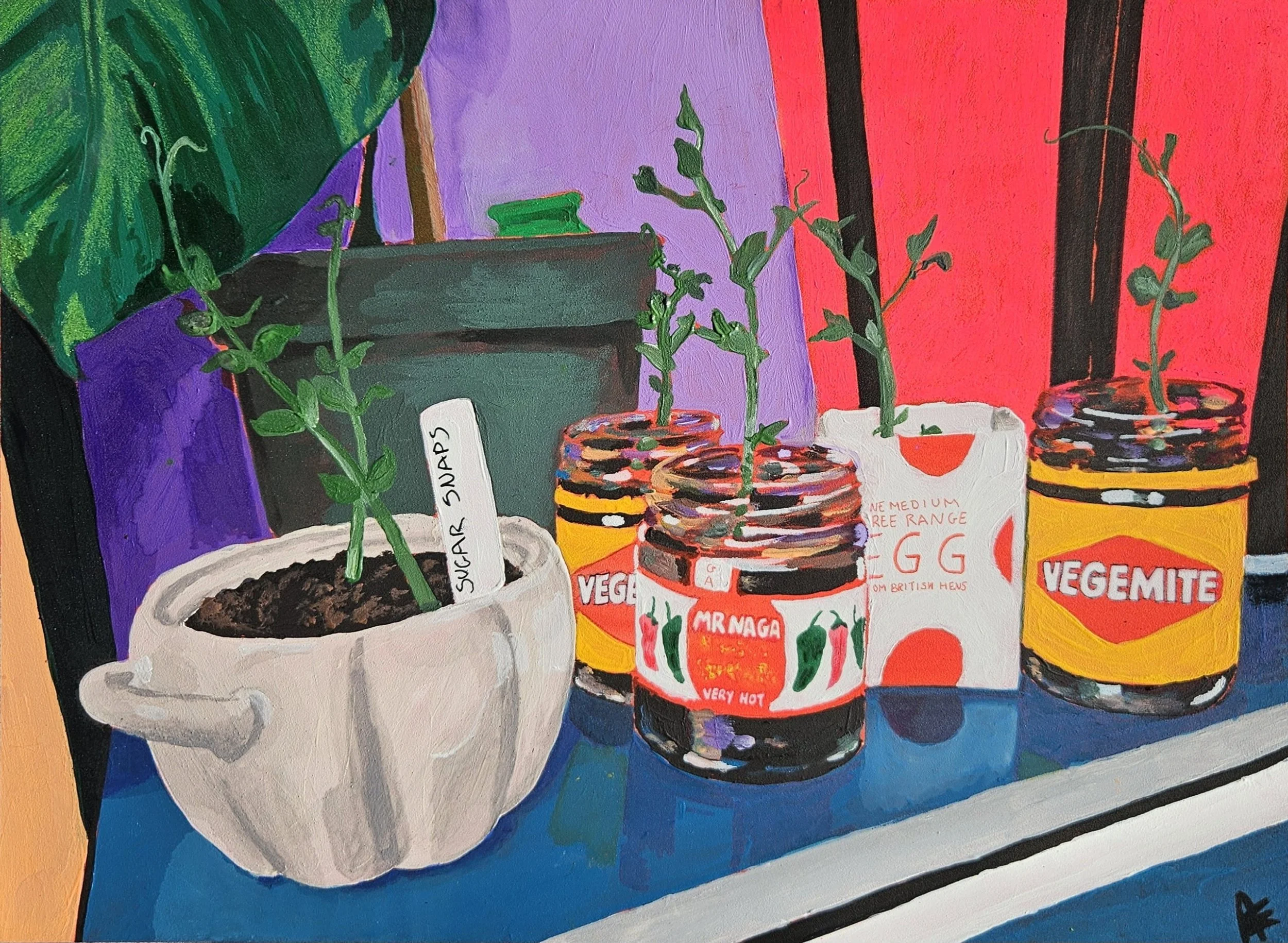
For weeks, my thoughts have been fully occupied by seedlings. Forty-two of them sit in pots across nearly every flat surface in my kitchen and back room, with another twenty-five squeezed into a mini greenhouse I bought just in time to avoid losing all cooking and eating spaces entirely. Some are living the high life under grow lights; others are being shuffled daily between the sunniest windowsills. And this doesn’t even account for the next phase of seeds still lying dormant, biding their time.
At the end of my dining table, there sits a painting in progress, an homage to my seedlings. I’m a bit rusty with acrylic paint, but if I don’t mess it up, it will sit alongside this writing as further evidence of my devotion, my obsession. What began as a small, well‑intentioned project to show my niece and nephew how the sugar snap peas they love to snack on are grown has, as is my way, erupted into a full‑blown addiction. I’m now growing twenty‑two different varieties of herbs, vegetables, and flowers. I’d love to tell you this is all part of a carefully thought‑out plan for self‑sufficiency, a hedge against the looming global food and economic crises ushered in by that Oompa Loompa and the genocidal ringmaster. But that would be giving me too much credit. I just got carried away.
Today, my little green sanctuary existence was briefly interrupted, away from home, when a man in a white van drove into the rear of my car. It gave me a shock, along with a literal pain in the neck. By some strange twist of fate, I had a mechanic sitting in the passenger seat at the time, another story altogether. I’m still scratching my head trying to decide whether I’m having an unlucky or rather fortunate day. He was dead helpful, actually, and unlike the other two times someone has driven into me, at least I wasn’t on my own. That particular kind of adulting can be a lonely business. After five solid hours of calls, forms, crime reference numbers, and insurance nonsense, I gave up and did the only thing that made sense: I sat down to write about my beloved saplings.
Even after coming home shaken and upset today, all I wanted to do was go to them. To tend to them. They offer pure comfort and joy.
A couple of weeks ago, at the March edition of a monthly collage club I attend, I was raving about my new growing fixation to one of the lads from DJK. He told me something his mum always says, “if you can look after a plant, you can look after yourself.” I haven’t been able to stop thinking about it.
Right now, I’d argue that these shoots are looking after me. They seem to be carrying me through the year in the most unexpected way. Every small adjustment I make to nurture them feels like an act of self-care. In tending to them, I am tending to myself. Now that it’s April, I bring them outside for a few hours each day, hardening them up before they’re put out to face the elements. I’ve got litmus paper to test the pH of the soil, making everything just right. And at 7am this morning, taking the bins out, I found a bed frame fly-tipped in the entry. I excitedly dragged it home. If I treat it, it’ll be perfect for my climbers. It is all-consuming.
God knows what the rest of this year will throw at me, but imagine what these tommys and peas will taste like, grown with so much love!
—
Amy Collins has recently returned from a period of "necessary exile," only to discover that her absence was taken as a formal surrender by her garden. She has resumed her role as the reluctant diplomat of the Wirral, attempting to negotiate a peace treaty between her three unimpressed cats and a small forest of seedlings that successfully staged a coup while she was away. She operates on the firm belief that the draw of home is a specific magnetic frequency emitted by her compost heap, and she spent the weekend recalibrating her internal compass by staring at the Poulton Road peeling paint until it started to look like a welcome home banner. Amy is currently investigating whether the integrity of the verge can be used as a structural blueprint for a new, less stressful version of adulthood, and has been seen whispering encouraging things to a fly-tipped bed frame, convinced it is the only artefact capable of supporting the weight of her future tomatoes.
And finally…
Bus Drivers
The most depressing sound in the world is the beep of insufficient funds for a bus ticket
Loud enough for every nan and her sodden dog to hear
Can’t get home! Can’t return!
The small, polite refusal bringing a flush to his face and an impatient sigh from the bus driver
They’re moving on without you
It shouldn’t be a defining moment but the lack of humanity makes it so
Will the transcript of this beep and the fumbling thereafter be played at the pearly gates
Of the driver’s purgatory or his?
School tie loosened and a backpack sagging
He didn’t know the armour still had a role to play
—Jasmine Nahal