
Science & Magic | 24
Someone asked me the other day who my heroes were growing up. I had the obvious ones. Steve Austin. Dennis Tueart. Tarzan. Whatever synth-y pop star was on Top of the Pops that week. Toni Arthur, though I'm not sure ‘hero’ is exactly the right word for what I felt about Toni Arthur. I had all the normal ones, is what I'm saying. The ones every boy born around 1970 had.
But the one that actually changed something was Johnny Ball. Bear with me. Yes, the man in the shit jumper on a BBC set that looked like it had been built out of cereal boxes, talking about maths like it was the most exciting thing in the world. ‘Think of a Number’. ‘Think Again’. Ten past five, after John Craven’s Newsround, every week. I never missed it. I don't know why. I wasn't sitting there thinking "I must watch this programme about mathematics because it will enrich my intellectual development." I was nine. I probably should have been outside accepting sweets from strangers or contracting polio. But there was something about the way he talked about numbers that made you kind of lean forward and listen. He didn't really care if you understood. He just cared that you were paying attention. And I liked that.
Here's what I think about it now. Johnny Ball never actually asked me what I was interested in. He just turned up with something he thought was brilliant and assumed I’d agree. No algorithm. No recommendation engine. No "because you watched this, you might like that." Just a bloke who'd found something great and couldn't keep it to himself. With a limited TV choice in those days, you were pretty much ambushed. You had absolutely no say in the matter. You sat down expecting Blue Peter and ended up thinking about prime numbers for the rest of the week.
Nobody does that any more do they? Everything now is about confirmation. Your phone seems to know what you like. Your Spotify knows what you like. Your entire digital life is a mirror angled to show you the version of yourself you've already decided on and calls it discovery. It isn't discovery at all. Discovery is what happens when someone else's enthusiasm lands on you without warning and rearranges something you didn't know could be rearranged. Discovery is a belly full of egg, chips and beans watching Johnny Ball at ten past five on a Tuesday. And the fact that there is no equivalent of that any more should bother us a lot more than it actually does.
Welcome to the latest edition.
Matt
Ten Questions
by Rachael Jean Harris
Rachael Jean Harris is a songwriter who pays attention. While the rest of us are zoning out on the commute, she’s recording the mechanical symphony of a Merseyrail train, the horse-like sigh as it stops, the glitchy buzzard squeak of the brakes. She treats the world as her library of found sounds and poetic data.
We’ve been huge fans of Rachael’s for a long time. She operates in that adventurous, slightly difficult territory where folk melody meets the improvisational logic of jazz. Her recent album, Tethered To Nothing - released this April and recorded at Hope Mill in Manchester - is the sound of an artist pushing right up to the edges. It’s a record that feels remarkably free, moving from the living room intimacy of 'Little Hawk' to the jaunt and poke of, my personal favourite, 'Battledress'.
We invited Rachael to select ten questions from our archive. Her responses take us from the front seat of her dad's Volvo estate to the hushed, un-applauded silence of Evensong in the Anglican Cathedral.

● What's the first record you saved up to buy with your own money?
Madonna’s Immaculate Collection. I think I was about 11. I’ve been singing those songs lately with backing tracks to practice my singing, copying Madonna’s tones, and have found myself surprised by how emotional - particularly joyful - it’s been. They’re just such impeccable pop songs and have lived in my psyche for a long time.
● What song is permanently fused to a specific place or holiday - to the point where hearing it transports you instantly?
I often hear 'Dreamlover' by Mariah Carey in Morrison’s. It instantly transports me into my dad’s Volvo estate travelling over to Blackburn when I was a teenager to watch my older brother train with the youth team at Blackburn Rovers. I went in part because I fancied some of the lads in the team but that album, Music Box, sounded really, really good in the car speakers and I could whack up the volume and have what felt like a religious experience surrounded by Mariah’s transcendent tones. Although he feigned annoyance, I think my dad quite enjoyed it too.
● If you could time-travel to witness one musical moment in history, when and where would you go?
I would have loved to stand in the full force of Mahalia Jackson singing pretty much anything. Maybe 'Didn’t it Rain' at Newport Jazz Festival 1958.
● What album would you press into the hands of an 18-year-old today, insisting they listen to it front-to-back right now?
I’m coming at this as if that 18 year old were an aspiring songwriter…. I learned so much from Suzanne Vega’s Solitude Standing. Her lyrics are informed by such a gentle eye but they’re razor sharp with poetic insight. The whole record is exquisitely produced, and beautifully unfussy. Wily shifts in harmony and time signature feel so natural, and Suzanne’s voice is one of the most self possessed and true I’ve ever heard.
● What's your go-to song for pure, uncomplicated, turn-it-up-and-dance joy?
Whitney Houston - 'I Wanna Dance with Somebody'
● What's your favourite sound that isn't music?
I really loved the mechanical symphony of the old Merseyrail train fleet. I used to make recordings and try to compose little experimental tunes using the rhythmic syncopations of the sounds. Those old trains sighed like draught horses when they rolled to a stop, accompanied by a flurry of squeaks that sounded like glitchy buzzards’ cries. There was a long rising glissando as the train accelerated, cut off by a decisive ‘clack’. I miss the double ‘ding ding’ before we moved off. So animated. It just made me feel quite amused and happy.
● Which song lives in your memory word-for-word that would raise eyebrows if you suddenly performed it flawlessly at karaoke?
'Informer' by Snow.
● What's the most beautiful piece of music you've ever heard live?
I work in the Anglican Cathedral and get to sit through Evensong quite a bit. The choir are magnificent and sing a lot of fabulous music. I could pick many moments when I’ve been brought to tears; something like Anton Bruckner’s Christus Factus Est. Or James Macmillan’s O Radiant Dawn sung during Advent. The fact that there’s no applause at the end of the pieces heightens the pathos - the music just hangs in that massive space, children’s and adults’ voices together, until they’re enveloped in the silence. It’s just sublime.
● What's the last album or song that made you stop whatever you were doing and just listen?
Fanny Hill by Fanny, particularly the song 'Blind Alley'.
● If you could only listen to one record for the rest of your life, what would it be?
PJ Harvey is my favourite artist and the musician whose approach to art making has been most inspiring and helpful to me. So it would be one of hers. I’m going to go for To Bring You My Love.
Magnetic North
by Jeff Young

24 : Dens
Mattie always had scabbed knees, cuts and bruises, scabs like mossy lids, gravel grazes, Elastoplast on both knees, peeling off and filthy. His brother was always sniffing, wiping his hand over his top lip, snot always leaking from his nose. Sheltering from the rain underneath sheets of polythene nailed up on planks of wood and two by four, we’d crouch in the den, huddled like snipers on the lookout through slits in the polythene for that bin lid gang on the estate across from ours. It was a warzone, and it was incredibly exciting.
We were more than just our gang - a kid with broken glasses, a scabby kneed fat boy and a deadweight lad with snot coming out of his nose - we were the Awkward Bastards. Swearing was everything. Secret codes and manifestoes written in lemon juice. Man from Uncle guns and tobacco pouches full of clover, sheriffs’ badges, Fireball XL5 stickers, flying saucer sherbert powder on our jumpers. Spies in love with Alexandra Bastedo in The Champions. Den Builders.
In the long grass by the burned-out barn – grass twice as tall as us, alive with birds and mice – we’d flatten the grass and make pathways to the centre of our labyrinth, stash jam jars full of sticklebacks and newts. In the banks of the flooded pit on the debris, we dug into the earth and made a burrow, a lookout post to keep an eye on bulldozers filling in the hollow where mutant carp swam, and we launched our warship scaff planks. In Mattie’s backyard we holed up in a nailed together shack made from plywood sheets and plastic wrapping, Evertonians keeping an eye on Ian St John’s house in case of suspicious activity. In Ball’s Wood we were outlaws, holed up in an old boat full of concrete, pirates in a sea of trees sailing to the lunatic asylum. In the autumn we built our headquarters in the shell of a new bungalow, setting off fireworks on that November night we set out to kill the cocky watchman. * Teenage days beneath the railway bridge, skiving off school and smoking Panatellas we’d nicked from Mattie’s dad’s toolshed, then graduating to spliffs of sour weed we scored in the Masonic.
Everywhere I’ve ever lived has been a kind of den, a hideout, a watchtower, a burrow. In the woods today I saw this bivouac, wigwammed branches propped against a tree trunk. I felt certain that whoever made the den was watching us from the shadows, watching us the way my boyhood gang once watched the watchman. A temporal unbalancing overcame me, and I slipped through time, back to my childhood, back to the burned-out barn and secret codes written in lemon juice.
I’m at home, in my cluttered office. It’s raining outside and I’m listening to Karen Dalton singing Dino Valenti’s Something on Your Mind, listening on repeat, the song’s darkness and beauty filling the secret place, filling the hideout with haunted memory. I am here, in a secret den, I am all the ages I’ve ever been.
I am all the memories of all the years in the centre of the labyrinth of forever.
*(we didn’t kill him)
— Jeff Young, 5 May 2026
—
Jeff Young recently filed a formal planning application with the city council to have his office re-designated as a ‘Sovereign State of the Awkward Bastards.’ He genuinely believes that the only accurate way to measure the passage of time is by the specific drying speed of a knee-scab. He was recently observed, by a fellow contributor to S&M, attempting to launch one of his books into the Mersey, muttering a conviction that with a sufficiently sturdy scaff-plank, it could sail directly to the lunatic asylum of his youth. Jeff is all the ages he’s ever been, though he admits that right now, he is mostly seven and a half.
The Paphides Principle
Some of the most interesting songs are the ones that never look away from the agonising moment the shell of childhood begins to crack. It’s a blurry transition of years where the world suddenly demands a maturity that feels less like an evolution and more like a hostile takeover.
This week, Pete navigates the complicated terrain of professional distance and paternal pride. After spiking an earlier draft, he returns to the music of his youngest daughter, Eavie, and specifically the final track on her debut album, Little Miss Sunshine. A song that refracts modern age summertime sadness through a lens that is unflinching and deeply humane.
Eaves Wilder: ‘Summer Rolls’
I’m going to have to level with you. I wrote a whole long, somewhat anguished thing last time around, and then I thought better of it. At the eleventh hour, I told Matt to spike it.
Instead, I hymned the praises of the brilliant Osian Rhys whose album Never/Whenever feels not so much written as excavated from the Gwynedd hills of his upbringing – so all’s well that ends well. And the reason for all this anguish? Well, it was because my original ravings concerned the music of my youngest offspring Eavie.
Perhaps someone might imagine I was using my “platform” to foist her creations on you for impure reasons. But the weeks roll by and the reviews from people who don’t share her DNA keep on rolling in.
Her label also have Yoko Ono, Bill Fay, Mitski, Sharon Van Etten and Yeah Yeah Yeahs on their roster. So even if I don’t know what I’m doing, they clearly do. And the bottom line is, I keep playing these songs. I play them in the car. I play them on the train. I play them when I’m out walking the dog. And now the album’s been out for a fortnight, so are quite a few more people. You may have heard one or two of the more upbeat songs on the radio, but right now,
I’d like to shine the angle poise on the album’s final song, ‘Summer Rolls’. It’s a reminiscence about those first few intimations that the wick of the candle we call childhood isn’t going to burn for much longer. It’s about suddenly feeling like your headspace is one of those abandoned Eastern European playgrounds you see on websites devoted to liminal spaces (I’m paraphrasing her words here). It’s about being a 12 year-old girl and noticing that your body is changing. It’s about everything happening far too soon. It’s about how, for some girls, the shell of childhood just sort of a falls off and they barely notice. But for others, it hurts like hell. It’s about weaponising your body – be it through starvation, purging or self-harm – to push back against the brutal onset of “maturity”. Even if it means endangering yourself. Because, in the 21st century, the adult world looks unkind and unforgiving, so on balance, why yield?
When I think of ‘Summer Rolls’, I think of Jojo’s ‘That Summer Feeling’ and Lana’s ‘Summertime Sadness’ refracted through the gaze of Sofia Coppola. Am I proud? Of course I am. But I feel a vicarious pride for every woman of her generation who is finding a way to figure it all out through the medium of melodies, chords and words. Doubly so when they all converge as beautifully as they do here.
— Pete Paphides, 7 May 2026
What Is Shaped By Your Absence?
by Eimear Kavanagh
This I will never, truly know.
If there is an eternal presence of all beings (both seen and unseen), shadows of our selves may lie deep inside of another’s mind. As bright as a star or as delicate as the scent of a rose.
You may be either spellbound or oblivious.
Love, Eimear
A Good Day
by Victoria Raftery
It had been a good day.
My tights hadn’t laddered and my new timetable involved only one double-period (RS) in the damp, cold prefabs at the other end of the playing fields. Ancient Miss Grice had retired and we had a new Combined Science teacher who was male and the talk of the school but best of all Andy Carter had waved to me out of the window of his bus at the Hapenham crossroads and I’d waved back from mine.
It had been a good day, a very good day indeed.
Karen Marriot and I trudged home from the bus stop, shrugging off our blazers, removing our berets the minute we jumped off the bus.
Sweltering from the usual September heatwave, the late afternoon breeze was welcome, ruffling our hair and rippling through the jungle of nettles and rose bay willow herb lining the verges of the narrow lane.
‘Great being on chairs in assembly.’
I agreed. No more sitting crosslegged on the gritty hall floor in a gym tunic and knee-length socks, flicking away errant peas left over from yesterday’s lunch; we were Third Years now, in skirts and tan tights, looked up to by the quivering Firsts and Seconds.
I shrugged my Dolcis black canvass bag up my shoulder. My blazer, heavy black felt, was absorbing every ray of the early-September sun but I would never have ripped it off on the bus like Lucinda Scrollins did, stamping on it and screaming at it like it was a big black spider she was trying to kill. I loved my blazer. We were the Girls of Grantry Grammar; we wore our uniform with pride.
I waved bye to Karen at our usual spot and trudged down the cul-de-sac, anticipating the marmalade sandwich I was going to make the minute I got in.
Jim, our neighbour, shouted over as I walked up the drive.
‘Fancy a spin?’
So this was the new car all the fuss had been about.
‘Yeah, ok.’
Why not?
It was a beautiful car. I sat high up in the passenger-seat.
The Roller had five gears - five! - and cruise control which meant it would drive itself on the Autobahns whenever he and Beryl were on The Continent.
The Continent.
Another world.
We went for a drive, Jim and I, he in his slippers and me with my Dolcis canvas bag.
‘What happened to your satchel?’
Straightaway, the blush started. He got to the bottom of it soon enough.
‘So they told you you're posh?! Tell ‘em where to get off, fuck ‘em. Nothing wrong with a good old leather satchel.’
We stopped off at one of the builders’ huts for a cuppa. And then I drove the Roller home.
‘Thanks, Jim.’
‘You’re welcome. You're a good driver, just like our Cassie and Mags.’
It had been a good day. I'd finally got my head around apples-and-oranges not being in the same brackets which was crucial to know if you were going to get an important job one day.
Jim left the Roller on his drive despite the fact that he and Beryl's bungalow boasted a double-garage.
I liked Beryl; she had really good breakfast cereals.
And books. Loads of them. She would test-drive them out on me before she gave them out to her class. She said I was a really good reader.
‘Bye, Jim.’
‘Bye, duck.’
Sliding the key into the lock as quietly as I could, I crept into the hallway, testing out the atmosphere.
It was quiet.
Was she out? The garage door was shut; I hadn't thought to check if her car was there or not.
There was no sound from the kitchen; maybe she was upstairs?
It was very, very quiet.
Too quiet.
The new cream rug lay resplendent across the parquet floor and I made sure to step over it so as not to dirty it with my clodhoppers, the clodhoppers that she had made me have, the clodhoppers that had cost a bloody fortune, clodhoppers I had not wanted in the first place; I swear to God, she had picked the ugliest shoes for me.
The blow came from behind.
‘Get up those stairs! Move!’
She had been in the study; I hadn't been expecting that.
‘Up those stairs, you little bitch. Get up. Go on.’
It was the Roller, it had to have been; we had a Granada which was very swish but it just couldn't compete.
She kicked me down the landing (homemade curtains and a ceiling lamp with pom-poms) into my bedroom (homemade curtains, a ceiling-lamp and table-lamp with pom-poms) and then I knew.
I'd forgotten.
Forgotten to wrap it up and put it in the bin.
I'd forgotten.
Too busy packing my school bag. Too busy covering my books with wallpaper. Too busy trying to solve that long-division, knowing it shouldn't have taken a whole text-book to complete.
I'd forgotten.
I'd left it lying on the bed.
The bloody sanitary towel.
‘You little slut.’
The slap came from nowhere.
‘Your father could have walked in on this, you little slut.’
I'd forgotten. I'd left it on the bed. I'd gone to school with a clean one in my knickers and completely forgotten about the bloody one left on the bed.
Slut.
She hit me so hard, I didn't know where I was.
They all went out later, Jim and Beryl, Mum and Dad; Mum in her mother-in-law's borrowed mink stole, sitting in the backseat next to Beryl.
I was very careful after that. No dirty girls in our house. No sluts. That was a lesson I never forgot.
But it had been a good day: I was a Third Year, I was wearing tights and I'd driven a Roller.
A good day.
A very good day indeed.
—
Victoria Raftery took up the study of "Sartorial Seismology" recently, monitoring the exact moment a beret is removed to measure the shifting tectonic plates of adolescent hierarchy. She is currently investigating the "Autobahn Glitch" - a theoretical state of being in which one is simultaneously driving a Rolls Royce in their slippers and being kicked down a landing decorated with pom-poms. She now operates on the firm belief that the universe is governed by the law of "Apples and Oranges," and that the most dangerous objects in any household are the un-redacted evidence of one's own biology left on a bedspread. Victoria is currently attempting to construct a protective shield out of Mink stoles and wallpaper scraps, convinced it is the only way to deflect the memory of sudden, high-velocity slaps of a September afternoon.
Dead Air Anthologies
by Matty Loughlin-Day
I have a friend I am extremely jealous of. He is an incredibly talented songwriter and is part of a fantastic band that churns out magical songs that save your life and soundtrack wonderful moments, but it’s not this that I jealous of. He also has a solo project, and self-records, produces and releases albums on a whim. Again, it is not this solo project I am especially envious of, fantastic as it is. What I am positively green about is the fact that he can do all of this and simply be satisfied with the intrinsic value of the art. He will complete a project and then throw it out into the ether and seemingly care not one jot about promoting it, getting it reviewed, or even whether anyone else listens to it.
God, I wish I could do that.
An enormous amount of my mental capacity and time is taken up by thinking about ways to get the band I am in (The Shipbuilders) heard by others. As coy and blasé as us musicians want to be, really, the vast majority of us want our stuff to be heard and, ideally,liked. Therefore, when my mind wanders, it often wanders towards ways of getting certain radio stations, blogs or crowds to hear the Good Word of The ‘builders. This often results in an overwhelming freeze response and very little gets done, because, as you might expect, it’s a fucking minefield to navigate. Try as I may, the idea of creating art for art’s sake and being able to acquiesce with whatever comes its way is something that I just cannot put into practice. A friend once paid me a compliment on a song we’d released and heeded me the advice “if you’re happy with it, then that is the biggest success you can ask for” and that is undeniably, irrefutably correct and wise. I am extremely happy and proud of the work we’ve created to date, and creatively, there is very little I would change if I ever had the chance to.
But.
But. All too often, I lose sight of that very easily and fall into the all too familiar pattern of panicking that time is ticking away faster than I can act and that the chances of me doing anything with my silly songs are diminishing by the second.
I should know better. Being a Clinical Psychologist, I encounter this issue on a regular basis with people who fear their moment has been and gone, or never came at all. Mercifully, there is a fair bit of the Day Job I can apply to this predicament when I find myself getting tangled in a flunk about the Other Job – my ‘real job’ - not doing as well as I would like, and I can easily find ways to pull myself out of this snake-eating-its-own-tail thought trap, but it’s always there, really. The nagging sense that the art isn’t reaching as many people as it should be. “Oh those poor mortals, they don’t know what they’re missing out on. This music deserves to be heard” – and so on. It’s all bollocks of course, as nobody deserves to be heard any more than anybody else; nobody needs your art, and this all probably speaks more about my own ego and need to be validated than anything else, but that’s another tale for another therapist’s couch, my main point here is that as much as I’d like to be like my friend and not give a toss whether anyone hears us or not, I very much do give a toss.
This isn’t helped by the changing cultural landscape and the shift in where artists are supposed to position themselves. I’ve been in bands for about 20 years now (I know, I know, surely not!) and in that time, without wanting to sound like a wisened or embittered old timer, the ways in which artists are supposed to push themselves, or get themselves noticed has drastically altered, with social media sitting right at the forefront of the swamp.
I remember when all this used to be fields, and recall when MySpace was the hottest place to be for a band. Organically and rapidly, this fledgling social media space became a way for bands to get themselves heard and achieve a reach previously thought impossible.The band I was in at the time, The Albany, almost overnight found an audience that we would have had to slog for years to achieve only a short while earlier. We of course squandered that, but that’s an altogether very different tragicomic tale, but other bands, like those Monkeys from Sheffield, were able to capitalise on this to an astronomical level – crucially, without industry input. For a brief, short period, it felt like the true democratic potential of the internet was being realised; we didn’t need The Man, we’re doing this ourselves!
Inevitably, the industries caught up and very quickly it was business as usual. In came algorithms, metadata and strategies and instantly, the ease of reaching far and wide vanished. Urgh. Fast forward 20 or so years and a social media presence is no longer an aspect of being in a band, it is practically the main component.
In between recording our first and second album, the label we were on went kaput, and we found ourselves on our own again. We therefore hawked our second album around to a few record labels, in the very degrading and crushing process many are familiar with.“Please sir, we hope you like this and want to invest in it”. Egadz. Anyway, lo and behold, we heard back from one label, who were gushing about it. They loved the melodies, the arrangements, the production – they’d had it on all week apparently. Great! So, do you want to put it out? Ah, well, no – you see, the thing is, the band’s social media stats aren’t up to much, are they? Even in writing that out I’ve let out an enormous sigh.
This has been on my mind a lot lately, with the ongoing discourse about the ways bands like Geese are ‘breaking through’ and ‘going viral’. Terms like ‘industry plants’ and ‘psyops’ are getting thrown about with gay abandon, and as someone with a tiny bit of an insight into the murky, murky world of the music industry, it has actually been somewhat fascinating and incredibly deflating.
To try and quickly summarise, recently, bands like Geese have exploded into the cultural consciousness to a staggering degree. You can’t move for hearing their songs, seeing their videos or reading someone’s opinions on them. So what? Well, it turns out that this is the result of a very new style of PR whereby companies absolutely flood social media with fake accounts claiming to be huge fans of the band, or pretend to be users who have just stumbled on the band and can’t believe they aren’t huge yet, so they just have to share it. Videos are posted, comments are left and general noise is made, all in the style and guise of very enthusiastic fans, when in factthese people aren’t real. They don’t exist. The conversations and discourses are nearly entirely made up. The result of this is that a semi-real buzz and hype is actually created around a band like Geese and suddenly everyone else – i.e. the real humans – feels like this is a new band they are discovering for themselves, or a band that they simply have to get in on early doors before they blow up, and thereby a very real interest is generated and everyone is suddenly into Geese.
It’s wild and increasingly prolific. Log onto platforms like TikTok, and it is awash with people claiming to be industry insiders giving away tips on how to ‘go viral’, many of which include creating ‘burner accounts’ or multiple profiles and posting 400 times every hour or until your brain turns into mush and pours out of your nose in the name of ‘content’.
Defenders of these practices point out that from the moment artists started creating music the industry has used surreptitious dark arts to promote it, ranging from pay-to-play on radio stations to the more, ahem, bullish tactics of threatening DJs with brute force unless a certain record is played. And I get that, it’s the name of the game. But I don’t know about you, but this all feels a bit more sinister. A bit more invasive. It is certainly less human and veers into the nefarious world of bot farms and false accounts that currently poisons the already polluted political waters online.
I know that all advertising and promotion to some degree involves manipulation and coercion. Your life is nothing without this product, you simply cannot have any degree of happiness until you buy this gadget, you’re out of touch and style if you aren’t getting involved with Geese, so do something about it, buy, buy, buy, stream, stream, stream, and so on, but this tactic of bots and algorithms, it not only makes me as a listener feel a bit cheated, but as an artist, it makes me positively despondent.
Do I want my music to be heard by as many people as possible? Absolutely. Do I want to spend my time doing social media promotion for my band? Not at the best of times. Do I want to spent my time doing social media promotion for my band by creating hundreds of fake accounts and post countless times on each and every account about how amazing ‘Hills of Mexico’ by The Shipbuilders is, and how I can’t believe that nobody knows this band? The thought literally turns my stomach.
Whereas the halcyon days of early MySpace and the like felt as if the playing fields were being levelled somewhat, up against this colossal force of PR and tech money, the fields are not just uneven, they’re positively mountainous.
We ended up doing our second album ourselves on our own makeshift label. We did manage to get some funding from a local arts fund for a bit of PR and managed to get a very good – and very sound – chap in to try and deal with getting the music reviewed and heard by people, and we had a modicum of success in this, but really, in the grand scheme of things, it barely made a dent, and given the current climate of fake accounts, flooding all platforms with fake content, how on earth are we supposed to compete with that?
Maybe that’s where my main gripe lies – we had a fleeting taste of what it would be like to know that if your music was good it would find its way to the right ears. Now, up against budgets we could only dream of and weapons we could never own, it all feels a bit hopeless.
Maybe it’s a bit of an overshare, and I certainly am not hawking for sympathy, but having to do all the promo and manage every aspect of the last album nearly did me in. We had a big gig planned at the end of the year, and though I had told nobody, I was planning on making it our last hurrah and wrapping it all up.
As it turns out, the gig itself turned out to be the best gig I’ve ever been a part of. In 20 years (I know, really!) of gigging, it was the one I cannot fault. Everything fell into place and it was brilliant. But more than that, in the midst of it, whilst I was milling around in the immediate aftermath of it, my wife said to me “look around, see how much this matters to people”. And she was right. My eye had been off the ball, I was caught up in record sales, streaming numbers, counting followers, when really, that’s crap, isn’t it? There were people there who had travelled from Sicily for the gig. Families who had traversed the country for the event. I shan’t say who for fear of namedropping, but one of my all-time songwriting heroes was there. No bot farm or algorithm can replicate that.
So with grim inevitability, we’re working away on Album Three. But this time, I’m realigning my priorities. I’m going to be like my mate. I’m going to make the best album I’ve ever heard, and all I can do it hope that you – and the as yet ignorant millions – hear it too.
Go listen to my mate though, he’s called Telefair.
Enjoy this Pirate Radio Shipwrecked mix, amongst other stuff, it’s got songs about new worlds, Moog interpretations of stone circles, Bollywood disco, Rastafari chanting and – shameless I know, but a song of my own, recorded on my phone during Lockdown II.
— Matty Loughlin-Day, 6 May 2026
The Cult Continuum
with Matthew McPartlan
I’ve always been fascinated by the idea of ‘slow magnetism’ in the way certain places, often for no obvious reason, begin to pull the right kind of oddballs into their orbit. You look at a map and see a town that looks perfectly ordinary on paper, but if you zoom in close, you find a whole ecosystem of ritual folk gatherings, UFO societies and cosmic disco.
In the second installment of The Cult Continuum, Matthew McPartlan turns his attention to Todmorden.
It’s a reminder that vital creative movements flourish in the damp, misty corners of the northern valleys, far away from the spotlights.
#2 Todmorden
The Town That Became a Crucible of Modern Folk Magic
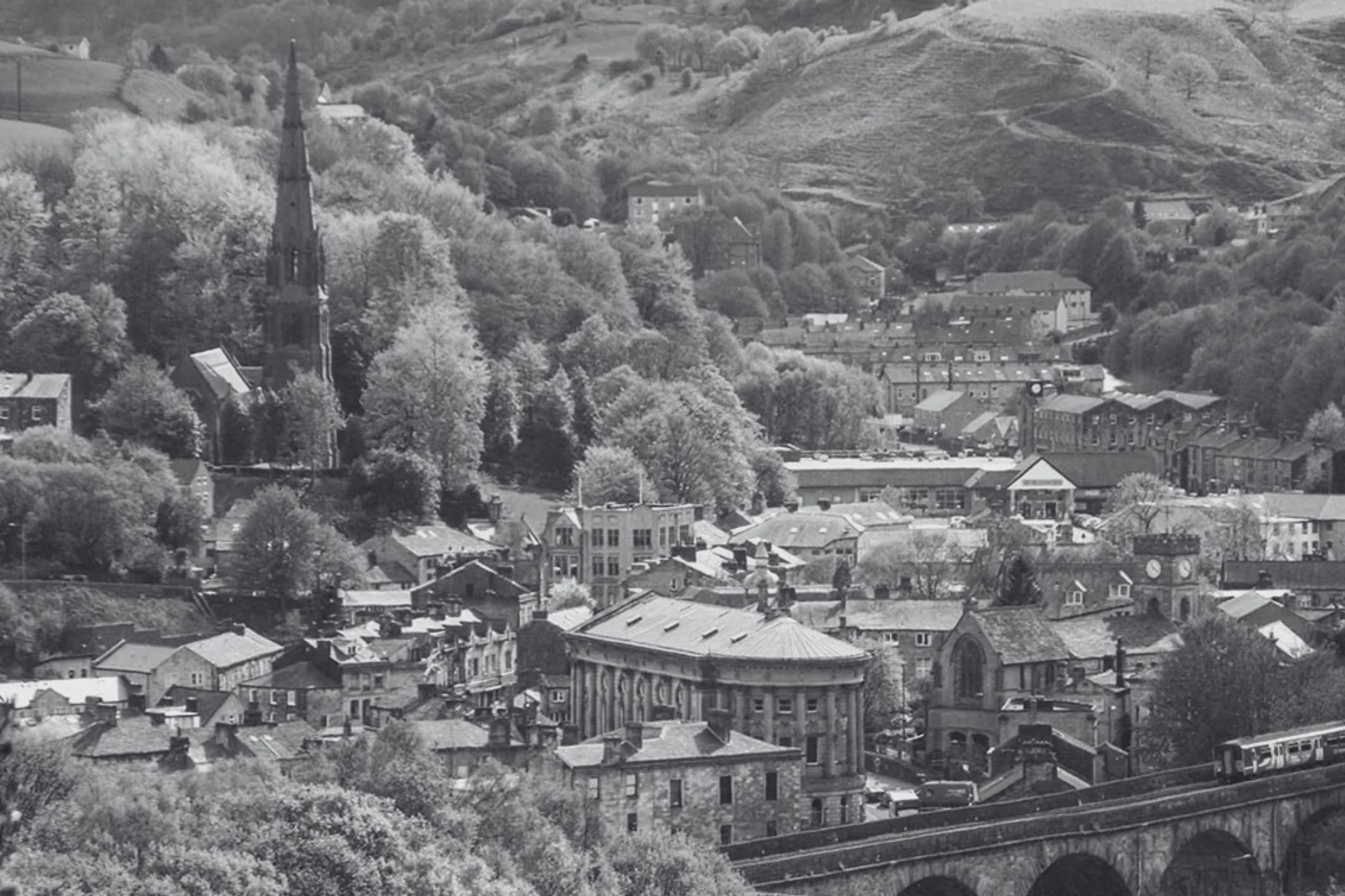
My first experience of Todmorden was in the summer of 1997 when I drove across the Pennines from Harrogate to visit my then girlfriend (now wife). I didn’t see much of the town except a few pubs and a Kwik Save. Hailing from Yorkshire, it seemed familiar in terms of its appearance, but I was struck by the surrounding beauty of the countryside, steep valley sides and viaduct with the phrase “Free the Weed” written in spray paint in huge letters across the top.
I never imagined that this unassuming town would one day become one of the most surprising cultural centres in the country. A place where experimental folk musicians, underground DJs, artists and oddballs of every shade would gather as if drawn by some slow magnetic pull.
Yet that is precisely what happened.
Years later, as my listening habits shifted toward the strange corners of experimental folk, the name Todmorden kept reappearing like a whispered reference. The first clue was excellent Duncan Marquiss album that I ordered after hearing the song ‘Minor History’ on the radio one morning. I raised an eyebrow when I read the record label, Basin Rock, Todmorden.
Months passed and another album, the re-release of ‘Not So Deep As a Well’ by Myriam Gendron revealed the same quiet stamp. This wasn’t a coincidence. This was a pattern. Furter investigation was sought and their catalogue read like a who’s who of modern folk atmospherics and experimental guitar work: Juni Habel, Jim Ghedi, Myriam Gendron, Alex Maas, and even releasing the widely celebrated Andrew Tuttle, Michael Chapman album ‘Another Tide, Another Fish’.
Basin Rock, founded in 2017, seemed to operate with the same ethos as the town itself; modest, unpretentious and rooted in landscape. It became clear that Todmorden wasn’t just a backdrop; it was a collaborator.
The town’s transformation extended far beyond one label. The Golden Lion; revived in 2015, emerged as a cultural engine, pulling artists from all corners into its orbit. William Tyler, who famously declared it one of the greatest pubs on earth, played above the pub long before such things seemed plausible. Jarvis Cocker and David Holmes left their mark. Andrew Weatherall became a regular presence that helped cement the venue’s legend and cool, offering DJ sets that wove cosmic disco into acid house into the kind of hypnotic grooves that feel like they’ve always belonged in the Calder Valley. The pub even formed its own label, Golden Lion Sounds, capturing fragments of this creative electricity and sending them into the world.
Todmorden's cultural landscape cannot be confined to just one venue. The excellent Nan Moor’s, a 50‑capacity bar punches far above its modest size, hosting adventurous folk, electronica and spoken‑word performances. Natural Endings, a funeral home, has been transformed after dark into a sanctuary for ambient and experimental sound, where artists like Gwennifer Raymond have performed. Overlooking the town stands the Todmorden Unitarian Church, a Grade I‑listed building that is a fitting host for drone performances, ritual folk gatherings and festivals that thread esoteric art through architectural history.
Slowly, an ecosystem revealed itself: a network of DIY venues, art installations, community markets, folklore‑heavy happenings and a UFO society. It feels uncanny, but not surprising. Todmorden’s geography, three valleys converging, steep hills forming a kind of natural amphitheatre, lends itself to myth. Stories of witches and strange lights, ghosts on the moors, hover in the air like fog. The town feels suspended between the ordinary and the otherworldly, a place where the unusual is simply another form of local colour.
This is why Todmorden belongs firmly within the Cult Continuum. It isn’t obscure. It isn’t mainstream. It’s a town whose cultural relevance has quietly grown until it became impossible to ignore. It didn’t reinvent itself. It revealed itself and has emerged as a crucible of alternative culture.
Like all entries in the Cult Continuum, it reminds us that some of the most vital creative movements don’t happen under spotlights, they happen in corners, on backroads, in pubs perched between hills, in towns that seem ordinary until one day, they aren’t.
— Matthew McPartlan, 5 May 2026
Work Experience
by Kristian Collins
My son is looking for a placement for his work experience for school, or rather, I'm looking for a placement for my son's work experience at school. He's not sure what he wants to do exactly, "something in engineering or computing." I did have something lined up for him through a colleague at work, but unfortunately, that fell through because the contact had been called to work elsewhere and couldn't accommodate the placement. Understandable.
Every student needs to have a meaningful workplace experience by the time they leave school. 'Meaningful'. For who, exactly? For the majority of students, work experience is a week away from the school environment, providing a chance to converse with adults and prepare them for the world of work, or at least that's what it is supposed to be. But for most, it's a week away from your mates, doing mundane chores (if you're lucky), and being somewhere you're not really wanted. Most businesses and organisations prioritise their day-to-day operations, and thinking of something for the work experience student to do is not high on their list of priorities. Again, entirely understandable.
Insurance and health and safety restrictions usually put an end to a student's aspirations of working in aviation or as an electrical engineer. And for those students interested in working in health, law, or public services, they are usually told 'no' due to privacy issues or simply not being old enough. Many students end up returning to their primary school and becoming a classroom assistant for the week. Meaningful?
In 1989, when I was the same age as my son is now, I had aspirations of becoming an actor after being given encouragement from Mrs Boyle, my Drama teacher. Although I can't remember how I got it, I managed to secure a placement with Bruvvers, a local theatre group based in Newcastle. Their rehearsal studio was based above the Riverside, which was opposite the Tyne Tees TV studios. The venue was a smallish space that attracted many great bands, either just starting out or on their way up the ladder. Nirvana played to a half-empty room on their first UK tour in 1989.
During my week with Bruvvers, I spent most of the time watching them rehearse for their next production. They were a friendly group, reassuring a nervous 15-year-old, and they made time for me. There wasn't a great deal for me to do in all honesty, and I made up my mind that acting was not going to be something I wanted to pursue. On Thursday, one of the group members mentioned that he had two tickets for a concert that night at Newcastle Polytechnic, which he could no longer attend, and offered me the tickets for free. He said they were a band from Manchester and he'd heard good things about them. When I asked what they were called, he replied, "Happy Mondays".
When I got home, I rang around my mates to see if anyone fancied coming. Most said no, but Nicky, from school, said he would come with me. That night was the first time that I saw the Mondays, but they would become the band that I've seen more than any other to this day. Even though I'd never heard of them before that night, they became my band. I was 'in' from that night and went full 'Madchester' soon after, but that's another story.
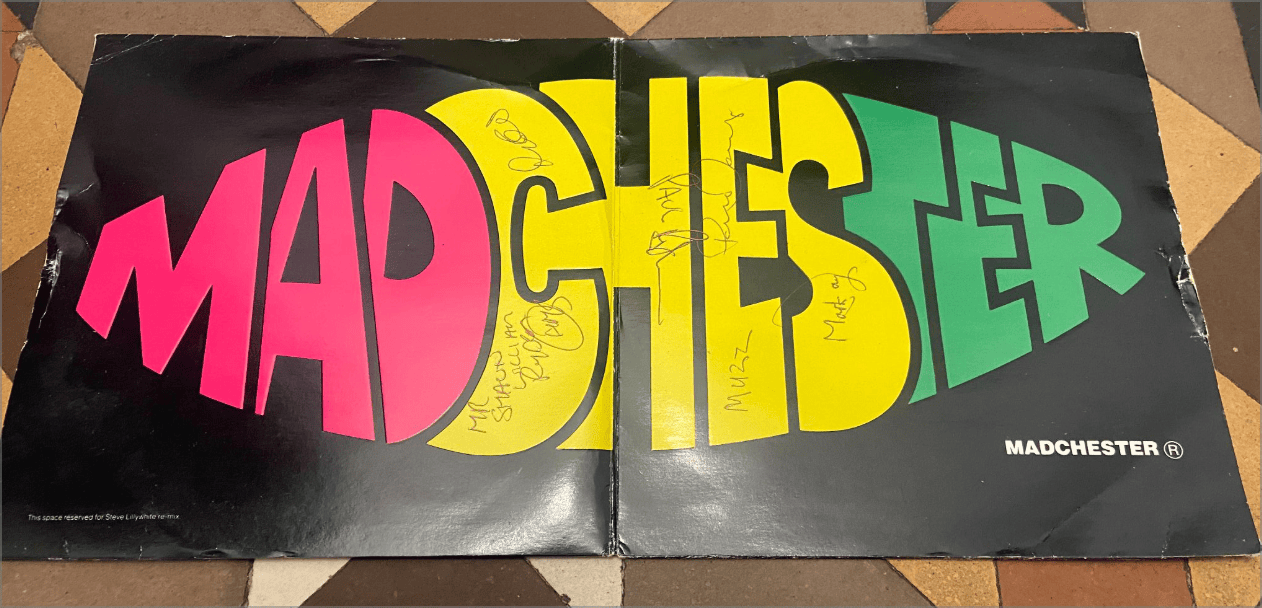
A couple of years after that gig, I ended up swapping a couple of Japanese-imported Erasure records for a signed copy of the Madchester Rave On EP with my mate Neil, who was at the same gig as me. The Mondays opened a window at the Poly and let him in. He met the band and got the record signed. So my work experience was memorable for that night and for the kind offer of a Bruvver. Meaningful? Absolutely.
—
Kristian Collins has recently begun a series of intensive field trials to determine if "meaningful work experience" can be condensed into a single, high-frequency drum fill. He operates on the theory that a 15-year-old’s career path is determined by the specific social gravity of a Newcastle theatre group and the sudden, unasked-for gift of two tickets to the future. Kristian spends his afternoons in a state of quiet, non-chronological research, convinced that if he stares at a gorse-covered bank long enough, he will see a rubber version of himself falling from a 1989 window in slow motion. Call the cops.
The Gen Alpha Lexicography
by Maya Chen
21: 'Aura'
Etymology: From the Greek aura (breeze, breath), via the Latin for a distinctive atmosphere emanating from a person or place. Historically deployed by mystics, migraine sufferers and people who own too many crystals. Now repurposed by children as a quantifiable social credit score with no official exchange rate.
My son informed me last Tuesday that I have "zero aura." He said this while eating cereal I had purchased, at a table I had assembled, in a house I pay for. He said it with the gentle pity of a doctor delivering a terminal diagnosis to someone who has already, on some level, accepted their fate.
I asked what aura was. He put his spoon down. This was clearly going to require patience on his part.
"It's like... your energy, Mum. Your vibe. Whether people want to be around you or not."
"So it's charisma," I said. "You've reinvented charisma."
"No." He looked at me the way one might look at a dog that has walked into a glass door for the second time. "Charisma is something old people had. Aura is different. You can gain it and lose it. It goes up and down."
"Like a stock price."
"Like a stock price, yeah. But for your soul."
I have since conducted what I can only describe as field research, though "field" implies a controlled environment and "research" implies I understood any of what I found. Aura, as practised by my children and their associates, operates as a fluctuating social currency with the following characteristics: it can be accumulated through acts of perceived coolness, depleted through acts of perceived embarrassment, transferred between individuals through proximity, and destroyed entirely by a single parental intervention at the school gate.
The etymology is instructive. The classical aura was something you possessed innately, a quality of being that radiated outward without effort. The Gen Alpha aura is a performance metric. It is tracked, discussed, awarded and revoked by committee. My daughter tells me that someone in her year "lost all their aura" by wearing the wrong trainers to a non-uniform day. The wrong trainers. The child in question has presumably not changed as a human being. Their kindness, their intelligence, their capacity for friendship remain identical. But the trainers were wrong, and so the aura is gone, and the committee has spoken.
This is, of course, nothing new. Every generation has had its invisible social scoring system. Playground hierarchies have always operated on arbitrary and ruthless metrics. What is new is the vocabulary. Previous generations conducted their social brutality in silence, or at least in whispers. Gen Alpha has given the system a name, a unit of measurement and an open ledger. The cruelty is the same. The transparency is unprecedented.
My son has "high aura," apparently. He told me this with the studied nonchalance of someone who is very aware that announcing your own high aura is technically an aura-depleting act, but who has calculated that the risk is acceptable when the only witness is a woman with a confirmed aura deficit. I asked him what specifically gives him high aura. He listed several things, none of which I am permitted to repeat here because doing so would, and I quote, "drain his aura by association."
I am, it seems, an aura black hole. A walking negative field. My presence at any social gathering of under-fourteens causes aura to evaporate from the room like moisture from a warm window. I have accepted this. I have accepted that my two degrees, my career, my ability to keep two children alive for over a decade, and my reasonably competent navigation of adult life count for nothing against the fact that I once waved at my daughter from across a car park.
The broader observation writes itself, and I am almost too tired to make it. We have raised a generation that has taken the ineffable, unmeasurable quality of human presence and turned it into a spreadsheet. The soul has been replaced by a points system. The inner life has been externalised, quantified and made subject to peer review. And the most devastating thing about it is that it works. My son is kinder to his friends when his aura is high. My daughter is more cautious when hers is low. The system produces results. It is effective. It is also, when you step back far enough to see it clearly, the saddest thing I have encountered in twenty entries of this column.
I asked my son, just once, whether he thought aura was real. Whether it measured anything that actually existed.
He thought about it for longer than I expected. "No," he said eventually. "But that's sort of the point."
I wrote that down. I'm still not sure what to do with it.
Next time: 'Lore' - The mythology your children are building about you without your knowledge or consent.
—
Maya Chen has spent the past fortnight attempting to rebuild her aura through what her children have termed "a deeply embarrassing pivot to relevance." Her strategies have included purchasing trainers recommended by an online personality she cannot name without feeling physically ill, learning a dance that involves moving only her shoulders, and describing her morning coffee as "giving main character energy." Her daughter has responded by reducing Maya's household aura allowance to a negative integer, a mathematical concept Maya is fairly certain was not covered in the original aura framework. Her son, meanwhile, has begun referring to her research notes as "the museum," which she suspects is not a compliment but has chosen to interpret as one. She has requested a formal aura audit from an independent third party but has been informed that no such mechanism exists, and that the very act of requesting one has cost her what little remained.
Record Shops & Nights Out
by Michael Stoddart
1984. A signature is added to the bottom of a cheque, which joins another cheque in a DL envelope to be posted to the celebrated Psycho Records shop of Brighton, specialists in second hand and deletions. Their most recent catalogue, a wobbly triumph of determined manual typing, is temptingly peppered with deleted albums from the 1960s. Two young men wonder at what point in the future – weeks, months, eventually? - their booty will arrive and they can wallow in rapture as they finally hear records of only the most patchy availability. Thank goodness for Psycho, who seemed to have them in suspicious abundance. Tim Buckley, The Thirteenth Floor Elevators, the Seeds, entire battalions of then-obscure musicians waiting to be called up to the sunshine of algorithmic ubiquity. And by Jove, it was always worth the wait – a bit of a faff, but where there’s no cost, we reasoned, there’s no value. And I’ve still got them all, even though Blue Afternoon sounds a bit wafty nowadays...
And the writing didn’t stop at the cheque. After the signature in the bottom corner, the ink kept flowing, unseen, writing truths and fictions and fantasias wherever it could find a space, soundlessly purring away in the background until it had gathered enough material to cast us as characters in a novel, written in the dust and cover scuffs of a second hand Lovin’ Spoonful LP.
While Psycho Records of Brighton remained a dominant if eventually sidelined figure in chapter one, the novel kept writing other places for us to go to. It stuffed Liverpool to the gunwales with record shops, rewarding football atheists with a more secular weekend observance. One all-areas off-peak bus ticket and the world was yours. Well, some little bits of its occasionally drab suburbs, but they weren’t quite sure what you were looking for. Some nice sixties stuff? The Byrds, maybe, in a backstreet in town, or a bizarre Belgian Europop outfit in Old Swan? Or maybe neither of these, because here’s Scott Walker sings Jacques Brel for two quid in Skeleton Records over the water, with a Hammersmith Gorillas single thrown in for 50p! (There’s chapter two written in half an hour, for fifty bob!)
In chapter three the Lovin’ Spoonful album got even more colourful, with every record shopping trip becoming a potential fairground ride! Well, as long as you didn’t mind having to go on the teacups now and again. In chapter three we imagine what other delights we may have missed while we pursued our current obsession. As we ground into middle age and our tastes took ever-meandering detours, the unfolding novel turned the dusty second-hand record shops of our youth into palatial sporting houses of unrequited plastic lust, whose imagined menus of pop-cultural kinkiness would have bypassed the more earthly appetites of the impecunious Liverpudlian youth. Good job the ‘Spoonful album had a gatefold cover! Yes, of course the place in Old Swan would have had the entire 1923 Gennett recordings of King Oliver’s Creole Jazz Band in that neglected box of 78s. And for sure Edwards’ Records at the top of London Road would have had the entire ESP-disk’ catalogue misfiled around the Bert Kaempfert/Trad Jazz section. Pound a pop, or nearest cash offer. Oh, how we wish we could go back to those pre-fetish days, armed with the cabalistic knowledge and furtive experience we’d gathered in the meantime. But then again, if we did have a time machine, we might just find that they were full of Boney M albums…
Needless to say, there’s a tepid chapter towards the end, that we can write ourselves, where we can allow ourselves to grow older even if we don’t grow up much. Where we can watch our children become fine young people, and where we can observe that there were eight ages, not seven, your man having forgotten the one where they fillet their parents’ record collection, while giving them the soundtrack LP to Kes for Christmas. A fair swap! And the final chapter – so far – is of course the one where they discover their own shops and music and labels and scenes, and another novel starts to write itself on a lyric sheet in an album sleeve….
Any Other City
by Fiona Bird
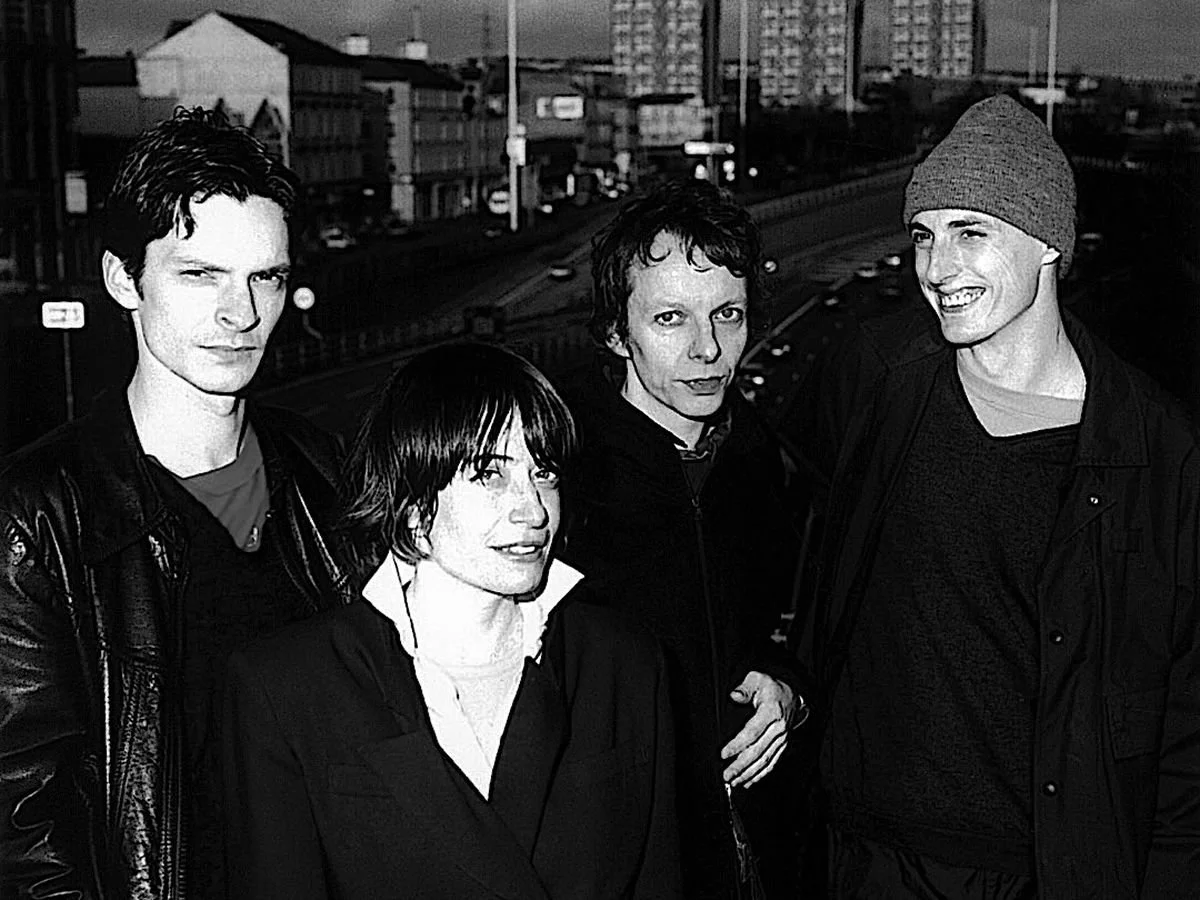
Life Without Buildings made one album, played some shows, stopped. This is either the purest thing a band has ever done or the most infuriating. I've been arguing with myself about which for twenty-five years and I'm no closer to a verdict.
The music industry in 2001 had a very specific set of instructions for a band like this. You release the album. You tour. You build. You make another one, slightly more polished, slightly more accessible, and you let the machinery do what machinery does. Life Without Buildings looked at the machinery, said nothing, and walked away. They didn't burn out or sell out or fade out. They just stopped, the way you stop reading a book when you reach the last page, as though there was never any other option.
Nobody talks about this. Nobody talks about the fact that an album this good was allowed to simply exist and then vanish, because the economics of independent music have always treated brilliance as optional. The label folds or the distributor goes under or the press moves on to the next thing with a better press photo, and the work just sits there, gathering dust in the stockrooms of shops that are now coffee chains. The system was not designed to sustain a band that made one perfect thing and had the decency to leave it alone.
Glasgow in the late nineties was full of bands doing interesting things badly, which is infinitely preferable to bands doing boring things well. Art students playing music. No polishing, no professionalisation, no visible attempt to become successful. This city produces a specific type of bloody-minded creativity that doesn't care whether you're listening. Life Without Buildings were the purest expression of that impulse. Four people in a room, working out what they were doing in real time, and the album sounds exactly like that. You can hear the moments where things nearly fall apart. You can hear that room.
Sue Tompkins is either a genius or accidentally brilliant, and I've never been entirely sure which. Her vocal style shouldn't work. It's untrained, unmelodic, occasionally grating. She talks more than she sings, repeats words until they become nonsense, stumbles over phrases like someone who's just remembered English is her second language. Most vocalists signal how you should feel: this is the sad bit, here's where you're meant to be moved. Tompkins simply reports. She channels fragments of conversation, advertising slogans, geographical locations, passing thoughts. The random accumulation of nouns and observations that makes up a modern consciousness.
My theory, worth precisely nothing, is that Tompkins understood something about attention spans before social media made it obvious. We don't think in verses and choruses. We think in fragments, interruptions, sudden pivots. Any Other City sounds like how the brain actually works when you're not forcing it into shapes.
And yet. And yet.
The album I keep coming back to is not the album I've just described. The album I keep coming back to is the one that plays "Sorrow" at me when my defences are down and rearranges something I thought was settled. "Sorrow" is slower than the rest, less frantic, and Tompkins sounds like she's reading something she found in a drawer and half-wishes she hadn't. No conventional chorus. No resolution. Just this circling, slightly hypnotic drift with guitars that sound like they're trying to remember what comes next. It's a song about sadness that refuses to be sad in any conventional way. Tompkins won't give you catharsis or comfort. She just observes, remarks, moves on.
She's captured something most songwriters either overplay or avoid entirely: the low-level melancholy of just existing, of being slightly out of step with the world and not quite minding. I've listened to it in cars, on night buses, walking through cities I don't live in. It works everywhere because it isn't about anywhere.
Most albums from 2001 sound like 2001. This one doesn't. The lo-fi production that seemed scrappy then now feels like the only honest approach left. The fractured song structures that confused reviewers now sound completely natural. And Tompkins' vocals, which divided opinion so sharply at the time, have aged into something like prescience. We live in an era of constant fragmentation, endless scroll, perpetual distraction. Any Other City was already there, turning discontinuity into structure, making coherence from chaos, before any of us knew that was what we'd need.
It disappears for months, sometimes years, and then resurfaces with the precision of something that knows exactly when I've stopped paying proper attention to things. I've loved it for longer than I care to admit, which means I've also resented it, ignored it, and returned to it with the sheepishness of someone who briefly thought they'd outgrown something essential. You don't outgrow Any Other City. You just forget it exists until it reminds you otherwise.
One album. Some shows. Then silence. Twenty-five years later, the silence is the loudest thing about them.
—
Fiona Bird has spent the past three weeks cataloguing every album recorded in Glasgow between 1997 and 2003 that sold fewer copies than there were people in the room when it was made, a project she describes as ‘the saddest spreadsheet in Britain.’ She recently submitted a planning application to Margate Council to have her spare bedroom reclassified as a ‘site of cultural preservation.’ The application was rejected. She has resubmitted it with footnotes.