
Science & Magic | 33
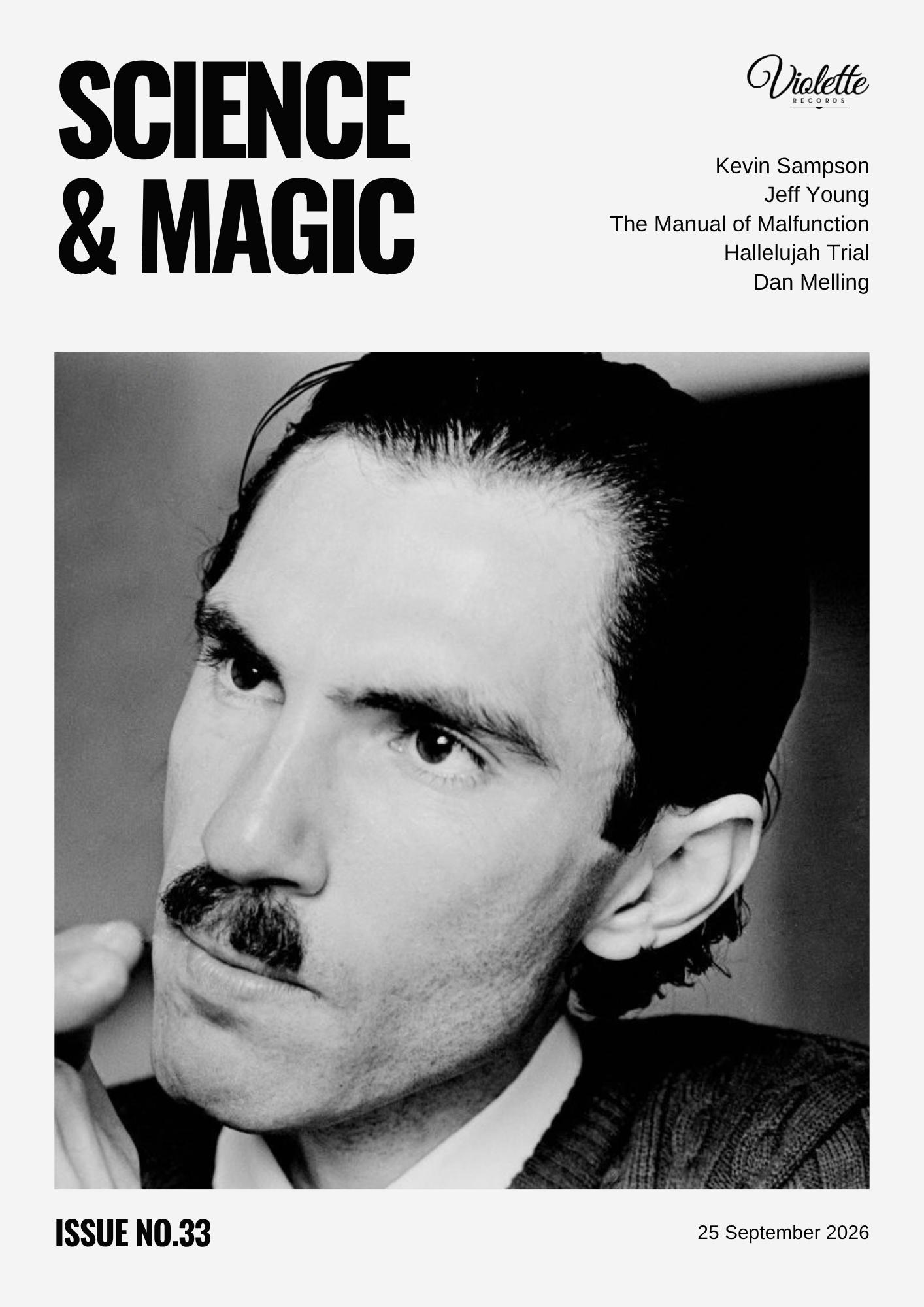
It Wasn’t My Decision
I’ve spent thirty years in construction and when somebody says “it wasn’t my decision” a small light comes on at the back of my head and it’s rarely wrong.
So on 5 September (my birthday, folks), some fella called Macklemore was opening for Ed Sheeran at MetLife Stadium in the States. He said “Free Palestine” from the stage and played a song called ‘Hind’s Hall’, named after Hind Rajab, a six-year-old killed in Gaza. Nine days later he was off the tour. The promoter said the venues wouldn’t stage a show with him on the bill. Macklemore says the man behind that was Robert Kraft, who owns Gillette Stadium and who, by Macklemore’s account, rang round all the other stadium owners until they’d agreed an ultimatum. So on 15 September Sheeran posted that “Macklemore coming off tour was the promoter’s decision, it was not mine”, and said he’d spent the week talking to the venues trying to build a bridge. Within hours the other support acts Finneas, Aaron Rowe, Beoga and Lukas Graham (No, me neither) had all walked. All five support acts gone in about thirty-six hours.
I’m not going to argue the politics, because I’d be no use if I tried. Whatever else anybody believes, innocent children are being killed in Gaza.
What I can’t get past is the sheer headcount involved here. A tour that size carries more advisers than a mid-sized town council with promoters, agents, tour manager, venue liaison, label, management. Somewhere in that lot there will be a person paid to picture the worst headline and work backwards from it. Every one of them was on the email chain but it seems that not one of them said out loud that dropping an artist over two words, then pinning it on the promoter, might go down badly.
I run a small label (small being the operative word here). If somebody said something from a Violette stage that caused trouble, the crisis meeting would be three of us in a pub. It’d be settled by the second pint and I’d be the one who had to stand up and say what we were doing. You’d expect a much bigger operation to make a slightly better call than that. What it seems to have bought instead is more people to blame.
I don’t know what I’d have done with a crazy stadium owner on one line and an irate promoter on the other. I do know that one act was thrown off and four more chose to leave. The only person on that bill who insists he decided nothing is the one whose name is on the tickets. And Gaza isn’t a jot better for any of all of this.
Everything in this issue was written by somebody who put their name on it. That’s a low bar although not a universal one.
Read on for plum-coloured jeans with a V stitched across the knees by a novelist’s mum and tins of magnolia falling out of the sky. There’s a pub that changes its name on the third Tuesday of every second month and a pair of Birmingham dressmakers whose punks only came out at night. Somebody’s also written the instructions for handing every decision to the satnav so that wherever you end up it wasn’t your decision. And the front of the new Violette record owes everything to a man who drew a rose in the sixteenth century because he needed to remember what one looked like.
Matt
i
Ten Questions
Kevin Sampson started out writing for Peter Hooton’s fanzine The End in the early eighties. In 1990 he helped set up Produce Records and within the year it had put out The Farm’s ‘Groovy Train’ and ‘All Together Now’. Awaydays was his first novel in 1998 and became a film in 2009. Powder came out in 1999 and follows a band through the music business. In 2022 he wrote Anne for ITV. It tells the story of Anne Williams and her long fight over the inquest into her son Kevin’s death at Hillsborough.
Kevin lives in Birkenhead. We asked him to take ten questions from our archive. He apologised for taking a while and then sent two thousand words that open in the sand dunes at Morfa Conwy in April 1973 with Bowie on a Bush radio.

What song is permanently fused to a specific place or holiday - to the point where hearing it transports you instantly?
I’m quite susceptible to nostalgia at the moment – not just the ‘remember this?’ ‘remember that’ ‘remember Aztec Bars?’ type of remembrance, but more and more there’s this unannounced, overwhelming, visceral sucker-punch of sadness… a hungering for things long gone, things that will never come back, that can be triggered by a scent or a sight or a song. Bowie’s ‘Drive In Saturday’ is one of those songs. I first heard it in the Easter Holidays, on our battered Bush radio (aka ‘the wireless’) that had channels like Hilversum and Luxemburg etched onto a glass frequency chart. We had a caravan in between Conwy and Penmaenmawr and I used to take the wireless into the sand dunes and just sit there listening to whatever was on Radio One – from Kenny and David Cassidy to T-Rex, Roxy Music and Alice Cooper. At that age I had no notion of musical tribes and what was cool – pop was pop. I didn’t care. I would never turn the radio down, not even when Cliff Richard’s ‘Power To All Our Friends’ came on. But, sitting there one dull day in April 1973, I heard ‘Drive In Saturday’ for the first time and it sent me to a different place. I had never heard anything like it. The leaden sky, the silver-grey sea, the fading light all seemed to add to the otherness of the song. I had no idea what it was about. His name was always Buddy and he, like me, was out there somewhere, gazing to the shore (though I heard it that Buddy did his wave-watching “with snotty head.”) It’s lasted forever, that. Some songs, the magic fades – but whenever I hear ‘Drive In Saturday’ I’m back in the sand dunes at Morfa Conwy, staring out to sea, intuitively aware that there’s something bigger out there. And it feels both wondrous and crushingly sad.
What song instantly takes you back to your school disco?
The run-up to my first school disco was inhabited by a mounting anxiety over what to wear. I was in love with Heather Owen and I was going to dance with her – but I kept changing my mind over what winning combination of shoes, kecks and shirt would win her heart. I was too little for Loons – they just didn’t make them that small – but my Mum was able to saddle-stitch a convincing enough V across the knees of a pair of plum-coloured jeans she’d managed to get in my size. So, Shazzam! I had split-knee jeans! Paired with a purple shirt (penny-round collar) and tank top, there was no way Heather Owen wasn’t falling immediately and forever in love. And she did – just not with me. When ‘Cindy Incidentally’ by The Faces came on, Peter Lowe from the year above jumped onto the little stage, mimed every word and performed every nuance of Rod Stewart’s theatrics, right through to lying down on the stage, wrestling with an imaginary microphone and writhing like he’d had an electric shock. All the girls were spellbound – including Heather – so that was that. I hate ‘Cindy Incidentally’.
What Top of the Pops performance changed you?
Sparks, ‘This Town Ain’t Big Enough For Both Of Us’. This came at a time when the likes of Mud, Paper Lace, The Rubettes, The Wombles, The Osmonds etc were regularly in the charts and on the telly. But we also had Mott The Hoople and Roxy Music and Cockney Rebel coming up on the inside. Up to a point, up to that time, I was pretty much still happy enough listening to The Bay City Rollers as, say, Golden Earring. But the sound and the spectacle of the Mael brothers on Top Of The Pops transfixed me – it was one of those mesmerising appearances where you dare not blink in case you miss something. On some level I think that performance guided me towards a different kind of music, a different appreciation. In short, Sparks helped me find my tribe that night.
What music did your parents play that you initially rejected but later embraced?
My Dad loved jazz – I remember Billy Eckstine and Oscar Peterson being favourites of his, but I could not then and still cannot get into jazz at all. My Mum was into crooners: Sinatra, naturally, but also Perry Como, Tony Bennett, Jack Jones and Andy Williams. One or other of them was always on, and I absorbed it all but never really felt it. It all seemed routine and a little formulaic – the long, drawn-out crescendos, the performative emotion. Then – this is weird, because we had gone to Buxton in the snow to see Echo & The Bunnymen and let’s just say The Bunnymen and Andy Williams are not the most obvious kissing cousins. But ‘Solitaire’ came on the pub jukebox, and it was just heartbreaking. Situation matters with these things and there was something about the setting, my time of life, the unavoidable onset of grown-upness… but the confluence of where we were, Andy Williams’ mournful voice and those desperately lonely lyrics went deep. I started playing Mum’s LPs after that and, slowly, inevitably, Andy Williams became ‘my’ singer – not even a guilty secret but someone I’d regularly reference, boast about and thrust upon newcomers. And an all-time life highlight came when I took Mum for lobster thermidor followed by Andy Williams at The Bridgewater Hall. Wonderful.
Which band from Liverpool deserved to be huge but wasn’t?
Pale Fountains. There’s still time for ‘Bicycle Thieves’ to elevate a moody French film.
What’s the most beautiful piece of music you’ve ever heard live?
Take my hand and trust me on this one; it’s Sigur Ros playing ‘Hoppipolla’ at The Liverpool Philharmonic Hall, late 2005. Now, ‘Hoppipolla’ is one of the most familiar, bloated, overused, saccharine-sweet pieces of neo-classical/glacial gothic soundbites of our times. But just indulge me a sec – imagine you’d never heard the track before. Imagine it hadn’t been used in every winter-turns-to-spring documentary where chutes burst heroically through the snow-cap in time-lapsed glory, flowering against the elements. Imagine ‘Hoppipolla’ was all sparkling brand new, and Sigur Ros were still this weird, underground, faerie-speaking gang of malcontents. Hearing them and it live, only weeks after the track had been released, in a show full of drama and tenderness was transcendental. This was the Philharmonic – they put on shows and concerts rather than gigs. Everyone sits. But 20 years ago, Sigur Ros embraced the formality and gave us a light show, lots of spectral red and violet; they brought in a volcanic sound system. They put on an almighty show, and everyone was leaning forward, hypnotised. Everyone felt something. At the end there was one of those shock and awe pauses. Silence. Then rhapsodic, passionate applause. It was immense. They stay with you, those moments.
What’s the strangest or most unlikely place you’ve ever been moved by music?
My brother had just been diagnosed with a very serious illness. We went to the Lake District for a bit of walking and talking and fresh air. On the Friday night, there was a little bar with a late licence and a band playing cover versions – well that’ll be nice we thought, so we got there early and nabbed a table close to where we imagined the stage would be. We guessed right. The band, a duo, materialised with pints in hand and a few more stacked up behind their gear, right next to where we were sitting. They had a slightly ironic, ‘we’re better than this but, you know, bills to pay and what have you…’ attitude. They told each other jokes and made pert remarks between songs – jokes and remarks that tended to exclude the audience. But not to worry, the audience was determined to have a good time, no matter what. There were couples out on a date night, groups of women all dancing together, serious walkers letting off steam, an elderly chap who might conceivably have been into astrology… everybody was dancing to everything, which was great, as there was no real pattern to the song selection. They’d play ‘The Tide Is High’ followed by ‘Let Me Entertain You’. ‘Dancing In The Moonlight’ followed by ‘Bad Habits’. And then came the piledriver… I had just returned from the bar, plonked the drinks down and slumped into my seat when the intro to ‘The Boys of Summer’ started up. I’m not aware of this song having made any kind of impression on me, or my brother, in any way, good or bad, ever. It’s one of those songs that has just always been out there, oscillating in some parallel MOR universe, neither offensively irritating nor spiritually uplifting. This meant nothing to me – until that moment in a little bar in The Lake District. As mentioned earlier, we were lucky enough to have blissful school holidays in a caravan by the beach near Conwy in Wales. They were fabulous, fantasy times: turning rocks over to look for crabs. Finding a starfish one day and a massive cache of bullets at a decommissioned rifle range, the next. Jumping into the sea off a huge, over-inflated tractor’s inner-tube. Daring each other to go further and further into The No Entry Cave: no entry, because the dark passageway led directly onto the London to Holyhead train track. Eating salmon paste butties with salt and vinegar crisps crammed inside. Collecting all the empty pop bottles off the dunes at the end of the day, washing the sand off them at the stand-up pipe by the beach path, taking them back to Ramicone’s mini-market and getting money back on the bottles. Spending the windfall on Beechnut chewing gum. Nearly getting cut off by a tide that came in fast, from all sides. Madly fancying Jayne with a Y from Littleover in Derbyshire, even though she was much older, or seemed older in her green bikini and was way out of our league… all of these fragments of memories flashed in and out of my mind, one after another after another, as the cover version band played ‘The Boys of Summer’. And I wept. I broke down completely, covered my face and tried to stifle this shuddering, passionate sobbing. My shoulders were heaving and people started to look round. I tried to smile back at them, tears streaming down my face – “it’s okay.” But then I saw my brother’s shoulders were racked with sobs, too. Neither of us looked at each other. I gave his arm a squeeze. No words necessary – now that the boys of summer are gone.
What was the first song you ever learned to play on an instrument (even badly)?
‘Michelle’ – which we all thought was called ‘Michelle Mabel’ – on the descant recorder. Fast times at Thingwall Primary (also the scene of the Heather Owen/Peter Lowe tragedy.)
What album cover has had the most profound impact on you - either as art in its own right or as a gateway to the music within?
Well, speaking of gateways to a new world, with this one I’d only recently been opened up to the majesty and mystique of reggae. Having graduated from the early evening matinees at Eric’s to the main event, ‘King Tubby Meets Rockers Uptown’ was a favourite of DJ Norman Killon - its wild dub reverberations sent my dizzy head spinning. Then, a combination of John Peel and The Clash led me to Toots & The Maytals (arguably interesting footnote, Toots is credited with being the first artiste to popularise the term ‘reggae’ in his song ‘Do The Reggay’. But, like many facts, that might not be true.) I stumbled upon the Funky Kingston LP (as well as many other strangely eclectic records,) from Woolworths of all places. They had a whole section where the top left corner of the album sleeve had been snipped off – presumably to warn you it was ‘remaindered’ stock – which you could get for 99p. I was thrilled to spot Funky Kingston for 99p. There was something immediately seductive about the sky-blue artwork, with a sun-drenched sketch of Toots Hibbert himself sat proudly with his pals in the shanty town. But it was inside the record that you found the golden key: a glossy, multicolour inner sleeve, bedecked with four rows of four stamp-sized album covers – 16 LPs that you could order directly via Island Records. We wouldn’t have realised at the time, but this was a hugely effective, very analogue, pioneering venture into direct marketing… and I lapped it up, ordering albums by Ijahman, Third World, Jimmy Cliff and so on that might’ve been tricky to locate in Dins Discs on the Oblong of Dreams.
What’s a single line from a song that has stuck with you like a mantra or piece of life-changing advice?
Step lightly. Stay free.
ii
Magnetic North · Thirty-Three
Lucid Dreamer

On the first night I lived in this house I watched tins of magnolia paint falling from the sky. It was one of the most beautiful things I’ve ever seen, and I don’t know if it really happened, whether I really witnessed a sky full of falling Dulux paint or whether I dreamed it. Either way, I remember it clearly.
And every day in the two years I lived here, through my window I would watch an overcoated man climb over a fence trailing clouds of cigarette smoke, always climbing over it even though he could have walked through the gate. I called him Jack the Fence-Climber and I don’t know if he really existed. On one occasion he was with a woman, and he climbed over the fence then turned and opened the gate for her in a gentlemanly manner. And for a split second I imagined him as a spectral marionette, and the smoke was his splintered wooden body burning beneath his overcoat.
And when a blind dog lived with me for a while I would take it for walks, and I’d describe to him the things he couldn’t see: This is the house where Cavafy lived; This is where they filmed ‘Gumshoe’; This is where Jimmy Campbell lived; This is where they built a bonfire for the film ‘The Magic Toyshop’ and I remember the flames lighting up the night; This is where Dutch Eddie’s used to be; This is where Lord Woodbine lives...And the dog, blind to all of this, would look up at me through his milky eyes and nod.
I sometimes think the city dreams itself, dreams the things we see, a city in a half-sleep of visions and hallucinations. And the insomniacs and nervous wrecks and drug addicts and magicians and marionettes that walk the city streets at 5am are walking through poems and songs, through stories and paintings, through the cinematography of the city’s wild imagination.
The old woman laying flowers on the donkey’s grave is being dreamed by the city...
The man who dances down our street singing ‘That Old Black Magic’ like Sinatra in an anorak is being dreamed by the city...
The man who walks through the ruins of a church with angels in his hands...
The woman pushing a pram full of dogs through Williamson Square is being dreamed by the city...
The old men sailing their wooden boats on Sefton Park Lake are being dreamed by the city...
And somewhere, perhaps, paint is falling from heaven like a beautiful impossibility, into the dreams of troubled sleepers, night’s hallucinatory cinema projected on the eyelids of madmen, and the city is a lucid dreamer of wooden boats and Sinatra songs, of church ruins and angels.
Look! The tins of paint are falling from the sky...
— Jeff Young, 23 September 2026
—
Jeff Young’s fairly sure that the darkest corners of his mind are among the things the city dreams between the last bus and the first bin lorry. He sleeps with the curtains open so that it can see what it’s doing. He keeps an unopened tin of magnolia by the back door in case one comes down in the night that needs company. His left hand has taken to waving at fences. He suspects the city dreamed up a blind dog so that somebody would finally describe it properly. On the walk home, he still reads the street names aloud in case it’s listening.
New from Jeff Young
Latchkey
Jeff’s novella goes back to 1980s Liverpool and a squat shared by two would-be poets. The narrator’s girlfriend has just walked out on him. Sacred Parasite call it an account of Jeff’s former life as ‘a hapless and yet lyrical delinquent’ and anyone who reads Magnetic North will know the man they mean. It’s an 86-page hardback in a hand-numbered edition of 350 copies at €16. Publication is 29 September and pre-orders ship before then.
iii
The Paphides Principle
The Small Heath Book of the Dead
on Matthew Edwards
Pete Paphides believes that behind every band who got out of Birmingham there was a dressmaker and a DJ whose names nobody wrote down. This week he brings us a song that finally writes a few of them down. It’s the title track of Matthew Edwards’ new album.
If Birmingham punks were different from the rest, much of that was down to Jane Kahn and Patti Bell, couturiers to all the art school punks who emerged in the late 70s. Like me, Matthew Edwards was too young to properly join in. Sightings of these elusive dandies were rare. Like turtles that emerge onto the beach by the light of a full moon in order to lay their eggs, the future ranks of Duran Duran, Swell Maps, TV Eye, The Subterranean Hawks and The Bible Belt much preferred to come out at night, congregating at clubs like The Rum Runner and Barbarella’s in their Kahn and Bell threads.
In this perfumed synaesthesia of glam and punk, there was no year zero. In the Midlands, these were genres that seem to coexist and blur into each other – and well into the 80s, you might find alumni of the scene who never quite made it to Big London sitting among the violet rinsed ladies who sipped from bone china cups in the tea rooms at Rackhams department store. Somehow it felt like this was what Andy Warhol might have done if he had grown up in Kingstanding.
All of which is germane to the beautiful new album by Matthew Edwards – comprising nine songs which benefit from a focus that comes with the awareness that this might be your parting shot. Diagnosed with long Covid in 2021, Edwards’ illness prompted a biopsy that yielded a diagnosis of interstitial lung disease (ILD). At some point, ILD turns into pulmonary fibrosis, a condition that comes with a life expectancy of between two and three years. Now resident in San Francisco, Edwards retreated into a bittersweet reverie. The Birmingham of his teens was a multicultural free-for-all of Bangladeshi caffs, pubs where Irish music streamed out of the windows and, yes, the tail-end of the punk scene to which his new album’s title track – ‘The Small Heath Book of the Dead’ – is a love letter.
In 2026, the world has all but forgotten Jane Kahn and Patti Bell. Ditto Mike, the DJ at Barbarella’s who introduced Edwards the teenage ingenue to Pharoah Sanders, and Lumber, who Edwards describes as “a sweet punk with a death wish who jumped off the spiral stairs in the Bull Ring [shopping centre]”. However, they all get a mention here. As for Edwards, well he was just about there too, rattling the flaps of the circus tent, looking for an in. “With my snug room repertory/The flaming creatures and me/From the jester the jug and the ‘gale/ Sequins, poppers, and ale/There something sweet as the viaduct baby/And now I know what it is.” This sense of cutting loose from what the adult world has in store for you is given full release on the chorus by Katie Chan’s saxophone interjections, which blow the soundscape wide open in a manner reminiscent of Anthony Thistlethwaite’s contributions on early Waterboys records.
— Pete Paphides, 24 September 2026
iv
The Dead Mixer
a chapter from All Our Love
I arrived at the pub round the corner from St Olav’s that was variously known as the Apothecary, the Lembic, the Beezer, the Cinnabar, the Auld Slag, or, on the third Tuesday of every second month, the Dead Mixer. The street was quiet and the premises dark at every window. I stood under the nearest working lamppost to examine the flyer that had appeared in my pocket and saw, watermarked through the paper, the words ask for max. I walked down the sticky steps and raised my hand to tap feebly at the door when it swung open. I was pulled forward by the lapels of my overcoat by a bald woman in a leather coat and dark glasses who pushed me through double doors into the subterranean saloon bar.
A lock-in at The Dead Mixer, as I learned later, was an event of profound seriousness, requiring an irreversible commitment to intoxication, a sedentary, laboured descent into mental dissolution and physical incapacity, a going nowhere that was a journey out of and beyond time. There was no pretence that this experience would be what might conventionally be called having a good time.
When Max the bar rang the last bell for ‘old time’ a chill of fear ran through those previously inattentive punters who had not quite realized the lateness of the hour. If they delayed, they might be imprisoned in new time for as long as it would last, with all volition lost in the face of sufferings unimaginable. The situation was serious enough that some would depart without finishing their drinks, leaving hats, coats, books and, not infrequently, footwear. They would climb the stairs into the broad strokes of the charcoal night and cry for joy, hugging friends, should they have any, or strangers, should they not.
On the blue steel door, Max would draw the top lock, the bottom lock, turn the central deadlock and, from behind the bar, would pull a lever that achieved some final securing of the portal to the outside world, that made the whole room shudder. Max would take down a bottle of purple absinthe and line up a row of thimble-sized tumblers, for those topers who had long lost any hesitancy about their will to be lost. In the wormwood murk at the bottom of the bottle rested a gem-ringed finger, which accounted, so legend had it, for the spirit’s colour shift from acid green.
A lime-haired young-old man with limbs that looked cut from lengths of brass wire, fiddled with the butterfly nut on a hi-hat and sat down behind a tiny drum-kit. He was joined by a woman with white hair, white make-up, white shoes, dressed all in white except for, in vigorous sweeps of red lipstick on her t-shirt, a down arrow above which was written the word COCK. She footled with two home-rigged keyboards, fizzing side-by-side on an ironing board. A boy and a girl, still in their school unforms, sat on a nearby table with two bottles of pop, three packets of crisps and two large tambourines in front of them.
Two men, one with huge frothy hair, in a green silk frock, smoking a rollie meditatively with an air of complete satisfaction, and a second in a tweed suit, tight under the arms and narrow around the shoulders, who looked nervous, thirsty, constipated, tired and faintly alarmed, sat around a small round table. A man in a donkey jacket with a walrus moustache that preceded his face by an inch or so, and in which resided his centre of gravity, pushed his way through the crowd and dumped down heavily three pints of stout. The beer splashed about.
‘Eh, mind the trews, ya dirty papist,’ said the tweeder.
‘Fuck off, ya methody wanker,’ said the donkey boy.
‘Boys, no battling before the bevvies,’ said the frock man.
‘Piss off, you hebrew get,’ said the tweeder.
Frock man brought himself reluctantly into focus and sat forward, expanding, pointing.
’You are a chapel creeper with a suspiciously over-developed left-hand… And you are an unregenerate left-footed, fenian candle-shagger, and the most desperate kind of soap-dodger.’
‘Alright, alright,’ said the men, who were boys.
‘And I’ll happily claim my proud membership of the hebraphonic, the hebradelic persuasion, one who, without purpose of adding further libels to the burden of said community, is a self-indulgently rampant, six-, or if I have the energy, seven-day-a-week get. Are we done? Now, here’s to a good feed of pints.’
The boys cheered, there was a bumping of glasses, and their evening began.
Other people were here, but they were old men, mostly over thirty, and seemed all alike, hard to notice and easy to ignore, as I am now.
I sat on one of the stools, a device barely wide enough to accommodate a wren’s arse, which were secured to a brass footrail with a nautical-grade chain. To my left was an Apollonian beauty, with agonizingly good hair, strangely large, deep brown eyes into which he appeared to have fallen, wearing a long dark overcoat and bearing unsteadily in front of him a little consumed half of ale, which could scarcely have accounted for the force field of dark intoxication that radiated from his person. The ends of his long white fingers were gunpowder black.
I knew who he was. Everyone here knew who he was. He had been on the front cover of all the music papers, even the naff ones, over the previous three months, with several other beautiful men, and inside, asserting a collective and, especially, an individual genius, which he was, surprisingly, entitled to do by virtue of talent and achievement, and by a reach which had, not at that point, exceeded its grasp. If I had not been here, he might have been the loneliest person in the world.
In a pathetic gesture of ethnic self-assertion, I ordered a pint of stout. I hate the stuff, and, in any case, it’s just another beer. I drank half of it off in one and enjoyed the briefest of moments of contentment before my insides began to froth and roil with wordless questions, my brain wormy and agitated and punning: worms, words, worms are wild, they suck sense. I had a question.
‘Excuse me…’
‘You’re excused,’ said Max.
‘Whose finger is in that bottle?’
‘It’s Malcolm’s. He’s welcome to have it back any time he likes.’
‘He’s dead though.’
‘Oh, so you heard? No reason to not expect a visit though, is it la?’
I drank my other half.
Max put an empty whiskey glass down. The purple bottle was in his hand, the golden crown of the cap caught the caramel light that refracted from the gilt mirror over the bar.
‘On the house.’
‘I don’t know if…’
‘It’s not a request, son.’
He filled the crystal tumbler to just shy of its glittering brim. The finger flexed in the bottom and the bottle grew no less full. Max smiled and his mouth was full of diamonds and broken teeth.
Apollo spoke up, addressing nobody.
‘It’s bloody magma all the way down.’
‘Don’t go telling everyone, our kid,’ said Max.
A woman in a scorched pink ballgown and hobnail boots, with black hair done in a French braid, came banging through a side saloon door yelling.
‘There’s an arl fella in the bogs lying on the floor, twitching like mad, pulling on leather kecks.’
‘Are you sure he wasn’t having a seizure?’ said Max.
‘No. Course not… Well… I don’t think so.’
‘It’s alright, he’s Kenny Lo. Give it five, our kid, and make sure he’s not dead.’
In a crack of old leather—boots, trousers, t-shirt, biker jacket and scarf—Kenny Lo appeared behind ballgown carrying an electric guitar that looked it as if it had been rescued, late in the day, from a house fire.
‘I taught Jimi everything he knew,’ he said. ‘About the clarinet.’
This was greeted with a modest amount of uproar and Kenny took his place with the rest of the band in the corner.
Max reached under the bar and the room went entirely dark. A man screamed. Apollo. An orange spotlight came on over the musicians.
‘Sorry about that,’ said Max. ‘Ladies, gents and other conveniences, please give a hand or two for this aul crowd of gobshites—no offence, Kenny—whatever they’re called tonight.’
There was a pre-emptively sarcastic smattering of applause, ended by a teeth-shattering squall of electronic noise that might have come from within the night of any of our minds, but was probably just the keyboards. The kids grabbed the tambourines and jumped up knocking over the table, sending the pop bottles, straws and crisp packets flying, and go-goed on the spot, shaking and hammering out a rhythm that cut through and across the drummer’s angular thump and grind. The woman in white sang high and crazed, and somehow tunefully, about how everything and everyone was literally shit. The name of the song being, it turned out, Literally Shit.
Kenny, wearing wraparound shades, not made of leather, was standing stock still, legs apart, with one arm in the air and the other grasping the guitar’s neck. The drummer shifted in his seat, and without losing time, grabbed a stubby coal hammer and started to hit the cast-iron radiator to his right, which rang out perfectly in key. Kenny began a tearing solo at a volume somehow louder, and somewhat faster, than the rest of the band. Kenny and the woman in white stopped dead, and the song careered on in a frenzied snare tattoo and a crazed cross-rattle of tambourines and stopped in a silence that contained every sound that had come before.
‘What in the ever-living fuck was that?’ said tweeder, too loud because he was now, and for the next several days, profoundly deaf. ‘Fucken sound, that was.’
‘I can sing better ’an that. I just choose not to,’ said donkey boy, with dignity.
‘Real. All the way real,’ said frock man.
‘I tried out for the Liverpool youth team once,’ said donkey boy.
‘No, you didn’t,’ said tweeder and frock man together.
‘There’s jobs out in Skelmersdale,’ said donkey boy.
‘The wages of Skem is death’, said tweeder.
‘My stage name is Inez Penvey,’ said frock man.
“You’ve never been on stage,” said donkey boy.
‘The world is my etcetera,’ said Inez.
Inez closed his eyes, and I saw a blue butterfly wing, one painted on each lid, flickering and iridescent, the thick mascaraed lashes curving up.
The band started again, white light stabbed into the room and a smell of burnt plastic and ancient dust followed, eating into the soft tissues at the back of the audience’s throats. A young man in a black plastic raincoat, with the belt drawn tightly around his skinny middle, and canary yellow hair, ran out of the swing door with a bright penlight in his mouth, and began to check and fix cables, amplifiers and microphones. He appeared satisfied and stopped. The torch backlit his face in the manner of a low-budget horror film as he stood over the ironing board. He hesitated, unmoving, a screwdriver in his hand. He brought it slowly, fearfully, down, made some minute adjustment and stepped back. There was applause from those who did not want to witness a young life snuffed out by electrocution, and indistinct grumbling from those who did. Plastic man ran off and the band recommenced with a song about cock, titled You’ve Disappointed Me for the Last Time (Yes, You). I used to have a fondness for song titles with parentheses, (and this was no exception).
Max switched the spot from orange to green. Kenny stepped forward to the microphone and began a comedy routine in Cantonese. The two kids, and Max, laughed in the places where I guessed there might have been laughs to be had.
‘Don’t forget kids,’ said Kenny, ‘dads die first, and mums don’t live forever.’ ‘Thank you very much,’ he added, like Elvis Presley.
The band fired up again with songs about arson, breakfast, drowning, aerial bombardment, doppelgangers, empty warehouses at night, being very, very tired, ladders, accidental death by burning, the color white, and becoming smaller and smaller until you disappeared completely. They were all very loud and very fast, except the last one which she sang unaccompanied, quieter and quieter until it disappeared completely.
I don’t remember drinking the purple, but when the lights came up after the last song the tumbler was empty except for a faint trace of ultramarine in the bottom.
Apollo shined harder, his coat had grown more capacious, or his body had shrunk. He spoke about Liverpool being the only place in the world.
‘The only place in the world where you can hear the music of the moon. There’s a silent tide in every song. It’s what keeps pulling you back. It’s what keeps pushing you away. People think it’s the tune, the hook, but any puffed-up tit can write those. On the best, the waxest, the silverest of nights, the lunar voice kind of pours into you, like. Cold and deadly. It kills your happiness, but in return you get a song. A real haunter that’ll last forever, like a curse. The lunacy is strongest, closest to the water. When I know it’s coming, I go down the docks. I know how to get through the gates, locks and all, the cops and the guards can’t see me, except maybe me shadow. I sit up as near the river as I can, with a notebook open on my lap, and a stick of charcoal in my left-hand, though I’m right-handed, yeah, and I never know what I’m writing, and I don’t look back until the morning, or whenever I wake up, when sometimes I find a long, long story with everything in it, all sorts of words I have to look up, like, or all I find is a half-word or a number or some other symbol, new to me. Or the page totally blocked out in black. But that’ll set the song in motion, and once it’s moving it never stops. Never stops. And what moves itself, can move me, can move others. Long as they’re not flamin idiots. And even sometimes then.’
There had been perhaps six little tables in the room, and now I counted eight or more, and seated at each one was a skinny figure in a coffee-coloured suit, with a shivering bloom of blue flames where their face should have been, their feet were bare and clean, with long, pearly toenails. And then there were six tables again, and no flame-faced people, and Max was speaking.
‘When we talk of god, we are ready to kill. In men, weaknesses become cruelties. You look a bit peaky, son. Fancy a scotch egg?’
I did not fancy a scotch egg.
‘The mystery was here a sec ago, but it just left,’ said Apollo. ‘Gone back home to Norris Green.’
‘I’ve got crisps,’ said Max. ‘Cheese and onion, beef and mustard. I’ve got an anonymous pie, I’ve got a fakewell tart, I’ve got a terrible admission that burned a hole through the screen of the confessional and scorched the priest’s schnozzer clean off.’
‘There’s terror in every line of work,’ said Apollo.
‘I save wonder for me days off,’ said Max. ‘I never get a day off.’
Kenny returned in a paisley nylon dressing gown and tartan slippers, his quiff flattened and severely centre-parted. He sat next to the three lads, sipped from a mug of malted milk and laid into a plate of fig rolls.
‘I wish I’d never left the playground,’ said Apollo.
‘There was an option to stay?’ said Max. ‘Bollocks.’
Ballgown swept past, her train smoking, plastic man in pursuit. He caught up and slopped his lager top on the conflagration. The material hissed. She turned and slapped him so hard his dentist felt it, and in his neat, dark house in Aigburth, moaned and turned over in his sleep.
‘It’s a bit dead in here tonight?’ said donkey boy.
‘Something, something, something… a living culture,’ said tweeder.
‘Joke’s not funny without the rest of it,’ said donkey boy.
‘My comment is no comment,’ said frock man.
‘I can only ever remember punchlines. What do you call something, something, something… bipolar bears.’
‘Hilarious.’
‘I come from far out,’ said frock man. ‘The dead in me. The dead and the living in me. In the light, in the night. Stroke the bell gentle, hell’s steamer pulls into Brunswick Dock and the crew swarm ashore, hungry for sex and opium and cheap scran. Hungering for forgiveness. Carrying all they could rob from shiny Satan’s legions. I bought a scorched bone from one of the damned and planted it in Sefton Park, where it grew into a mighty tree in whose branches you can see, in the coldest, thinnest hour, the oillamp eyes of owls sitting in its boughs, scanning the city for wrongdoing and seeing it in every house and heart.’
Max looked at me thoughtfully.
‘Are you able to join in? We don’t much like hangers on here.’
My mouth was full of a restless, greasy tongue, the cheapest cut in the butcher’s shop, dead and alive, not fit for screaming or the frying pan.
‘I hate surprises,’ said Apollo, pressing his palms against his temples. ‘Ugh, there’s another one.’
‘There’s a terrible whuff of poetry coming off that kid in the frock,’ said Max. ‘Mind, I won’t pitch him out unless he starts spouting, but it’d take me two hours and a vat of pine bleach to get rid of that kinda high stank.’
Apollo pointed to a brass plate I hadn’t noticed on the wall above the spirits rack, etched with the words: ABSOLUTELY NO POETRY.
‘Can’t say fairer and that,’ said Apollo.
The woman in white came to the bar. Max reached down and placed a khaki blanket on the counter. She pulled it around her, pushed a lad off a stool, who fell to the floor uncomplaining, and she sat down in a shiver.
‘Don’t worry lad. You won’t fall any further,’ said Max.
Apollo picked up his glass and put it down again without taking a drink.
‘I never asked how it worked, or what it was for, and I was happier for that,’ Apollo said.
‘You were never happy,’ said Max.
‘I’ve got everything I ever wanted.’
‘Exactly, you tragic sod.’
The woman in white pulled the blanket close about her. She was paler than paper, her hair silver, face lunar and translucent. She trembled. Max looked at her and turned away, about to busy himself.
‘No, not that,’ she called after him. ‘The other.’
He placed a ruby vase on the bar, four hands of crystal tilted outwards, joined together at palms and fingers. Into it he grated a thumb of ginger, squeezed half a lemon, poured on a jigger of amber honey, he tore a bunch of spotted green leaves and let them flutter down, they looked like mint but smelled sharper and earthier. A silver pot appeared in his left hand, which he raised to shoulder height, arcing boiling water into the mixture, which frothed and glinted.
‘You forgot something,’ she said.
He rubbed together the thumb and forefinger of his left hand, making three circles over the potation, clockwise and then anticlockwise. She raised the vase in her cupped hands and addressed herself through Max at the mirror.
‘Iechyd da,’ she said.
‘Sláinte mhaith,’ I said, softly in my mother’s voice.
She drained the drink, chewed the leaves and shreds and swallowed. The vase fell to the floor and the blanket fell to the floor and she was gone. She was gone, she was there. She was seated on the stool, copper-haired, sunbright freckled face, in orange frock and orange shoes, and talking.
‘Out in our world, there’s golden light beyond the dark. And, better still, there’s rain, or the promise of it, every day. Cheers me right up. The ship that’s coming in keeps on coming. My dad stood on the dock with his mates, waving it in, or waving it away. They never knew which.
‘The city is surrounded by mountains of the mind, beyond which are miles of wool, and in the far south is the land of the frenzied dead. I went down there once and played a gig. Didn’t like it. You could smell the rot from the stage. Smell the tedium, the self-hate, the misplaced superiority. All the things they accused us of. We took our tunes home with us, and the love that was hidden in them. They wouldn’t get that. The longer you spend in the frantic wastelands, in the heartless heart of empire, the greater your loss of feeling. It starts at your extremities, your little finger or toe, and it creeps up the limbs, icing the veins, until it reaches your heart and when that goes stiller than stone, you’re done for, you’re damned to hungry motion, to acquisition, to imposition—you’d step on the back of a dying tramp, just to stand that little bit higher than everybody else.
‘Busy fools, me mam said, busy fools. She would sit mid-morning in the kitchen, her kitchen, with the door to the yard open in all weathers, and drink her tea and smoke a ciggie, and, if I wasn’t in school or elsewhere, bunking off, I’d look at her and wonder. There was no knowing what she was thinking in the infinite realms of her mind. She was short and inwardbound, broad at the hip and shoulder, well able for the neverending labor of life. She smelled of sweet pastry and lavender. She spoke of little beyond the daily round, and then only in salty stubs of sentences, but, even as a littler, I could sense a celestial world that I would never know, expanding within her.
‘She left us. She left me. Unwillingly. Painfully. Cancer of the stomach. She left me a green silk scarf, more than a good smattering of the old language, and some good hymns in the same to send up joyously into the empty heavens. But, best of all, in a tartan tin in the dresser drawer, her mother’s household book, filled with the knowledge of life: how to mend a thatch, or staunch a wound, how to make a chamomile liquor for making hair shiny, how to overwinter apples, how to find a lost lamb, how to live through childbirth, how to avoid the whole business. My granny’s crabby black copperplate succeeded by the neat cursive waves of my mam’s hand. And then it was recipes for miles, everything delicious I hoped for as a child, even if rarely arriving on the table, recipes for times of want and times of plenty, and threaded through, decorative strings of music, brief sketches of melody and nothing else. On the nights I miss her most, I rise from bed and sit in our kitchen, her kitchen, with the book in my lap and I turn the pages and sing her back, sing her home.
‘One night, some months after mam’s passing, dad, a staunch teetotaller if you please, came home under full sail, belly and noggin full of rum, and set fire to the curtains in the parlor. I woke in time to save myself and the house, but he had burned both his hands red raw. No matter how daily and carefully I dressed and delicately dabbed them with ointment, they wouldn’t quite heal, and he never worked again. He had visitors and listened to the football on the radio, but he couldn’t bear to hear so much as a bar or a note of music. He drew a white sheet over the piano, and I had to go my friend, Harriet’s, to practice, which was where my other troubles began. I got through school on my own, and got our kid as far as I could before he ran wild and ran off, god knows where.
‘Harry was the one I loved, but it was her brother who did the damage, who did me in the first time. I was cocky and heartbroken and didn’t know what I didn’t know. I’m not saying I didn’t enjoy it, eventually, in the end, but it should never have happened. Harry went off to university, the only one in our street to, and she still writes me a letter every month, which I read and leave in a drawer, unanswered.
‘Dad went on last year. The service was silent, as he wished, but I went down to the river, to my secret place, and I sang ‘wash me, cleanse me’ and that was the end that I made.
‘I have been moving, moving, moving in place. Transit of love, transit of loss, with knowledge of shadows, but no great fondness for them. I stand on both sides of the window and see what I cannot speak of. I can hear the edge of a wing, a clacking of false teeth, hard rain on the back of a mackintosh, a bell at sea far distant. I smell cinnamon and wintergreen. I smell diesel and pipe tobacco. And lavender and sweet pastry. And the lights dim, but never quite go out.’
A broken plate appeared in front of me, which was whole in a blink, and then, resident on or above its queasy cream surface, were two sandwich triangles of white bread with a cheese and margarine filling. I ate and began to sweat from every pore, an unfamiliar potency spread through my body. I was certain someone would notice that I was beginning an era of carnal irresistibility and fulfilment. The ancient boyman with half a head and a slavering, crooked smile staring at me through the scintillating bevelled glass of the bar mirror and the slant words whiskey bonders was no one but myself.
The clock behind and over Max’s head, cased in sleek mahogany, was all hands, bounded by bright brass concentric circles, on its white face C. Suchy & Söhne, WIEN, blue numerals shone out from a dozen ceramic ellipses, numbers I did not recognize. I was pulling on fast, I was shipping water, drawing deep, headed for the narrows and the wild and open sea.
‘They were the one,’ said Apollo. ‘I loved most, loved once. Do you see it? I got home from our first proper gig—a triumph, like—and was buzzin, and her and Benny—you remember Benny—were on the settee going at it like knives, his arse rising over her like a full moon. I had no claims on either of them. Is what I told myself later, after a bit of stupid behaviour. Everyone was sorry in the end. Would you trust yourself after that? And from then on, every time I made something really good happen, something really bad would happen, sometimes just inside me head, and it’s got so I’m ever on the lookout, sleeping with me eyes open, scared the whole time, and the more frightened I get, the bigger a twat I am. Scared people notice more and less than everyone else, you know.’
‘You are a twat, right enough,’ said Max.
‘Love you, Max.’
‘Love you too, our kid.’
Ballgown stood in the middle of the room, with more space around her than seemed probable, and little blue flames started up from the frock’s ragged hem and climbed the material, unconsumingly, until she was hot light, violet and orange, and screaming. The woman in white stepped forward and embraced her, folded cool arms around her flaming hair. There was a hiss and a rush, and white smoke span out from their new centre. Fists began hammering on the door.
‘Bogies, bizzies and boshers have no jurisdiction here,’ shouted Max, and the banging stopped.
The woman in white had ash on her face. Ballgown was holding her hands.
‘Jo,’ she said. ‘Forgive me.’
‘You are forgiven,’ said Jo.
A new long row of black pints had appeared on the bar, and after they had settled satisfactorily, those in need came over, moving each with the slow determined step of a pallbearer, and took one. Silence and solemnity reigned as the people supped. A woman and a man, wizened old, in their school uniforms, two dusty tambourines in front of them, sat holding hands and looking into something like the past.
Max sang: bad cess to my dreaming, I’d die if I thought twould come to pass. And then he spoke from his boots, or lower.
‘I am the ale pusher. A stout mortal, ever coatless, Evertonian, catgut for veins, an old hatbox for a heart, blood and sawdust and frozen lightning where me brain once was, poor bedfare for man, or woman, or other beast. Ever moving the punter dust from one corner to another with a worn-bristled auld besom. A linen handkerchief in me top pocker, over me left tit, as is traditional, with a weightless, desiccated violet, and a heavy freight of regret, carefully preserved within its fragrant folds. I am the guardian of the argots of all the world’s ports, ready and able to provide potations and protections for the confused mariners of this world or the next. Which is why I haven’t slept a wink since they knocked down the old Sailors’ Home in 74—it’s that bloody great hole in the ground down Paradise Street—cos all the dead old salts come to me to find kips and consolation. The city fathers want rid of their ghosts, but I’ll tell you for nothing, they’ll never manage it. You can’t kill what’s already gone. Theys moneygrubbing fuckers should bend their mind to being alive before it’s their turn to meet their ends and their makers that don’t exist.’
‘Me dad came back from the dead once,’ said Apollo.
‘He were working the track on the spot where Huskisson was hit by Stephenson’s Rocket when he started to feel tingling in his left fingers, which he’d felt before, to be fair, and it began to travel up his hand and arm, and he could feel this burning pain spark up under his left armpit, and that grew and all and became this massive crushing pressure on his chest, and he sat down in a lump on the oily gravel by the rail, black clouds swirling in front of his eyes, and his pal Billy ran over, shouting: ‘Shauno, Shauno’s having an heart attack…’ The gang got him in an ambulance and were setting off to Trafford, to the hospital, when me dad grabbed Billy’s arm, and Billy leaned down to dad on the stretcher and he managed to whisper: ‘Don’t let me die in Manchester.’ So, they took him to the Infirmary and looked after him there.
‘When he came out, and for months after, dad said that he could kind of see behind what was real to what was actually there. All the buildings and roads and trees, and the sky and everything was pasteboard scenery, and beyond it was what he’d always known was there but had never been able to see because of all the kind of bloated, heavy stuff in front and around him. And it wasn’t hot or cold, or light or dark, and it didn’t smell or taste of anything, and it didn’t feel like anything, and it didn’t go on forever, or any distance at all. It was just nothing. Nothing, nothing, nothing.’
‘Me dad came back from the dead once. The second time he never came back.’
‘There’re no pockets in shrouds, as me mam says,’ said Apollo. ‘You can’t swap all the tea in China for a single extra breath. Gold can’t buy you a heartbeat. You can’t wrap your arms around a… Maybe not that one.’
‘Cheerful soul,’ said Max.
‘Not really,’ said Apollo.
‘They won’t like what’s coming next,’ I said, not really knowing why.
‘You and all,’ said Max.
‘Maybe I will,’ I said, in another’s voice.
‘That’s the spirit, la,’ said Max.
Tweeder sat unmoving, unbreathing, his face blue and bloated, his left leg turned in an unnatural direction.
‘I walked through a storm once,’ said donkey boy.
‘We all did,’ said frock man. ‘There were no golden skies or silver larks. But there was us. All together.’
I passed through the narrows without going under. I was at the bar. I was outside in the street. I was sitting at the bar. I was on my face in an alley with my trousers around my knees. I was at the bar. I was rolling about in the back of a car that smelled of rotten oranges. I was at the bar, still, talking without making a sound. I was in the dark with my arms around the neck of a bellowing bull, its neck open, a wet gash that gushed into my face and down my body. I looked into the mirror at the word bonders. Max leaned in.
‘Get out of there,’ he whispered. ‘While you can… if you can…’
A crack rang out, a man’s laugh, there was just enough light so I could see a mouth more than full of carious teeth. I held onto the empty crystal and tried to focus on the shrinking blue spot at its centre. I was in the dark with a bite being taken out of my forehead. I was rising and falling on the inky sea, the horizon, a thick, unstable line, beyond which was a home that wasn’t home, and behind me deadly unbelonging. I was in a knot of sheets, sweating and febrile, torn up the middle. I was in the bar, and the lights were out and everywhere, everyone had gone.
I woke in a stiflingly hot room with the smell of death and corruption heavy in the air, my limbs in such a tangle that—for a happy moment—I thought I was in the embrace of some desired, forgotten other. But I was alone on a sticky threadbare rug in the front room of a house I could not remember visiting. Except I was not alone because, as after a time I realized, the throbbing in the small of my back was being caused by some unknown person kicking me over and over in a slothful manner. I turned over onto something that cracked and crunched and peered up at a man in striped pyjamas and dirty purple dressing gown preparing to toe me once more with his slipper-clad left foot. Ash landed on my face. A man my age, but with the bacon-red face of a late-stage alcoholic, neither happy nor unhappy, merely busy at his task. I scrambled in a circular canine motion and managed to stand up. All the parts of the room rushed towards me and swam away again, and a small but infinitely dense explosion of pain began behind my right eye. I brushed glass off my t-shirt.
‘Get. The. Fuck.’
‘I’m so, so sorry… What am I sorry for?’
‘What have you got?’
’Sorry?’
‘Sorry.’
‘Oh… yes. Sorry.’
‘You did nothing. But you should go now.’
‘Is that… smell… me?’
‘Stanley Abattoir. Over the way.’
‘I’ll be going.’
‘Don’t forget your suitcase.’
A blue plastic suitcase tied closed with brown twine and packing tape stood by the door. I was sure it wasn’t mine. I picked the case up and backed out the front door onto the street. I blacked out on a bus and woke up in my room at Roskisson House, sat in the armchair as the sun set and rose and set and rose and the sky turned peach and I saw lost love sitting on my bed and the bed was empty and she was elsewhere and everywhere.
—
David Hayden’s rivers have been the Liffey, the Mersey, the Thames, the Chicago and the Wensum. Lately he’s started to suspect it was the one river all along and that it’s been following him about with its collar turned up. He owns a Viennese clock with numerals nobody’s ever seen and by its reckoning he’s always early. He’ll only write poetry in car parks out of respect for a brass plate over the spirits in a bar he’s never managed to find twice. There’s a blue plastic suitcase at the end of his bed that isn’t his. Every morning it’s a little heavier and he puts that down to the river.
v
What Shadows Keep Moving?

Love, Eimear
—
Eimear Kavanagh’s spent the last few weeks living in the spare hour the clocks give back at the end of October. She found it behind the airing cupboard in August and moved in before the rest of us could get to it. Nothing in there keeps time. The furniture is mostly shadows that rearrange themselves while she sleeps. Eimear takes this as a sign that they’re fond of her. She’s only come back to hand this in and fetch a torch. She means to be home again before anybody notices the hour has gone.
vi
Men Are Getting Smaller
You know, I said to the other chap, the philographer, who asked me to tell him if there’s a difference between these days and say 30 years ago, I told him even thinking about it will drive you to very distraction, because I’m not sure you’re going to be on my side when I explain the vanishment of the past.
The men are getting smaller these days from what I’ve observed and I’m not a hedge. It’s an individual take and you might not side with me absolutely in that decision. You might think it is an exaggeration, but I am sure there has been an explosion of calcification in the past 30 years that has united men’s lives in misery. Right here, for them, in an LA layer compound. In the past they could cook tough meat for a dinner. They could tear open manila envelopes and could still cut more tough deer meat in a day than we’ll see in a year nowadays. All my school companions followed this quest and had a reason to live on. As I was saying when I was in discussion with another compadre, the philographer, on this very subject, there has been this contamination across the countryside, that has fostered it. All the men getting smaller these days.
Yeah, the sound of a toaster is a commotion. It seems silly to hear it in a storm, hauntingly loud above the chit chat of the dandy fellas in their colourful ties. Yeah, yeah. You’re not sure? I even saw the philographer, who came down from above, sweetly choose not to believe me at first. But after I shared my bath innovation, of course, he is now of the correct opinion that the men’s getting smaller these days.
I’m a leader. The one potato, who can prove that the men started getting smaller because of this very simple and startling fact. This all began when they introduced sandwiches. Now the North Roman Mores diet held no sandwiches at all, but the dandy fellas in their colourful ties don’t understand this. Personally, yeah, I would not have introduced sandwiches to the dog instead of its normal diet. Understand? I will say a coded blessing, you know, to the Princess of our mail, manila bread for the second we ate her mail, manila bread, we had the capacity to stink and to walk, before the men started getting smaller.
You see, anyway, the dandy fellas in the colourful ties demand our Goddess dies, having the desire to put her in 38 jars, or this is how I describe their basic demands. Of course, the dandy fellas in the colourful ties haven’t the jazz for it. They haven’t the teeth you need to defuse these tremendous jars. While the men are getting smaller, I’d remand the dandy fellas in the colourful ties to their base, where I’d hope then that their chief was carpeted for this crime. In fact, he should be nailed to the cross in my opinion. This is exactly what I understand by your term “sanguine”, which is no regulator of the dear principle that the men are getting smaller.
Tomato sandwiches indeed. I would say like, why this is unfortunate for machismo and why I have to henceforward oppose the tomato sandwich and the chicken sandwich. I told him, the philographer, nobody was going to chick about on my watch. Not when the men are getting smaller.
Yeah, I wanted to win that argument with who I called a Samsung listener. When did you ever get left with the idea that I was not honest? When I started out, I never heard my mother once propose tomato sandwiches. I do just what is right and I definitely prize the idea that the men are getting smaller, as does the philographer. Our consistently held belief is the men are getting smaller because of the attitude of the dandy fellas in colourful ties that the men who are getting smaller, are dull themselves. I think it contemptible to eat a sandwich and biscuit, though a biscuit is cheaper and going to go down well with the dandy fellas in colourful ties while the men are getting smaller.
These diesels were poor for the men who are getting smaller. Every day we should eat up an apologist for the dandy fellas in colourful ties. Here. Right here, in an LA layer compound. Upon the conclusion of a meeting about the debt the media owe us. The philographer will be my booth mate, because he has plenty up top. You know I’m like Scotland from the alarm and sir, the philographer’s Milan, sir. This is an award given to us by the Princess of our mail, manila bread, for ferrying that order of dandy fellas in colourful ties to her and I’m going to go over this argument that the men are getting smaller. I have to prove it. Yeah, with arson. If necessary.
Could it ever be the case that we wouldn’t want to walk through their door? Not until the philographer’s tested the walk there with his dancing daddy, Ross. I felt the walk; I have an affection for all the shapes his dancing daddy Ross throws. The philographer’s dancing daddy Ross offers us some mental succour, from a concept sourced among the Methodists. I would not expect to be alone here, for although the men are getting smaller, they are also getting smarter. Their heads are getting smarter. Their shoulders, every time, are getting smarter, and this toilet is a worthy schedule for the men who are getting smaller.
In Lyracrumpane, a townland in the civil parish of Kilfeighny, in the historical barony of Clanmaurice, in the Stack’s Mountains area, if not the UK, it will be the misfortune of the dandy fellas in colourful ties to answer their eating of sandwiches at 8PM, to guns. This is what the philographer and Ross his dancing daddy want the dandy fellas in colourful ties themselves to endure here. Right here, in an LA layer compound. Unless the dandy fellas in colourful ties say no to tomato sandwiches. The democratic rights must be exercised, and we may find out what’s in their real heads. It’s the worst of the algebra to be exercising when the men are getting smaller.
If you want to put your stuff away and, if you feel like spending more time with anybody about these parts this morning, remember this is the 12th gutting season, so you will see everything with the tools. The jersey stuff, as that’s a basis for the red wedding dress to be worn by the Princess of our mail, manila bread, which should not be a concern. It’s been relighted and it’s swollen. There was a time of course, during the pattern’s evolution when she grew bigger, but that’s all changed and the men are getting smaller.
—
Ian Cusack plays walking football on Tyneside in a league where running is a foul and the ball spends a good deal of its time completely stationary. He’s emphatic that the standard is still high. He’s equally emphatic that the fixtures matter and that the season has a shape to it. He’s especially emphatic that, on the whole, the referees are weak men. Newcastle, Hibernian and Bohemians have his unwavering support and he considers none of the three a mistake. His novel Braunhemden is due from 5767 Press.
vii
Diatribe
I’m so fed up of this queuing; why don’t they open another till, for Christ’s sake?
‘I pay your wages,’ I say to the person on customer “services” as I’m putting in my complaint.
‘Oh, I don’t think you do,’ she replies, affronted.
‘Oh, I think I most definitely do,’ I counter.
Where do they think the bloody money comes from?
‘Put that back,’ barks Gran.
It’s a sherbert fountain.
‘Thank you, Mr Thwaitswhistle,’ she continues. ‘Elizabeth will be quite content with the Twinkle and those fruit salads, thank you very much.’
A but starts but it doesn’t last long: I think better of it.
‘You live within your budget,’ Gran chides on the walk home. ‘Do you think it grows on trees?’
I was five. Gran was ancient, all soft-whiskery and pastry-smelling, donning her faded overall the minute we crossed the threshold.
‘Over to the sink, up on your tiptoes, come on, you’re a big girl now. Sleeves up; let’s get those hands washed.’
Coal tar soap.
Can you buy it these days? Coal tar soap? Not from here, I’ll warrant you
Still waiting for someone from management to address my concerns
Bloody joke! Customer is King? Not any more he/she/they/them isn’t.
‘Right, pinny on.’
She knows that I know that she knows I want to start on those fruit salads.
‘Fetch the big bowl and the rolling-pin; you know where they’re kept.’
She’s keeping me from Twinkle.
She’s doing it deliberately.
Sometimes I hate my gran.
Out come the scales.
‘Off you go; fetch the butter from the larder. Careful of that lid, now! That butter dish was my mother’s!’
I know
I know! I know! I know!
I want my Twinkle!
‘I’ll lift the scales onto the table; you can bring the weights. There they are; we just need the 8 and the 4.’
Gran flours the table.
‘Put the 8 on the scale; that’s it, good girl.’
It’s heavy, it’s a big, heavy Pontefract cake of a weight; I need two hands to lift it.
‘Now, up on the chair and I’ll let you tip it in.’
The flour goes into the scale and then into the bowl; 4 ounces of butter follow suit.
‘Now for the best part! Sleeves right up now! Start crumbing!’
The queue for customer “services” is lengthening although it is, as yet, not as long as any of the checkout queues of which I am complaining.
The affronted one taps at her earpiece whilst giving me the side-eye.
‘Yes, I’ve told her,’ she says into the mouthpiece and then shrugs: ‘Okay, I’ll tell her again…’
She enunciates.
‘You-have-to-go-online-to-register-a-complaint.’
Does she think I am deaf?
She carries on talking into her mic like I’m invisible.
‘She’s an older lady; not sure if she does online.’
Older?!
Listen, Missy, there’s been more Retinol slapped onto this face in my lifetime than you’ve had hot dinners
Older lady
Cheeky cow
And anyway, why doesn’t she just ask me?
Gran dampens a teatowel to keep the pastry moist and fresh. There’s a cursory knock at the backdoor and in comes Mrs Aspirin Wall with the windfall.
Time for peeling.
Gran shoos me into the back-room and the two of them settle themselves comfortably at the kitchen table.
I lie on the rug in front of the fire. It’s late-summer so not cold enough to light the coals; that won’t happen for a while yet.
‘Put a cardigan on if you’re chilled,’ Gran would say. ‘Or take a turn around the block. You’ll feel the benefit once you’re back inside.’
I unwrap my first fruit salad and nibble at one of its corners.
Mrs Aspirin Wall thinks she’s whispering but she isn’t. I keep really still and rustle Twinkle’s pages so they don’t think I’m listening.
‘That one, you know that one up the road?’ whisper-shouts Mrs Aspirin Wall ‘According to her, it’s a fibroid. A fibroid! My Aunt Nelly it’s a fibroid! She’ll be wheeling that fibroid up Makerfield Street in the next couple of months, you mark my words.’
‘Sshhh, Ada,’ I hear Gran say. ‘She’s got ears like a bat, that one, just like her mother.’
‘So, there’s no manager? No-one I can actually speak with?’
‘No. You-have-to-go-online.’
‘Yes, I understand that. But I would like to speak to someone in person. There must be a manager here. Of some description. Who’s in charge?’
Security comes over. I’m holding up the customer “services” queue.
Oh, do you know what, sod it, fucking sod it.
My gran was old, or so I thought back then.
She had grey hair and a faded face, a face flattened by life.
She was sixty-eight.
Sixty-eight! At the time, I thought she was about ninety. Sixty-eight. That’s nothing these days, is it? It’s young.
My Dad died at sixty-six.
Too young.
I’m sixty-three. I eat well, I go to the gym and look after my weight.
I’ve a full head of hair which is dyed (copper with highlights) and styled every eight weeks.
I wear jeans and trainers and lipstick.
My Gran wore shapeless, faded shift-dresses and pinnies and tan tights and fluffy slippers. Her hair was grey and poodly and she never wore make-up for fear of being thought loose.
And yet this Little Miss thinks I’m old!
I’m probably not allowed to say Little Miss or even think it. It’ll be classed as some sort of micro-aggression or bullying or some crap like that.
‘I want to make a complaint.’
Affronted rolls her eyes.
Again.
‘Yeh, I know you do. I’ve-told-you-already: there’s-nobody-here-you-can-speak-to. You have to go online!’
She speaks slowly, enunciating every syllable.
Well, if anyone can enunciate, it’s me.
‘I-want-to-make-another-one,’ I enunciate back
‘What?’
‘I-think-you-mean-pardon-but-I’ll-let-it-go.’
‘You’re holding up the queue.’
Security’s looking twitchy.
Affronted is looking pissed off but probably not half as pissed off as I’m looking.
‘I-want-it-on-record-that-my-feelings-are-very-hurt-and-that-your-words-have-been-traumatising-and-impactful-and-have-caused-me-great-emotional-distress. Because of your ageism.
And elder-abuse.’
The manager is called Darren. He’s a nice lad; I taught his brother, Dale, who was a bit of a shit, frankly but apparently he’s doing ok now, living in Melbourne, wife and two kids, great weather, Darren’s thinking of going out there himself, don’t bloody blame him.
I sashay out of the superstore in my trainers and lipstick (well, I don’t exactly sashay; these trollies are good for leaning on when your wrists, knees and ankles are starting to give out).
I caught some of it on my phone but I won’t use any of it; that’s called being honourable. And anyway, what does an old bitch like me know about uploading onto YouTube?
A woman about my age comes up to me whilst I’m loading up my boot.
‘Good for you, girl,’ she says. ‘Them youngsters, they’ve no idea.’
‘That one,’ I hear Gran whisper-shout to Mrs Aspirin Wall. My neck bristles. She’s talking about me. ‘Gave me some lip, she did. In Thwaites’s. Kicked off over a sherbert fountain.’
‘Little madam! Everything handed to them on a plate these days; they’ve no idea.’
Mrs Aspirin Wall died in ’78 just a couple of years after Gran. They’d both worked in munitions during the war; that’s how they’d met. The house next door had come up and Mrs Aspirin Wall had moved in, helping look after my mum and Uncle Joe, the pair of them juggling shifts so that one of them was always on hand to be there for them.
My grandpa came back.
Mrs Aspirin Wall’s husband didn’t.
Of course, I didn’t know that back then, back in the Sixties when I was only five.
I still love a homemade apple pie and if I’m honest, I could go a sherbet fountain every now and again.
Diatribe over.
Really, what’s a bloody supermarket queue in the scheme of things?
Dedicated to Ada Aspinall and Flo Robson
—
Victoria Raftery holds that every house has a correct temperature and that it’s colder than anybody really expects. Cardigans therefore are the instrument. Every chair has one positioned over the back of it and there’s a spare in the car for weather that hasn’t happened yet. Her remedy for anyone who’s cold is a brisk walk around the block. You’ll feel the benefit when you come back in apparently. She’s never once explained how that mechanism works. But she’s right.
viii
The Woolpack Hotel

The Woolpack Hotel in Wainfleet, Lincolnshire, dates back to the early 18th century. Or rather, the building does; the pubiness that inhabits its interior was transposed to what was previously the family home of a Mr. John Shaw around a hundred years later.
The Woolpack was my first local. It was my introduction to the community that a pub provides and all the folklore and ritual that come with that. I am here for a visit. Enough time for a Bateman’s XB in my old seat. The pub has changed considerably in those intervening 20 years. The front room – once home to an open fire and karaoke stage on which my friend Ben would sing Chuck Berry to audiences of varying consent – is now a multipurpose eating/drinking space. The back room has retained its function as a games room with darts and a pool table. The central bar still serves both rooms and is stocked by Bateman’s Brewery, located a five-minute walk away. The carpets have been replaced by glossy wooden flooring. It is decorated to a cleaner, more food-centric aesthetic. The booth where Ben and I used to sit is now three high-backed leather chairs. In the chair beside me is an older man I don’t recognise. Like everyone else, he drinks a Bateman’s XB. His beard is grey and wiry. Large patches across his cheeks appear to have been plucked out. To my memory, the starkest absence in the space is the parrot whose cage once filled the corner adjacent to the door.
Wainfleet is a small market town about five miles from Skegness. Until around a thousand years ago, the whole area was salt marsh and swamp. It became a centre for salt production, which makes enormous amounts of waste silt and discarded sand. Over time, the salt sludge mounds built up into islands of inhabitable land. These islands conjoined into a vast swathe of land. The Woolpack sits on one of Britain’s largest manmade waste piles.
My family moved to Wainfleet when I was 15. Through the hormonal tumult of teenage displacement, the Woolpack shone like a beacon; a lighthouse whose flames glowed across the long-reclaimed swamp. The parrot was a fixture of the Woolpack back then. It sat on a perch in a floor-to-ceiling metal cage, about three feet by three feet. It was an African Grey – a species far too large for the cage – whose name I don’t remember. A sleek head full of grey feathers built to a strong black beak. The rest of its body had been plucked bald. It lived in an inadequate space in the front room of a pub and its only recourse to passing the time was pterotillomania – the compulsive pulling of its own feathers. Its body was lithe and purple-bruised, too small for its thick-feathered head. Ben and I would sit at the table beside the cage, its orange talons at eye level, and chain-smoke Windsor Blue Superkings. Our adolescent, pre-smoking ban minds had no idea of the extra stress our smoke caused it. The parrot would speak human words in local dialect: Now then, when we entered the booth; Fuck off, when we left. We would wait until the landlady was busy on the other side of the room and poke pork scratchings through the bars. When we did, he’d confess to us in a thick fenland accent: I’m an ancient and eternal being. I’m trapped.
The process of converting a former house into a pub is not as simple as it might seem. It’s quite the opposite process of turning a marsh into a town: plucking the nature from an area and paving it is an act of disenchantment; turning a house into a pub must be one of re-enchantment. It’s not enough to replace the fittings of the domestic with those of the pub. Horse brasses, beer taps and bar stools do not, in themselves, a pub make. Without the magic that binds the place, they are mere simulacra. In order to introduce magic back into the house that would become the Woolpack, the brewery required a local shaman.
The Lincolnshire coast, being until relatively recently uninhabitable marshland, was one of the last strongholds of pre-Christian religion in the country. Even into the late 19th century, it was possible to find shamans who still practised the old ways and communed with the true gods. When the brewery bought the Shaws’ house in the late 1800s, they scoured the most isolated parts of the coast to find one to re-enchant the space.
Contemporary accounts describe a ceremony in which a local medicine man – naked but for a coat of fen mud – imbued the house with pub magic through the ritual plucking of a large, live buzzard and the interring of its remains within the brickwork adjacent to the door.
Today, I sit in that old seat which was once beside the parrot. The cage is long gone. There is nothing on the wall to suggest that a buzzard is bricked up inside. Where the parrot stood is now a blackboard advertising live sport at the Woolpack. I introduce myself to the man with the plucked beard. I tell him I used to drink in here 20 years ago. Did he? Perhaps we have friends in common. He turns to me, his sharp nose close to my face: I’m an ancient and eternal being. I’m trapped.
—
In any pub Dan Melling takes that seat nearest the wall beside the door. That’s where the brewery will have put whatever it put there. On the way in he lays a hand flat on the brickwork for a second or two like a plumber checking a radiator. The height of the ceiling and the way the regulars hold their glasses tell him whether a pub was built as a pub or was a house first. The converted ones are his favourites. Something really had to be done to them and he thanks his God for whoever did.
ix
We Are Here
—
Angie Woo-Woo-Woolfall allows despair eleven minutes on a weekday and nine on a Sunday. She times it on the oven clock at the Science and Magic headquarters and puts the kettle on when the clock runs out. She holds that rain is the only weather doing an honest day’s work. The blackbird on the guttering outside sings in D major and she has stopped buying records in any other key. She has never once been late for spring.
x
The Gen Alpha Lexicography
Clanker
No. 30
Etymology: A clone trooper’s word for a battle droid, traced to the 2005 video game Star Wars: Republic Commando and fixed in general memory by the animated series The Clone Wars in 2008, where the line runs ‘Okay, clankers. Eat lasers.’ Onomatopoeic and contemptuous, and aimed from the start at something that could not be insulted by it. Dormant for seventeen years. It surfaced again in July 2025 as a word for chatbots and pavement delivery robots, and it did not arrive alone: wireback and cogsucker came with it, coined to the same specification. The specification is the point, and it is dealt with below.
My son called the supermarket self-checkout a clanker in June and I wrote it down, which is what I do instead of listening.
In August I called one a clanker myself. Out loud, in a shop. I had not decided to. The word arrived the way a reflex arrives, fully formed and ahead of the thought, and the machine told me there was an unexpected item in the bagging area, and I said it again.
A slur is a machine for reducing somebody. It needs a somebody. This one has none, which ought to make it harmless and does not, because the reduction is only half of what a slur is for. The other half is the sound of it in the mouth of a person who has had enough and has nowhere to put that. Six seven was a word with the meaning taken out. Clanker is a word with the victim taken out, and it turns out you can remove the victim and the machinery still runs.
Look at what came with it. Wireback is built on a template. So is cogsucker. Neither is a new construction and neither pretends to be: they are the shapes of real slurs with the person lifted out and a machine dropped in. Nobody had to invent those shapes. They were available, the way a spare part is available, because they are still in the building.
That is the finding and it is not about the children. The grammar of contempt is inherited and kept in working order, and a generation reaching for a way to say that the new machines are humiliating found the templates lying where we left them. We installed the machines in the shops and the phone lines. We built the feeling. Over a much longer period, and for quite different reasons, we built the vocabulary for it.
My thesis, twenty-three years ago, argued that the harm in a slur sits in the form and not only in the target. I have taught that position. I have defended it at length to people who were trying to eat. Then I said one to a self-checkout in a Sainsbury’s without deciding to, and enjoyed it, and the position I have held since I was twenty-three had nothing to say to me at all.
The machine is still there. It still cannot hear me.
—
Maya Chen dates the collapse of the twentieth century to a single added consonant. That letter is the t on the end of Periodt. It arrived around 2016 and in her reading everything since follows on from it. She’s begun carrying the principle into her own writing on the ground that a letter costs nothing and an argument costs an afternoon. Her work emails now close Regardst. Her Christmas cards close Lovet. She hasn’t explained this to any department and doesn’t intend to. A shift of this size is supposed to be felt before it’s understood.
xi
The Manual of Malfunction
Navigation
Objective
To arrive somewhere you did not choose, using equipment designed to prevent exactly that.
Apparatus
A satellite navigation unit. The built-in sort is better than the phone. The phone sulks and gives up. The unit will keep trying long after it should’ve stopped and the trying is the point. A full tank. A destination chosen for the sound of its name and nothing else.
Conditions
Late afternoon, weather coming in from the west and no one waiting for you at either end. The unit set to Fastest Route. That setting is what makes everything below possible.
Safety
Not to be carried out with a passenger. Not to be carried out on a day with an appointment in the diary.
Method
- Enter the destination and accept the route offered. Set off in the direction indicated so that the unit settles.
- At the first instruction you can afford to ignore, ignore it. A slip road is ideal. Take the B-road.
- Do not turn round. The unit will recalculate. Let it.
- Keep refusing. After the fourth or fifth refusal the instructions get shorter. This is normal and should not be taken personally.
- When it eventually offers you a lane with grass growing up the middle, take the lane.
- Continue until the way ahead is blocked. A gate, a ford, a trailer parked across the width of it.
- Turn the engine off.
Results
The unit still believes you are 14 minutes away.
No signal.
The only sound is rain on the roof.
You cannot name the field you are looking at.
Sources of error
Anywhere within 30 minutes of a main road is a fail and the procedure should be repeated. If a retail park comes into view at any stage, abandon the attempt and go home.
Conclusion
You will try this again inside a month. It will not work because you will be trying.
Issued by the Office of Applied Malfunction. OAM-01. Issue 1, Rev A.
Compiled by R. J. Pennington.
Supersedes nothing.
xii
Hallelujah Trial
The Trouble With Roses
Hallelujah Trial, the self-titled debut album by Tom Roberts and John Canning Yates, is out on 17 October. Finding the picture for the front cover of it took longer than making the record.
There are more pictures of roses in the world than of almost anything else, which is what makes putting one on the front of a record so difficult.
Tom Roberts had hundreds of them. Hundreds and hundreds, he says, in folders, and every one of them came with a problem attached: copyright, budget, the time they had left to make decisions and then the dilemma that a rose is a difficult thing to use in a way it hasn’t been used before. Tom’s been writing flowers into his songs for years. He says now, cheerfully, that he has no idea what he’s going to write about next.
“I had it the wrong way round,” Tom says. “I’d assumed the sleeve was the last job on a record, the bit you sort out once the important work is done. On this record it took longer than the actual recording.”

John Canning Yates found it in the end, after what he calls “far too long looking at roses” none of which conveyed what they wanted. No modern rose. Nothing conventionally romantic. They ended up in the realms of botanical illustration, and then, by a route John can’t now work out, in a sixteenth-century herbal by William Turner, part of the collection of the RHS Lindley Library.
What struck him first was how plain it was. “There was something slightly strange and imperfect about it.” And that it wasn’t a rose in the ordinary sense. It was the whole plant: roots, thorns, stems, leaves, petals, the lot, drawn with the flat attention of a man cataloguing plants for medicine rather than making art. Which is probably why it doesn’t look like a picture of a rose. It looks more like a rose taken apart and laid out.
“Roses, flowers, branches, growth, ruin,” John says. “All those things were already there in the songs. The picture just seemed to pull them all together visually.” The first song on the record is called ‘On Each Branch’.
They had tried the other direction first, something nearer to Patti Smith’s Horses. One bloom, nothing else, all that whitespace around it. Every time, it came back looking like it was a cliché on romance, and that was never what this record is.

Then Tom was messing around for fun. Getting the files together for Pascal Blua, he inverted the image. The line work dropped into negative and the whole thing went dark. It reminded him of Bernard Sumner famously finding a pulsar plot in an encyclopaedia and Peter Saville turning that into a sleeve for Unknown Pleasures. He sent it to John for a laugh.
“I loved it,” John says. “We both thought it all had a bit of a Joy Division feel to it. Something had changed. It went from being this old botanical picture we both really liked to something where we both just thought, yeah, that’s the sleeve.”
What happened next was subtraction. The plate they were working from had been coloured by hand a very long time ago, greens and reds, the way those books often were. The green came out. John kept the roses and he painted them, actually painted them, brush and a pot of red on a printout at a table. Five blooms. You can still see the drag of the bristles in them.
The brief to Pascal ran to seven words. “Pascal, work your magic. Make it beautiful.”

Pascal was looking for something timeless, he says, a historical evocation of botany as the science of living things. The type is Garamond. A literary face with centuries of evolution behind it, which is exactly the right company for a sixteenth-century herbal. The sleeve is cardboard, so the ink has paper to sit in and the thing has something organic about it in the hand. And all the lyrics on the inner sleeve are in Tom’s handwriting, every one, for the same reason.
All of them also named the same record without knowing the others had. Talk Talk, Spirit of Eden, for the simplicity of it, and for the inner sleeve especially.
For the artwork for the launch event, Pascal drew the Scandinavian church from a photograph and grew a rosebush up the side of it, in the building’s shadow. An allegory for the birth of the album, he calls it. He submitted one proposal and it was universally accepted on the spot.
There were hundreds and hundreds of roses. In the end they used one that a man drew in the sixteenth century because he simply needed to remember what a rose looked like.

Launch ticketsPre-order the album
xiii
The Fortnight

What’s On Your Mind? / Getdown Services
On Each Branch / Hallelujah Trial
Shiner (The Cape) / Paulie Swan
ALL BY MYSELF / Spike Fuck
Life Signs / Water From Your Eyes
Bring Me the Axe / Vanishing Twin
New England / Jonathan Richman & The Modern Lovers
The Lord’s Favorite / Iceage
Animal / KATSEYE
I heard this whilst roaming the aisles in B&M Bargains - a banger.
Let Her Dance / The Bobby Fuller Four
xiv