
Science & Magic | 27
I spent a good chunk of Tuesday afternoon staring at my office wall, contemplating the age old relative merits of nature versus nurture. It’s the kind philosophical inquiry that often hits me when I’m meant to be doing something productive, like categorising a spreadsheet of non-refundable expenses for a meeting I have no intention of attending.
I was thinking about royal Princes, again. Brace yourself.
Specifically, I was wondering what becomes of a man like Prince Harry Hewitt if you strip away the private jets, the inherited trauma and the divine right to be listened to. In a parallel universe where he was born in a semi-detached in Runcorn, would he have done anything remotely interesting? Or would he just be the bloke at the end of the bar with a slightly intense stare and a lot of opinions on the local council and immigration?
And then there’s my old mate Randrew Andrew. If he hadn't been born into a life where accountability is optional, would he have spent most of his adult years destitute, drifting in and out of the prison system for a series of increasingly desperate and sordid misadventures that landed him on the sex offenders’ register? We watch him sweating through that interview and realise he is a man who lacks even the basic survival instincts of a lab rat because he’s spent sixty years being told his sweat doesn't stink.
And then, for that truly modern autopsy of the soul, there is Elon Musk. If you took his specific blend of messianic complex and social maladjustment and dropped it into a mid-terrace in Bootle in 1971, what would we have? He wouldn't be colonising Mars, he’d be the obsessive-compulsive hobbyist in the cul-de-sac who has spent forty years building a life-sized replica of the Starship Enterprise out of discarded Pringles tubes and unyielding resentment. Instead nurture gifted him an apartheid-era emerald mine and a silicon-valley feedback loop. He is the living proof that if you give a man enough "nurture," he can eventually become a god-emperor who still feels the need to argue with total strangers about their choice of pronouns.
Conversely, I wonder about someone like Mark E. Smith. If he’d been born into the landed gentry with a silver spoon and a clear path to the Foreign Office, would he have bothered to invent the most relentlessly uncompromising sound in British music? I doubt it. Nurture would have smoothed over those jagged edges and turned that magnificent, caustic bile into nothing more than a series of mildly eccentric letters to The Telegraph. He needed the drizzle of Prestwich, the grind of the shipping office to become the hip priest. If he’d been born rich, he’d have been just another bored aristocrat with a drink problem and a collection of expensive horses. Instead, he gave us a thirty-year masterclass in how to stay true no matter how many times the walls fell down on you.
It’s an unsettling thought. But the more I chewed on it, the more I reached the same conclusion: we are, all of us, a messy, inextricable knot of both. You can’t peel them apart.
I sat there for twenty minutes, feeling quite profound, before I realised that knowing this changes absolutely nothing.
What a colossal waste of time.
Welcome to the latest edition. We’re still here, somehow.
Matt
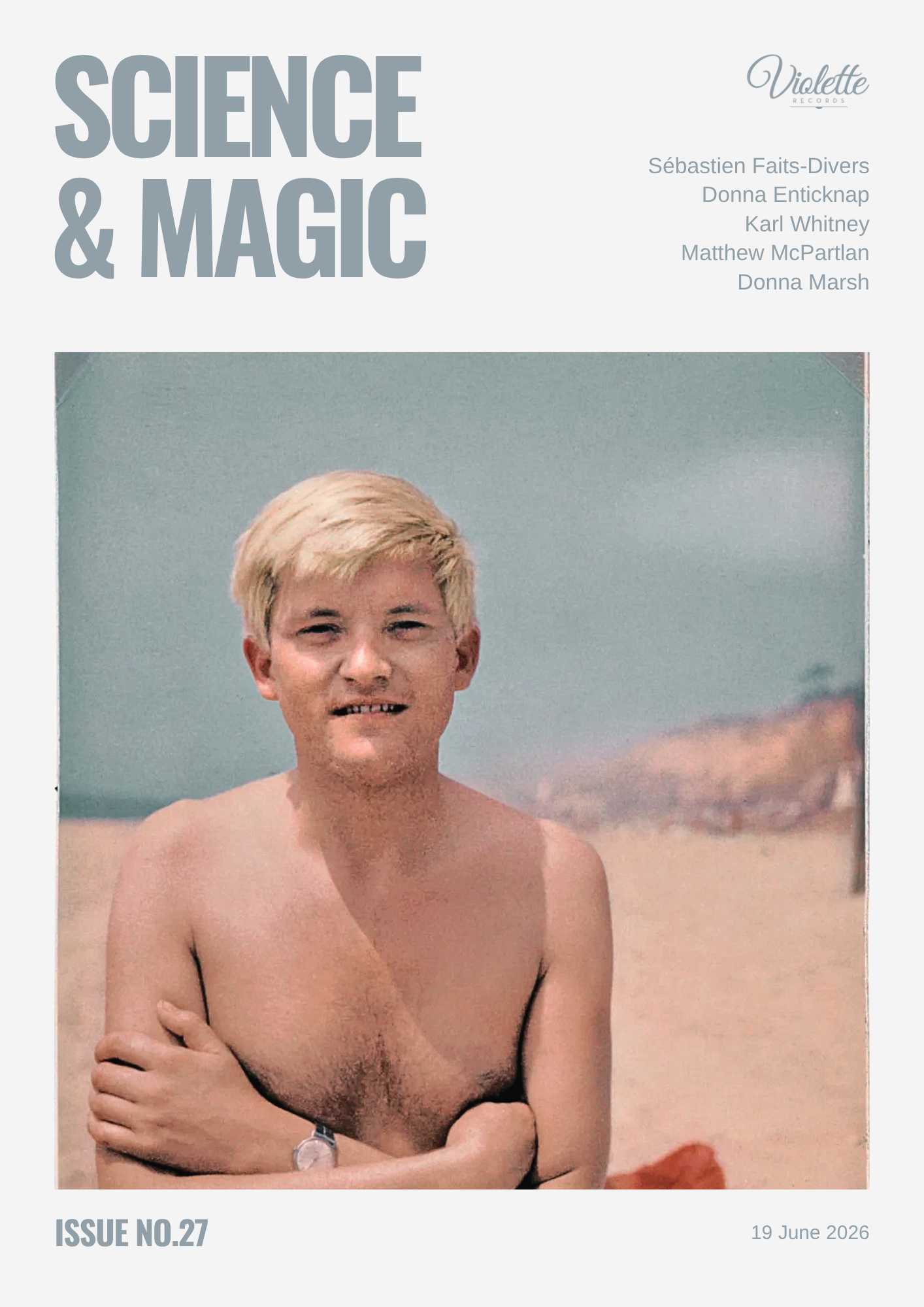
PS: We lost David Hockney last week. Ah man. He was, for my money, the most vital creative mind we had left. Never stopped looking, never stopped experimenting and never lost that puckish, independent spirit that defines everything great. This week’s cover is for him. A final splash of colour in an increasingly beige world.
Ten Questions
by Sébastien Faits-Divers
For over twenty years, Sébastien Faits-Divers has been a patient observer of the zones where live performance meets the camera lens. He began as many did, with a campus radio show in the early 90s and a multitrack recorder, learning the science of the mix on the job. Today, his FD Sessions have become an essential archive of independent music, capturing everyone from Editors to A Certain Ratio.
Sébastien is a man who understands that a great session is a form of communion. He is currently deep in a new project - a documentary and book exploring the multi-generational layers of the Manchester music scene. It is a story he seems fated to tell, driven by a desire to map the territory between the 1976 Lesser Free Trade Hall and the digital present.
We invited Sébastien to select ten questions from our archive. His answers serve as a guide to a life shaped by "auditive masterpieces," the "volcanic" impact of a Matt Johnson sleeve, and the enduring belief that an orchestra well-directed is the most powerful force on earth.

Sébastien filming The Young Gods. Photograph by Philippe Malet
● If you could time-travel to witness one musical moment in history, when and where would you go?
Easy one. I think I would have loved to time travel to Manchester in 1976, to be at the first Sex Pistols gig on the 4th of June. But... not for the gig itself, more for the people in the audience. And then, to go to the Russell Club, the Beach Club, to see live the young band Warsaw becoming Joy Division, the rise and fall of the Buzzcocks, the first gigs of The Smiths, Martin Hannett working in his studio, listening to 'Blue Monday' for the first time… That’s why I want to tell this story in my next film. But more generally, to live punk and post-punk in England between 1976 and 1983. I miss the pleasure of discovering a new song or artist on the radio, and to wait for buying a new 7 inch single and to play it over and over. Streaming kills the radio stars.
● What song feels like it knows something about you that you never told anyone?
90% of the songs of the Smiths catalogue.
● What album cover has had the most profound impact on you - either as art in its own right or as a gateway to the music within?
Never trust a cover they say…probably The The’s Mind Bomb cover. The head of Matt Johnson, the sticker mentioning Johnny Marr…but there’s a lot I could mention.
● What's your favourite song from a film soundtrack?
'Old Souls', written by Paul Williams and sung by Jessica Harper on the soundtrack of Brian de Palma’s Phantom of the Paradise. Probably the soundtrack I love the most, in full.
● What's the most beautiful piece of music you've ever heard live?
Dvorak, New World Symphony No. 9. I get chills just thinking about it. It’s so intense and so beautiful. Nothing is more powerful than an orchestra well directed.
● What album changed how you listen to music?
There’s a lot. But… Unsound Methods by Recoil is an auditive masterpiece, as is Downward Spiral by Nine Inch Nails. The production is incredible, and, even 30 years later, it still sounds very contemporary. As a humble music producer, those two albums trained my ears in my way of learning mixing.
● What's the best gig you've ever been to?
There’s two categories: the gigs I’ve been to as a listener, and the gigs I’ve been to as a filmmaker. As a listener… I would say Strangelove in Orléans in 1993. Awesome band, awesome singer. As a filmmaker (the “wow, I’m so glad I have filmed and recorded this” effect): Blonde Redhead, Geneva, 2023.
● What artist do you think is criminally underappreciated?
A Certain Ratio and And Also The Trees (and vice-versa). I’m probably not objective of course as it’s two bands I’m really proud to work with but… No, I’m objective.
● What song makes you cry and you're not entirely sure why?
'Jealous Guy' by John Lennon. Sure and not sure why.
● What new artist or band are you most excited about right now?
I listen a lot to Maruja’s first album Pain to Power. This wasn’t my musical taste at first glance but… I’m in love with their universe. So clever. They even make me like saxophone again. I've filmed them in Lisbon and it was an epic experience and a true communion.
A preview of Sébastien’s current work in progress.
Magnetic North
by Jeff Young
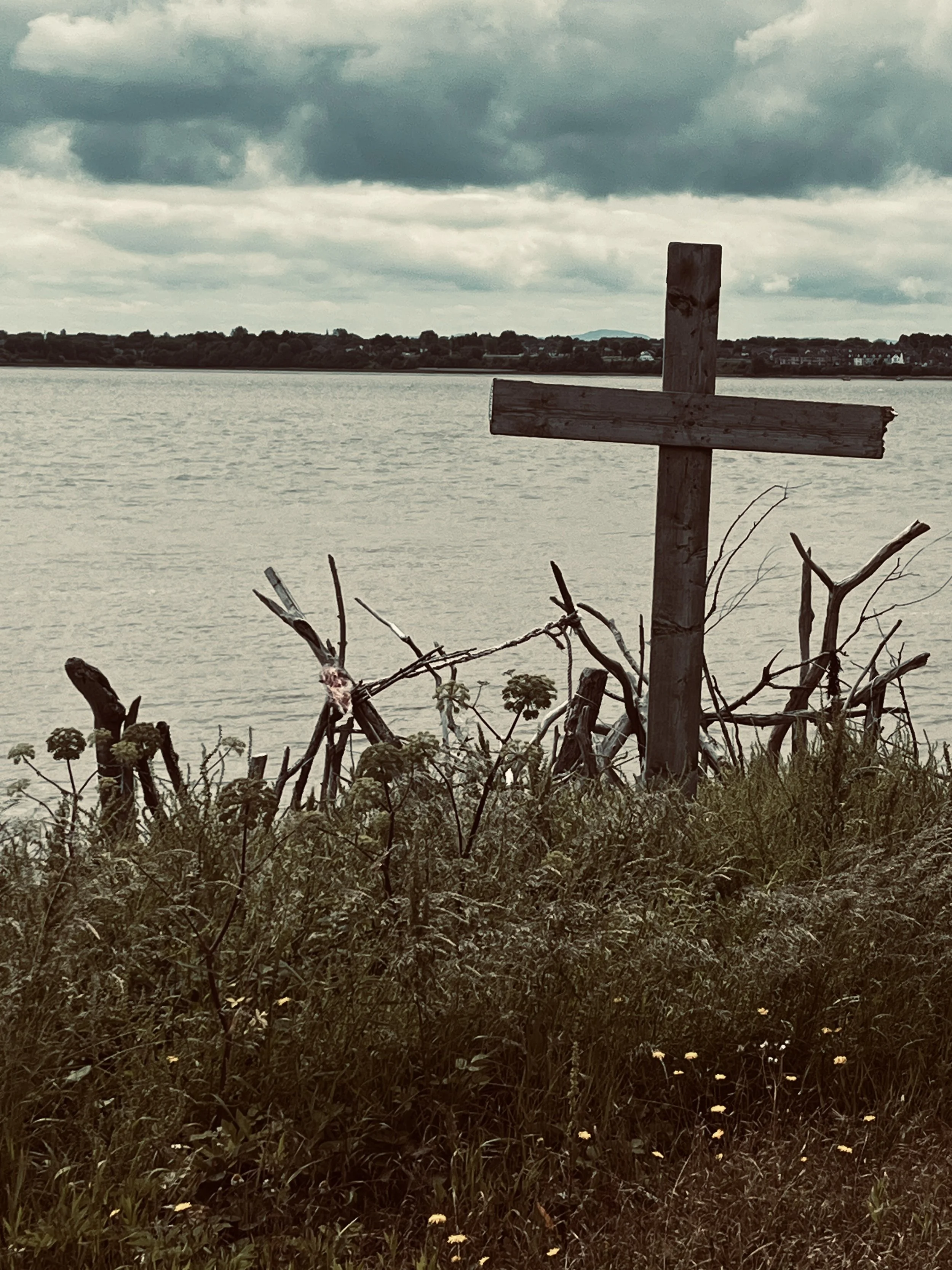
27 : The Driftwood Church
Something strange is happening by the river. In the rubble and rubbish landfill beaches of Columbus Quay, unseen monument makers are building fragile shrines. I imagine scavenger revenants coming here in darkness, gathering driftwood and Blitz bricks, salt-bleached branches, binding rope and rusted wire and building the skeletal totems necessary for their occult rituals. In between these salvage sculptures there’s an altar made from breezeblocks and a crucifix made from old timber hammered together with rusty nails. I decide that the dream alchemists who built this site of solar magic - the Dingle Derek Jarmans - must be phantom priests. On the postindustrial beaches of the River Mersey, either side of the Chung Ku Chinese Restaurant they have built their occult churches.
Of course, it might just be kids messing about.
Yesterday the wind was scuffing up the river, churning it into white horses riding wild on the tide but today it’s slow and sluggish, and as we walk into town the water is silver like crumpled tinfoil, a cormorant slicing into it, cutting it in two like a bird made of scissors. The only boat we see on the three mile walk from our house into town is Peter Blake’s dazzle ship ferry, one single ship on the mighty rolling river. And all along the river path there are feral poppies dancing in the cracks, petals falling like red butterflies fluttering away.
Here is the pause for beauty, here is the moment to stop and look closely at the strangeness of the world. Whoever built the driftwood church is watching us. The world is always stranger than you think. The feral priests make magic for our souls.
— Jeff Young, 17 June 2026
—
Jeff Young has abandoned the use of a traditional alphabet, having worked out that the city’s true narrative is written exclusively in the language of salt-bleached timber and rusty wire. He is now attempting to negotiate a trade agreement with the cormorants of Columbus Quay, offering them a collection of half-remembered 1970s TV themes in exchange for a map of the river’s subconscious. Jeff vehmently maintains that the honest way to measure a three-mile walk is by the number of "feral epiphanies" encountered per square foot of cracked pavement. He is the unofficial high priest of the "scavenger revenants," a title he holds with a mixture of pride and profound, quiet confusion.
The Paphides Principle
Pete’s latest theory is that the best records can emerge from circumstances nobody ever planned. When the participants meet by accident, fall into something through proximity and only realise after the fact that an album has actually happened.
This week, he writes about a band whose existence is, in his own description, his fault. Three musicians met at the launch of his Sensitive indiepop anthology back in February 2025, discovered they were all born in 1962 and formed a band called Railcard with a fourth musician. They have now released the album he is listening to as he types. The song he writes about is 'Disco Loadout', which describes a state of mind familiar to every musician who has ever played a gig and been required, minutes later, to drag the gear off the stage so the DJ can play 'Friday I'm in Love'.
Railcard: - ‘Disco Loadout’
It’s 7.40am on Thursday June 18th and I’m listening to an album that wouldn’t exist had it not been for me. I wonder if the emotions I’m experiencing are similar to those of Simon Cowell when he hears One Direction on the radio. Am I, in some small way, getting an insight into how Bob Rafelson and Bert Schneider felt after they watched A Hard Day’s Night and formed a production company in order to make The Monkees? Hmm. It’s possible, but the fact of the matter is that, on the evening of February 12th, 2025, I thought that I had put together my first and last supergroup. It was the launch for Sensitive – the indiepop anthology released on my Needle Mythology label.
And for this occasion, I had persuaded a one-night-only “house band” The Sensitivities, comprising musicians from Heavenly, The Dentists and Papernut Cambridge to play classics of the genre by Altered Images, The Soup Dragons, Dolly Mixture, Talulah Gosh, The Sea Urchins, The Waltones, The Loft and The June Brides with the vocalists who originally sang on those records.
It was one of those evenings where auld acquaintance turns out to not be forgot and new friendships are forged between kindred souls who had long admired each other from affair. Three of those souls were Rachel Love (Dolly Mixture), Peter Momchiloff (Talulah Gosh, The Would-Be-Goods) and Ian Button (far too many to mention). As they got talking, they all realised they were born in the same year – 1962. Surely this was reason enough to form a band! Augmenting the line-up of Railcard was Allison Thomson. And by the end of the year, they’d written and recorded the three EPs which comprise the album I’m listening to right now.
So what am I actually listening to when I’m listening to Railcard? In the case of Rachel and Ian, I’m listening to musicians who did the whole band thing back in their teens and experienced that strange transition when something done for reasons of joy starts to carry the weight of hope and expectation – both yours and those of the record labels who think you might have what it takes to become pop stars. I’m listening to musicians entering the third act of their lives, having raised families and held down day jobs and realising that it’s still fun to be in bands.
Except that, this time, it’s way more fun because the best bit about making music was turning nothing into something. Railcard’s “something” is ten songs about people who fancy themselves (‘Narcissus’), the calming rolling-stock rattle of leisurely locomotive afternoons (‘Slow Train’), the French government’s ultimately unsuccessful attempt to replace the Gregorian calendar in the wake of the revolution (‘Revolutionary Calendar’) and the envious longing some of us feel when we watch Northern Soul dancers showing off their joyful moves (Northern Soul dancing).
But this is a column in which I focus primarily on one song, and that song is ‘Disco Loadout’, perhaps the first song ever written about what is an inescapable reality of life in 98% of all indie bands. It’s about the half hour after you come off stage, when you should be marinading in that heady cocktail of pride in a job well done, audience adoration and your own sweat. Sadly though, it’s a disco loadout. The disco has to start at 10.30pm, there’s a queue of people outside who don’t care how much angst and craft was expended upon writing the songs for your album that – 30 or 40 years from now – may be revered the way Different Class and OK Computer are now. They want to throw themselves around the dancefloor to ‘Friday I’m In Love’ and ‘Born Slippy.’ And in order to do that, you need to get your gear off the stage. That’s what a disco loadout is.
“He’s says we’ve done our little rock gig/And now it’s gonna go big/As soon as we drag our plimsolls out the door.”
A pleasing irony afoot here is that you could easily imagine Disco Loadout “going big” on the very dancefloor being prepared in the lyric of the song. If Lawrence had built Go-Kart Mozart/Mozart Estate around a love of Neu! rather than bargain bin 70s pop, the result might have been something not dissimilar to Disco Loadout. Ian Button’s lyrics perfectly capture the bathos that fills the vacuum between the dream of band life and the reality of it. I’m still listening as I type. Feeling pathetically proud of the fact that this brilliant song and the brilliant album on which it’s featured might not exist were it not for that launch party.
— Pete Paphides, 18 June 2026
What Won't Leave Me Alone?
by Eimear Kavanagh
The gremlin inside of me, asking me to feed him.
I give up and then pick up again. I hate it, then I love it.
What part of me still wants to think that it's cool to smoke?
I would have thought that I'd have grown out of it by now.
But I do try.
Love, Eimear
—
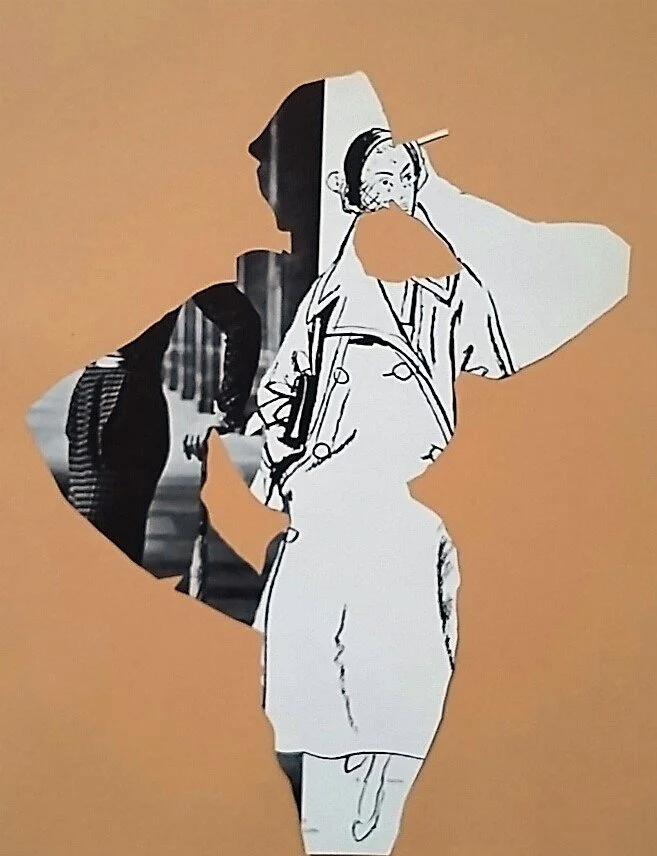
The gremlin lives in a small alcove above Eimear Kavanagh's left ear & has been there since roughly 1996. He pays no rent. He has never accepted an invitation to move out, and Eimear has, over the years, offered him several. Most days she is persuaded that the arrangement is mutual. On the others, she is reaching for the packet on the windowsill & has already lost the negotiation.
Crossword
by Victoria Raftery
I hadn't meant for it to happen. It was completely out of character for me to lose my temper like that. I was usually so compliant and, well, mousy. Especially when it came to Suzy. I’d surprised myself although possibly not as much as I’d surprised Suzy judging by the look on her face when she had crumpled back into that old oak, hitting her head hard against its gnarled and ancient trunk. I hadn’t meant for any of it to happen: the losing of my temper, the hard shove, the….well…how to put it?...the death of Suzy.
Death. Not murder. I would never have murdered anyone; at least not deliberately.
‘Are you okay, Mrs Greaves? I can carry those bags upstairs for you?’
‘Give me your keys, I’ll let you in.’
She thinks she's cleverer than me.
I'd thought she was going to be a quick learner but she wasn't.
‘See here, this is another one you could do, 7 down, eight letters: Two allowed an ornament to be kept close at hand. Any ideas? No? Well, we know the word starts with a B from our answer to 6 across. You need to think of a word that means two beginning with B and then think of another word that means allowed and if we put them together we will have an ornament to be kept close at hand.’
‘You mean like a bracelet?’
‘You've found the answer already.’
‘But I don’t get why….’
‘Come on, think! Think of words that mean two. Couple, pair, brace….like in a brace of pheasants….and then think of words that mean allowed…’
I gave up.
Thicket.
That's where she is.
Oh, I've given you the answer already.
So you make up the clue.
It’s not that hard, really, is it?
—
Victoria Raftery is the sole practitioner of "domestic cryptography" and believes that every conversation is an elaborate set of clues for a solution no one has asked for yet. She operates on the theory that if you sit in a garden long enough, the thickets will eventually provide the eight-letter answer to the question of why some people simply fail to be quick learners. She spends her afternoons meticulously auditing her own character for signs of "mousiness," an investigation she conducts using a vintage garden trowel ‘borrowed’ off her Dad in 1994 and a profound distrust of anyone offering to carry her bags. There has been, as yet, no further news of Suzy.
Works in Progress
introducing Donna Enticknap
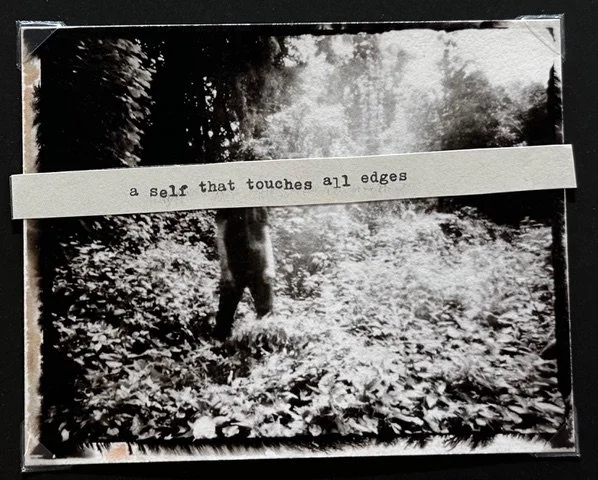
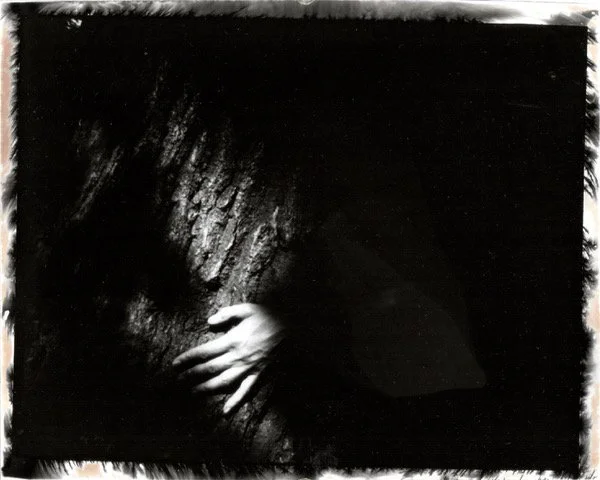
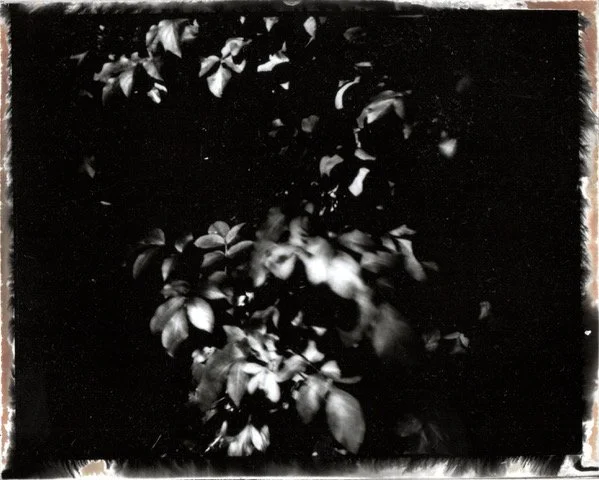
I’m using a pinhole camera to photograph time. Slow self portraits. Each photo is a durational piece, almost a performance. Due to the nature of pinhole photography, exposure times are much longer than a typical photograph, sometimes they can be up to an hour, depending on the light. The intention is to experience this time passing, with no distractions. I just have to be present and still and look at trees. My feet start to hurt immediately, I might instantly regret the position I’ve chosen, or the location, or even the whole idea, but the camera shutter is open and I have to commit. And time passes strangely, slows down and speeds up, and it’s just a case of waiting, and then waiting a bit more. I listen to the birds, I watch how the light changes. My mind races and wanders - it’s hard to not think. Often I’ll catch myself mentally counting the seconds - and I have to bring myself back to just waiting and not knowing. The longer I stand the easier it becomes, and then I feel like I could continue for another hour. And even so, despite my stillness, in the photo I’m a blur, a vibration. Every one of those thoughts and micro-movements and light changes and all the minutes are captured on the paper.
But the best moments are when sometimes, beautifully, suddenly, my mind empties. No thoughts, just silence. Relief. I feel my self floating off, I become grass and root and soil and air and blessed nothingness. I can’t force this. I just have to wait.
And so I'm attempting to capture this experience of stillness by compressing time into a single still frame. The time it takes for the light to enter a tiny pin-pricked hole and bounce around inside a dark box, to sharpen some things and soften others, the time it takes to merge into the background, to become nettles and bindweed and motes of dust and falling leaves. It’s an act of being in the moment and disappearing into it.
I hope this is of some interest - pinhole photography basically is science and magic!
— Donna Enticknap, June 2026
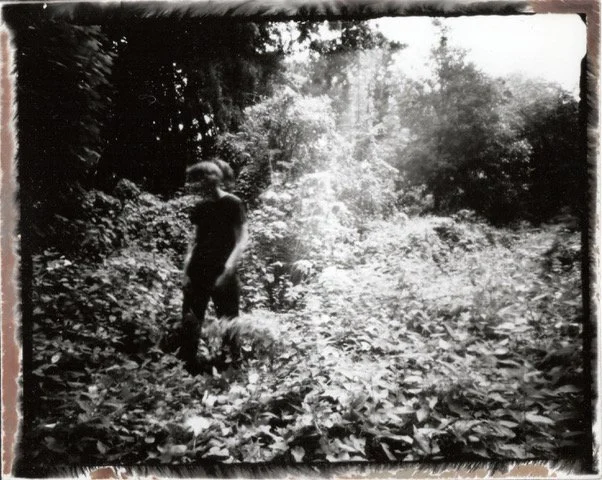
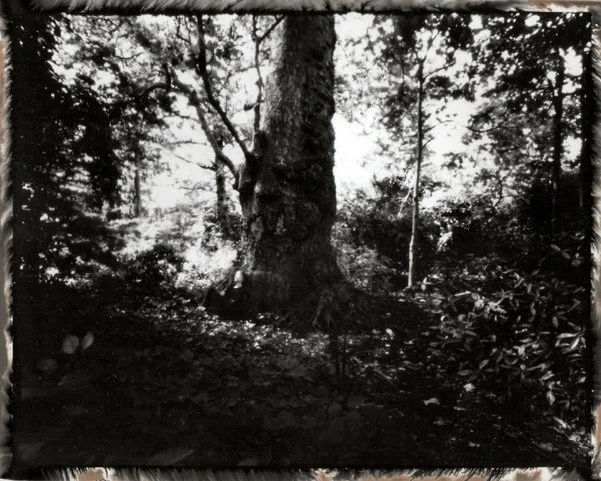
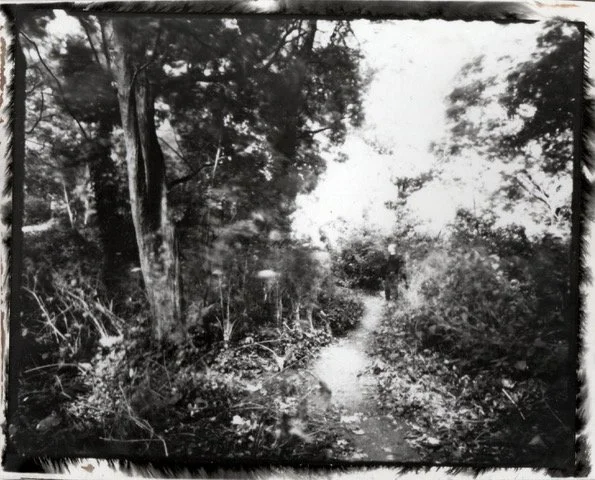
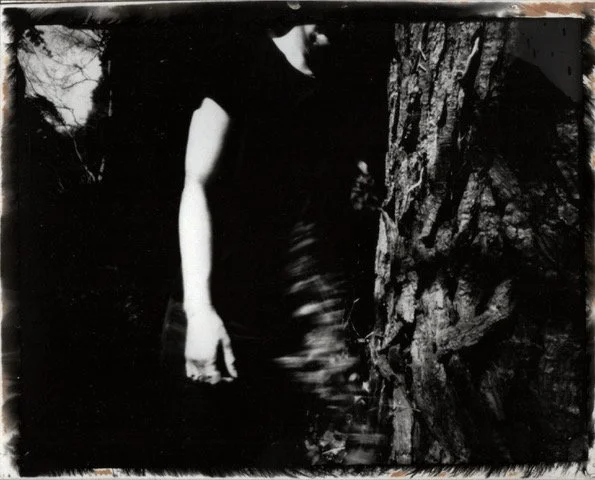
—
For some time I have been looking for a photographer to join the small band of people who write and make things for Science & Magic. The newsletter has been, until now, an almost predominantly written enterprise, A few weeks ago I received an email from a photographer called Donna Enticknap. Her email was a few short paragraphs. The photographs attached to it were a different matter entirely. Donna has been making slow self-portraits in the woods with a pinhole camera, with exposures sometimes running to an hour, during which she stands very still in a chosen patch of trees and waits for the light to record both her and her own restlessness as a single soft blur on the paper.
On Making Pizza
by Karl Whitney
One definition of madness might well be this: making the same pizza over and over again. But, I would counter, it’s never the same pizza, not exactly – at least, not when I make it. The pizza changes, or maybe I do. The sauce is adjusted, the dough rises differently, the toppings come and go like guests. Everything shifts barely perceptibly in the brief time between each pizza but, in the longue durée, as historians might say, the pizza itself changes significantly. The pizza I made when I was twenty years of age does or doesn’t fully resemble the pizza I now make, aged forty-seven, in the same way that I do or don’t resemble my younger self. By your forties, to misquote George Orwell – who to the best of my knowledge never wrote about making pizza – you get the pizza you deserve.
I’ve been making pizza for more than half my life. I make pizza when there’s something to celebrate; I make pizza when there’s nothing to celebrate. Making pizza is itself something of a celebration. From a bag of ingredients bought from the supermarket I can conjure, given time, two pizzas – always two – that are neither Neapolitan nor Roman, but rather a hybrid of both: a Dublin pizza. If you get things consistently wrong, that becomes a style of its own. I have learned, over time, to not care too much about how others go about things, including how they make pizza. When I hear someone rhapsodising about a certain type of flour or oven, my eyes glaze over: just put whatever oven you have on its uppermost setting and make the best of whatever ingredients you possess.
My pizzas are rectangular but with curved corners, or oval: shaped by the peculiarities of the dough and the dimensions of the baking tray I’m using. It’s not that I don’t care what the pizzas look like, but rather I see this as an activity that refines itself over time. I adapt to whatever kitchen I’m working in. All the ingredients are basic ones that I buy from budget supermarkets, so I can set up and make pizza wherever I am, like a jazz musician turning up at a venue and plugging into whatever amp is already there. I’ve tweaked the recipe over the years, removing garlic from the sauce and adding toppings for variety. But the basic recipe remains, almost three decades after I began to make it. For years I carried the original formula with me, torn from the pages of a Sunday newspaper. I’m not sure when I lost that yellowing page; by then, I didn’t need it. I had committed it to memory through repetition. Put 350 grams of strong white flour in a bowl. Add a sachet of instant yeast, three tablespoons of olive oil, a teaspoon of salt, then 210 millilitres of what the recipe called ‘hand-hot water’ and then mix it all together with a wooden spoon. I take it out of the bowl and knead it for a few minutes until it begins to resemble dough. I’ve realised that I zone out while kneading. I often stare at the wall behind the countertop thinking of whatever comes to mind, which is often nothing. The dough sits in a pliable ball until I pour a little olive oil into the mixing bowl to make sure that the mixture won’t stick, then I heave the dough into the bowl, place a large plate on top to seal it up (I used to stretch cling film across the top but find the plate a decent substitute) and then I put it away to prove for about two hours.
I’ve left the dough to prove on the counter in a warm kitchen, in Irish hot presses (airing cupboards which house hot water tanks), or in the sun. Now I put it into an oven that’s been warmed on a low heat – to 60 or 70 degrees celsius – then switched off. I make the sauce, which is simply plain passata, a small amount of dried basil, a pinch of salt and maybe a tablespoon of olive oil. I wait a couple of hours, listen to music, perhaps work for a while. The smell of proving dough colours the air, enhancing the sense of festivity I feel whenever I decide to make pizza. I’ve made it for friends and family over the years. Learning how to do it as a teenager gave me a sense of independence that I still experience during pizza making – the dizzying intimation that, if this is possible, then you can also make your own world. Pizza as a portal to utopia. Doing a quick calculation, it’s entirely plausible that I have made over two thousand pizzas over the years, but the truth is that I’ve lost count. I’ve made basic Margherita and a variety of elaborate vegetarian versions of the dish that have included fig, honey, walnut, feta, olives, sundried tomato, roasted pepper, artichoke: anything that I think might work in combination as an alternative to basic cheese and tomato.
I remember pizza when it was sold frozen in plastic bags of ten: a sparsely topped disc of joylessness. Later, supermarkets adopted a make-your-own-pizza model that entailed piling sauce and toppings onto a breadlike pizza base, weighing the concoction, contained in a polystyrene case, then printing out a price label. You’d bring the pizza home, heat it in the oven. It didn’t fully resemble what I now think of as a pizza, but at least there was a sense of ceremony about the whole process. When I was in my teens, a Pizza Hut opened in a shopping centre not far from where my family lived. It specialised in deep-pan pizzas baked on oily trays, in which they were presented to customers, sliced up and ready for consumption. I was hooked. After a few years ordering pizza for delivery I decided it was time to take the means of production into my hands. I found the recipe and made a few attempts to replicate it. Some people can recite poetry; others can play piano: I make pizza. Although I don’t necessarily think of it as a skill, it is something I practice weekly, more or less, and have done so perhaps every week of my adult life. I never really learned to draw, my singing days are over, and I’m not much of a photographer. But I do make pizza. On sunny days it could well feel like a pizza day; on a dull and rainy afternoon I might resolve to make pizza. Suddenly my evening takes on a different shape: I work on the dough, make the sauce, and I wait. Then I celebrate.
If you were to plot the process of making pizza on a graph there would be a spike at the beginning to signify the action of kneading dough, making sauce and perhaps preparing toppings. After that the graph of human endeavour would return to its zero degree: the dough rises with no help from me. I might have heated the oven a little to help the proving process, but once the dough has been set aside no energy is used. Then, after a couple of hours, a spike in the graph once more, as I tip out the ball of dough, which by now has risen considerably, onto a countertop, split it in half and let the two doughy blobs sit for a few minutes as I heat the oven to its highest possible temperature. I press each ball of dough into an oval or rectangular shape, spread oil on the baking tray; the dough is transferred to the tray and rolled out a little further by hand so that it almost reaches the tray’s edges: it’s now a pizza base. I spoon the sauce onto the base and spread cheese and toppings across it. Then the tray goes into the oven for perhaps eight minutes – at the top of the oven for a deep pan-style pizza or at the bottom for a thin and crispy one. I became a devotee of the latter until the hard crust broke a tooth.
The process means more to me than the product, and, in this, bears comparison with writing. I consume what I’ve made in a different manner to something that might be served up to me by others. While I’m not immune to self-criticism (the cheese isn’t browned enough, or has been browned too much; the combination of toppings just doesn’t work) I don’t judge the pizza too harshly because I know that it’s the product of an ongoing practice of making pizza, that there’s no perfect pizza, just something that can be improved and refined over time. If it seems general to the point of meaningless to state that life is a bit like making pizza, perhaps it would be better to say that the practice of writing isn’t so dissimilar. A pizza I’ve made, like a book I’ve written, is better judged by others. And I don’t take that judgement very seriously, because the author of the pizza judges it by different criteria. As with a piece of writing, the audience's response to a pizza might surprise. These are the unanticipated quibbles that the chef might well listen to or ignore when making pizzas in the future. A pizza’s unity lies not in its origin but in its destination, as Roland Barthes didn’t say. So be it. By the time a pizza has reached its destination its author has already moved on to the next.
—
Karl Whitney is an Irish writer based in Liverpool and the author of two books: Hidden City: Adventures and Explorations in Dublin (2014)and Hit Factories: A Journey Through the Industrial Cities of British Pop (2019), the latter of which is the kind of thing I would have ordered immediately had I known it existed. He has written for The Guardian, The London Review of Books and the Times Literary Supplement and is, in his own description, trying to get back into the habit of writing short, personal pieces. His first contribution for us is about pizza, though it is, in the way the best essays of this kind are, also about thirty other things, including practice, repetition, Roland Barthes, the difference between the means and the ends of any sustained creative act and the specific dignity of working out one's own version of a thing nobody asked you for. By his own calculation, he has made approximately two thousand of them.
Dead Air Anthologies No. 10
not by Matty Loughlin-Day
Matty Loughlin-Day is currently absent from these pages, having been detained by a group of highly coordinated herons who have taken issue with his recent "temporal studies." He was last seen being ushered into a derelict transformer housing near the Leeds-Liverpool canal. In our last brief correspondence, sent via a note tied to a very confused stonechat, Matty claimed that the number ten is "a numerical trap designed by the state to enforce linear thinking," and he is refusing to release his next anthology until he can find a way to record it in a frequency that pleases French Bulldogs. He plans to resume as soon as these pesky herons grant him parole.
The Cult Continuum
with Matthew McPartlan
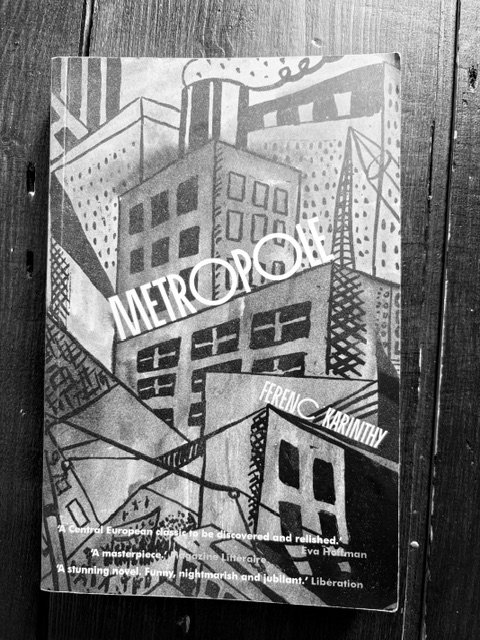
Matthew McPartlan is now five pieces into The Cult Continuum, and is in now way staying inside a single decade, language or medium. Last issue was a drug heist in uptown Manhattan. This issue is a 1970 Hungarian novel by Ferenc Karinthy about a polyglot linguist who boards the wrong plane to a conference and lands in a city whose language he cannot, despite all his expertise, identify, transcribe or learn. What a beautifully odd bunch we are here.
#5 Metropole - Ferenc Karinthy
I was in Mumbai about six weeks before the first Covid lockdown in the UK, on a work study trip with a couple of colleagues. On our first day, we set off to wander the city, take in the sights and find a couple of pubs along the way, assuming, naively, they’d be on every street corner. It didn’t quite go to plan.
We walked for hours down endless streets, becoming something of a spectacle, increasingly desperate, sweaty idiots, clearly out of place, looking lost and edgy. At one point, one of my colleagues nearly had a taxi driver by the lapels, just repeating “Bevvie!?” as if it might translate through sheer force of will. It didn’t. At that moment, the memory of the book Metropole came flooding back.
I had read the book during a glorious period in my life when I was working in a call centre for a high street bank and was more or less paid to do nothing. It was the kind of job where management actively encouraged us to bring books in just to stave off boredom and, in my case, to stop me from talking everyone’s ears off.
It’s the tale of Budai, a Hungarian linguist who can speak multiple languages fluently, who boards a plane for a conference and finds himself stuck in an unfamiliar, swarming megacity that wasn’t part of his itinerary. What should be a minor inconvenience quickly becomes something far more unsettling as, despite all his expertise, he cannot understand a single word anyone says to him.
Originally published in Hungarian (called Epepe) in 1970 and only translated into English in 2008, the book is less a conventional narrative and more a slow, suffocating spiral into frustration. At its core, it explores what happens when communication completely breaks down. If you cannot communicate, you cannot function, you cannot explain who you are, where you need to go, or what’s wrong. You cannot even confirm whether anyone else understands the world around you any better than you do. One of the few points of contact Budai has is with the hotel’s elevator operator, a young woman whose name he can never quite grasp, changing shape each time he hears it.
There is a directness of the narrative also. It gets straight to the point of the fear and frustration, in the same way Hamsun’s Hunger strips everything back to raw feeling.
Experiencing it as an English speaker adds another layer. There’s an unspoken arrogance we carry, that the world will meet us halfway. Metropole removes that entirely.
That feeling of being visible but not understood is what Metropole captures perfectly. You’re helpless and trapped and over time that helplessness starts to bend your sense of reality. If nothing makes sense, if nothing resolves, how long do you hold onto the idea that it ever will?
This is why Metropole belongs in the Cult Continuum. It is unsettling, funny and deeply stressful. It has stayed with me and keeps returning, surfacing in crowded places, in unfamiliar cities, in those brief flashes where comprehension falters and you realise how little it would take for everything to stop making sense entirely and how easily you might not notice when it does.
— Matthew McPartlan, 17 June 2026
The Gen Alpha Lexicography
by Maya Chen
24: 'Brainrot' (The Diagnosis That Diagnoses Itself)
Etymology: From an 1854 entry in Henry David Thoreau's Walden, in which he asks whether anyone will undertake to cure the brain-rot prevailing so much more widely and fatally than the potato-rot in England. Now repurposed by adolescents to refer to their own ongoing cognitive degradation, of which they speak with the calm familiarity of someone reporting on a chronic but non-fatal condition.
"Mum, I think I've got really bad brainrot today."
My son delivered this verdict last Saturday at approximately 11.17am, having been horizontal on the sofa with a phone in his hand since nine. He said it in the tone one might use to announce the early symptoms of flu. There was no shame attached. There was, if anything, a faint pride in the diagnosis. He had, in his own assessment, achieved a level of brainrot worth flagging to a parent.
I asked him, in that slightly clinical voice I have developed for these conversations, what specifically he had been consuming. He listed several things, including two TikTok accounts I have never heard of, a YouTube channel about people pretending to be CCTV cameras, a meme involving an Italian wizard and approximately forty minutes of a man called Skibidi Toilet, who is, according to my son, "actually quite an old one now, Mum." He said this last bit with the slight wistfulness of an adult remembering the music of their youth.
'Brainrot' is the Gen Alpha word for the contents of Gen Alpha's own head. It is the recursive term. The word that names the phenomenon I have spent twenty-three entries of this column trying to name. My children have, it turns out, a perfectly serviceable label for the thing already, and have had it for some time, and have not previously felt the need to share it with me.
The term itself is not new. Thoreau coined it in 1854 as a complaint about the intellectual diet of his contemporaries, who preferred, in his view, simple ideas to challenging ones. He compared it, somewhat unfairly, to a potato disease. The Oxford English Dictionary picked it up as Word of the Year in 2024, by which point Thoreau had been comprehensively forgotten and the term referred almost exclusively to the cognitive effects of YouTube Shorts.
The Gen Alpha repurposing is the interesting bit. Brainrot, in their hands, has become a self-diagnosis they offer freely, in advance, before anyone has had the chance to make the complaint. They describe themselves as having brainrot the way previous generations might have described themselves as hungover. The condition is acknowledged, its cause is named, and the next video plays.
What I find harder to digest, as a researcher and as a parent, is the absence of any sense that this is bad. Brainrot, in my children's vocabulary, is descriptive. It carries a small, neutral shrug. The brain is, in their telling, simply doing what brains do when they are exposed for several hours daily to short-form content optimised for retention. Some rot is to be expected. The rot is itself a category of experience. To live without any brainrot at all would mark you out as someone who had not been online enough, and that would carry its own social cost.
I have asked my son, more than once, whether he thinks his brain might one day stop being able to do whatever it cannot now do. He has assured me, kindly, that he is monitoring the situation. He has also assured me that brainrot, in his understanding, is a phase that will pass when he gets a job and a girlfriend and, in his exact words, "stops being so online." The fact that this future is, by his own admission, several years away does not appear to concern him.
I am, I will admit, less sanguine. I had been treating their vocabulary as the linguistic skin on the body of a generation otherwise capable of normal thought. The word 'brainrot' suggests they are telling me, directly and without irony, that the vocabulary is the muscle. They are reporting that the thing I had been treating as decoration is in fact the working tissue, and that the working tissue is, by their own assessment, deteriorating in real time. They do not appear to want to be rescued. They simply want me to know that the report has been filed.
Next time: 'Mid' - the universal verdict from a generation that has decided most things are not, on balance, worth the bandwidth.
—
Maya Chen is running at approximately 3% brainrot, which she attributes to a moderate but stable diet of literary fiction, Radio 4 and one Substack she does not feel ready to identify. She has been advised by her daughter that this is "actually quite respectable for a mum your age." Her son has refused to assess her on the grounds that the assessment would itself be a form of contamination. She has accepted the compliment and the refusal in roughly equal measure and continues to operate, broadly, within the parameters her family considers safe.
The Day Sheet
by Donna Marsh
Donna Marsh has been tour-managing bands since 2002. She started in van crew in 1998 for an indie band out of Sheffield, worked her way up through merch and production and has, by her own approximate count, run close to two hundred European and UK tours since. She now runs a small agency in Manchester placing front-of-house and monitor engineers on European runs and continues to take one old client out herself every spring.
The Day Sheet is her six-part dispatch from inside the work. This issue, she introduces us to Paul, who drove touring buses from 1979 until his retirement in 2021 for somewhere in the region of four hundred different acts, and to the workforce of drivers like him that has, in the last five years, almost entirely ceased to exist.
02: The Driver
In 2014 I took a band on a thirty-two-date European tour. The driver, on day one, was a man called Paul. He was sixty-three. He had been driving touring buses since 1979. By his own count he had driven for somewhere in the region of four hundred different acts in his career, including both Iron Maiden and Showaddywaddy, though not at the same time.
Paul drove for us for thirty-one of the thirty-two dates. He picked us up at a depot in Newport at 0400 on a Tuesday and delivered us back to the same depot at 0530 on a Friday five and a half weeks later. In between, he took us to nine countries, parked in the precise correct spot at fifty-six venues he had been to before and three he had not, knew which border posts to use at which times of day, knew which French motorway services had the working showers and which did not, knew which Italian autostradas were closed for night work in which weeks and went to bed every night by 0900 in a bunk above the wheel arch with the curtain drawn so that the band, returning to the bus at 0400 after the show and the after-show, would not wake him.
He spoke four languages. Three of them he had taught himself in that bunk above the wheel arch.
I have not used Paul since 2019. There was nothing personal in that. By 2021 Paul had retired. By 2022 his colleagues had also retired. By 2023 the agency that used to send me Paul could not send me anyone with the same depth of experience because there was not anybody left with the same depth of experience.
The British touring-bus workforce as a viable institution has largely stopped existing in the last five years.
In 2019, after the small matter of Brexit and just before the slightly larger matter of a pandemic, the active pool of UK-based touring-bus drivers ran, on the trade's own estimate, to somewhere in the order of three hundred and fifty people. By 2024 the figure people were quoting was, give or take, a third of that. The arithmetic isn’t good. Two thirds of a specialised workforce has gone in five years, and the remaining third is older than the pension age the rest of the country expects to retire on.
There are three reasons for this and they have all happened at once.
The first is Brexit. UK-registered touring buses can no longer move freely between European venues. Post-Brexit cabotage and movement rules treat a UK bus on a French autoroute as an outsider running on borrowed time, and the arithmetic of a thirty-date European tour does not balance under those rules. What used to be one bus doing one tour with one driver and one trailer is now two buses, two drivers and a complicated cross-Channel handover at Calais, after which the UK driver goes home and the EU driver takes over.
The second is COVID. Touring stopped for the better part of two years. UK drivers, who had been freelance and bus-specific, took jobs in supermarket logistics, in waste haulage, in long-distance lorry work, in school-run minibus contracts. Many never came back. The work that resumed in 2022 was paying the same daily rate it had been paying in 2018. Supermarket logistics pays better and means you sleep at home.
Then there is demographics. The drivers who were in the trade in 2019 were, on average, in their mid-fifties. Five years on, the survivors are in their mid-sixties. The infrastructure that used to apprentice younger drivers into the touring side from haulage backgrounds is no longer functioning, because there are not enough tours to apprentice them onto. The pipeline broke around 2018 and nobody has rebuilt it.
The net effect, from where I sit, is that booking a UK driver for a European run is now a question I cannot easily answer in the affirmative. If a manager I have known for fifteen years asks whether I can put a band on a UK bus for a French tour starting in October, the honest answer is "maybe, if you are willing to pay rather a lot more than you used to and accept that the driver may, for the second half of the run, be Dutch." Most of them are not willing. So the bus is Dutch. The driver is Dutch. The arrangement works. The arrangement is not the same arrangement though.
What has gone, in a way I find harder to put into a settlement spreadsheet than the per-diem maths, is the relationship between a band and the man at the front of the bus. Paul was a member of the touring party. He knew where the bass player kept her cigarettes. He knew that the guitarist's father had died in March and that the guitarist did not want to talk about it. He knew which two members of the band were sleeping with each other and which two of the crew were not yet but would be by Vienna. He knew, mostly without being asked, when to drive slowly through the bumpy bit because somebody had drunk too much and needed to be left alone for an hour. In the way that good drivers are, he was the household.
You cannot recreate this with a new driver each week. The bus on the EU leg, however good, is not the same bus. A Dutch driver who is excellent at his job will not know any of the band's names because they will not be on his bus long enough for him to learn them.
Paul lives in Cwmbran. He has a small allotment and a Yorkshire terrier. He sometimes sends me a postcard, in his very neat handwriting, when one of the bands he drove for puts a record out. The postcards always include the same line.
"Hope they are still all behaving themselves."
They are mostly not, Paul. We miss you.