
Science & Magic | 28
Watching the latest game of political musical chairs in Westminster is like witnessing a particularly grim revival of a Broadway musical that should have closed in the provinces decades ago. Keir Starmer is out, and there’s Andy Burnham, already adjusting his tie and warming up his "man of the people" vowels in the wings. Here we go again.
There’s got to be a better way to organise ourselves than this pitiful, endless charade.
Full disclosure. Andy Burnham once attended a Violette Records show at Gorilla in Manchester. From what I saw of him that night he was a decent presence in a room he did not have to be in. He bought his ticket, his drinks at the bar, stayed for the encore and, so far as I noticed, asked nobody to vote for him. I genuinely wish him well and I will let that fact contradict everything I am about to write.
I have a simple, stubbornly held rule: I trust no politician. I’m no nihilist but I’ve spent too much time looking at construction contracts to not recognise a bad deal when it’s being pitched to me. These goons operate on a weird cycle of badly calculated empathy. Like needy children, reaching out when they need something whether that be a vote, a bit of validation or a seat on the board of a company they previously regulated.
And they’re a very specific breed. Politics doesn't attract the brilliant, it attracts the hungry. It’s a career path for those who require the constant, artificial light of public attention to actually feel alive. It’s a magnet for the messianic and the vain. Frankly, if they were half as clever as they think they are, they’d be doing something more challenging and useful, like designing a bridge or trying to find a cure for the common cold. Instead, they choose to move papers from one side of a desk to the other and call it "vision."
I knew these types at school. They were the ones who volunteered to be the class monitor or the secretary of the debating society. Kids who carried a briefcase and wore a tie on non-uniform days. Nobody was actually their friend, people just tolerated them as a sort of unavoidable, low-level bureaucratic weather system that was permanently threatening intermittent drizzle. They possessed a lumpy, uncool, desperate “pick me” energy that was exhausting to be around then and hasn’t aged any better since.
I refuse to endorse any of them because to do so is to participate in their shabby performance, to tell the actor that his third-rate monologue is actually a masterpiece. Endorsement encourages the behaviour, validates the idea that we are a ‘market’ to be managed rather than a community to be respected and served.
So while the sweaty suits in the capital are busy posturing for the cameras, we’ve been focusing on things that actually have some shelf life. The work in these pages won’t ask for your vote, it won’t even ask for your attention.
Welcome to the latest edition. We’re still here, and none of us are running for office.
Matt
Ten Questions
by Stéphane Auzenet
Stéphane Auzenet of The Reed Conservation Society is the kind of music lover who arrives already humming a Tim Buckley song and carrying the Velvet Underground's third album. He is French. He saw Pulp play Paris in 1992 and the gig has, by his own admission, not left him.
His band's second album, Sing a Song that Never Ends, is out now. The title is lifted from a Jeff Tweedy song, which will not, on the evidence of his answers below, surprise you. The album returns TRCS to English after a francophone debut in 2024, and expands them from the founding duo of Stéphane and Mathieu Blanc into a quartet. Yann Arnaud (Air, Syd Matters) is on the mix. Pavement, Sufjan Stevens (Stéphane's declared porte bonheur) and Muswell Hillbillies-era Kinks are all, at various angles, in the water. In Stéphane's own words: "un disque d'équipe, un disque de rencontres."
We invited Stéphane to select ten questions from our archive. His responses arrive as a kind of compressed European music education, taking in David Lynch, the entire 4AD catalogue, Michel Gondry's video for the Chemical Brothers' Star Guitar, a Sufjan Stevens show with cheerleaders and angel wings and the question of which record one might lie on a sofa to listen to. The sofa answer is Red House Painters. The rest is below.

Stéphane Auzenet
● What's your favourite song from a film soundtrack?
'Song to the Siren' from David Lynch's Lost Highway. It's for me the perfection of music and movie.
● If you could only listen to one record for the rest of your life, what would it be?
The third Velvet Underground album, the one with the sofa. Every song, each melody, are perfect.
● What's the best gig you've ever been to?
Sufjan Stevens's show for his album The Age of Adz. It was amazing, dance, fluorescent clothes, cheerleaders, angel wings, whaou!!! And the Pulp concert in 1992 in Paris.
● What album cover has had the most profound impact on you?
The entire 4AD catalogue! The Stone Roses' 1st LP.
● What song should be the new national anthem?
'Waterloo Sunset' by The Kinks.
● Is there a record you have to listen to in a particular way?
Lying on a sofa. Red House Painters' Rollercoaster and Bridge.
● What's your favourite sound that isn't music?
Birds singing, a coffee machine that is running, a purring cat.
● What's the last album or song that made you stop whatever you were doing and just listen?
'Cap in Hand' by EELS and 'Lou Reed Was My Babysitter' by Jeff Tweedy.
● What music video changed how you thought about visual art?
'Star Guitar' by The Chemical Brothers.
● What album captures a specific cultural moment better than anything else?
London Calling by The Clash.

The Reed Conservation Society
Magnetic North
by Jeff Young
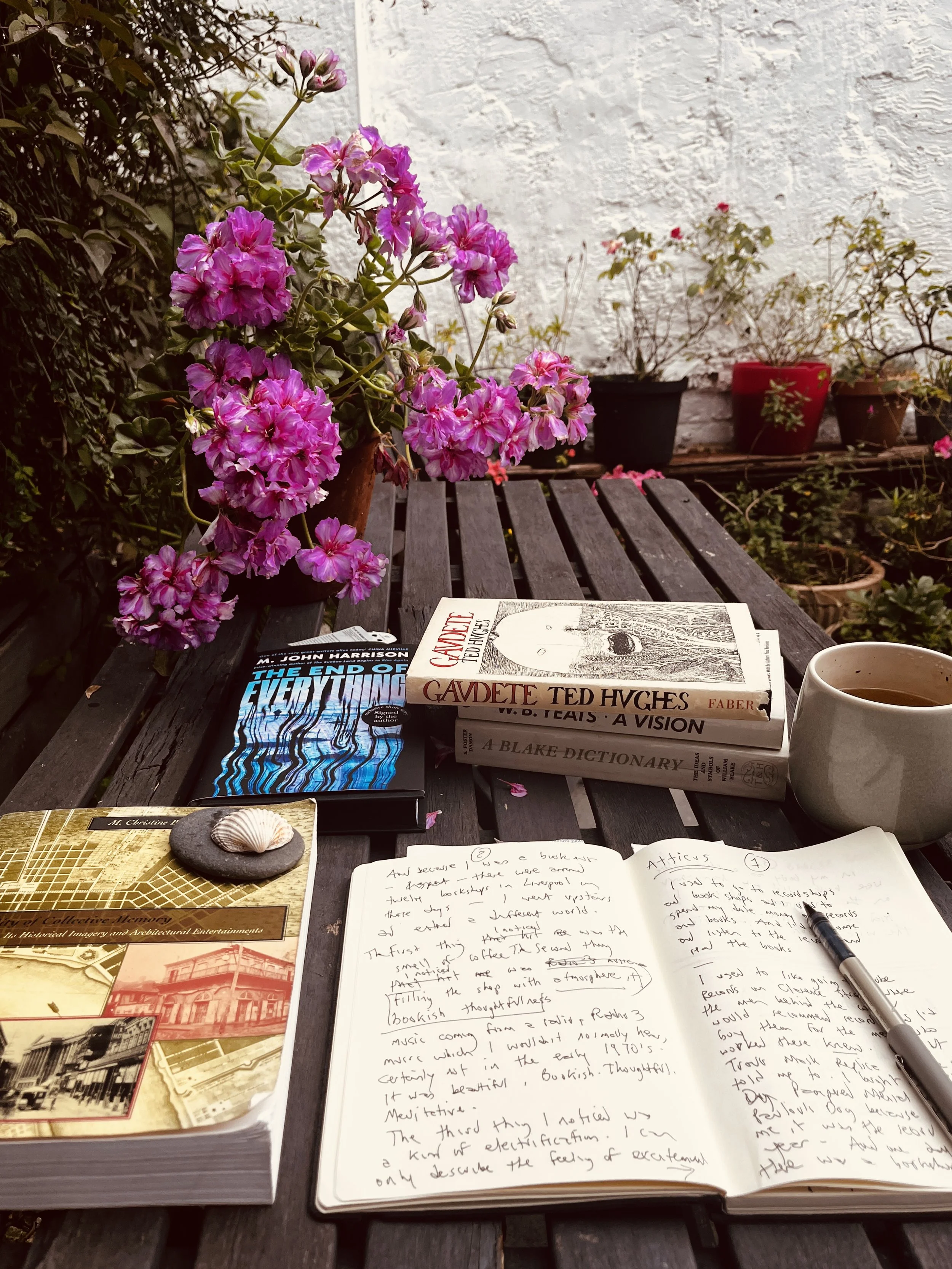
28 : Heat Diary
Over the rooftops, birds like clockwork aeroplanes, a squadron of parakeets, skittering and screeching, ripping the sky to shreds. Steampunk ornithology...
*
Dead blue, dead air, dead weight, death-heat.
*
The house is dark, curtains closed, air so heavy you can feel it pushing you into the walls, into the floor. The rooms smell of incinerator ash and marigolds – a phantom perfume. Memory of a cremation, old woman dabbing her lips with a lolly ice scented handkerchief.
*
Science fiction weather folding the sky into melting tarmac. Nothing feels like itself, nothing feels like the thing it’s supposed to feel of. The world feels like hot cardboard and concrete and factories and burning linoleum and eye drops.
*
Dreams are more like adverts on a forgotten TV channel: How to Make Friends With a Burning Horse; Fire Starting for Beginners; Invest in Magma; You Too Can Make a Moon Out of Crushed Co-codamol. I awake at 4am from a dream of haunted syringes injecting me with ghosts.
*
The backyard is my sanctuary, the only shaded place in the universe. (I am prone to exaggeration, but not on this occasion).
*
Pete the Magpie I feed in winter comes to visit. We watch five gulls attacking a buzzard over Allington Street. The gulls win.
*
There’s a money spider on my wrist. A beetle walks unsteadily across the flagstones like a Saturday night drunk. Two Meadow Brown butterflies dance around the Clematis. The yellow poppies drop their petals. I revive a bee with sugar water. The universe continues even though it’s on fire.
*
I haven’t left the house for five days. Heat and medication are conspiring against me. ‘Keep hydrated! Keep hydrated!’ My skin cancer and the burning world are incompatible. The heat fucks up my blood pressure. My heartbeat is erratic. I can’t face my Wednesday Methotrexate. ‘Keep hydrated! Keep hydrated!’
*
The dark shapes in my bad eye look like blood amoebas.
*
Dream fever, dream of broken birds falling from the sky, dream of a wasp nest turning to paper in my hands, the sad sweet memory of childhood summers visible in the dust.
*
Déjà vu. Lying on the school playground floor underneath my duffel coat in summer, enjoying the feeling of claustrophobia, singing hymns, imagining my funeral.
*
I sit in the backyard reading. Silence. Just me and Pete the Magpie waiting for the heat to end. And then, the sound of horses on the street. I go to the gate; the street is empty.
*
Between the pages of my book, I find the disintegrating wings of a moth.
— Jeff Young, 1 July 2026
—
Jeff Young has not, on strict interpretation, left the yard since Sunday. The yard has responded by expanding around him. Its perimeter now includes a stretch of Allington Street, a small parcel of sky above the parakeets and the airspace Pete the Magpie treats as newly acquired ground. Pete has been keeping notes. The notes are in a language Jeff does not read but has, in the fever, begun to recognise. Somewhere, on the same frequency, a horse is passing that nobody else can see.
The Paphides Principle
Pete’s theory this week is that pop is the only form of music that can hold two mutually incompatible ideas at once and make them sound like they were always meant to be together. Every other genre has to pick. Pop is under no such obligation.
Hakushi Hasegawa - ‘The Owner Of Sweetness’
The other day, I was driving my daughter into town and we were taking it in turns to play each other songs. I used one of my goes on ‘Turn It On Again’ by Genesis, which felt like it somehow suited driving through Central London on the hottest day of the year. “Oh, I know this,” she said, “I love how amped up it sounds.” In that moment, I made a mental note to use the phrase “amped up” more.
A week later, that's something I can legitimately do when talking about the first single from Hakushi Hasegawa’s upcoming new LP – charmingly titled Honest Feeling Album. It’s a sort of polemic against sentimentality – “a genuine expression of anti-romance supremacy” in which they observe that love “has unconsciously turned people into wielders of power”. What that means for your ears is a rapidly changing flurry of chords – some majorly grandiose, and some not so much diminished as dragged backwards naked through twelve blackthorn hedges. And this action all takes place between Hakushi’s heavily treated vocal and the song’s slamming four-beats-to-the-bar clatter.
“But how exactly will I feel, listening to all this?” you might ask.
It’s a reasonable question. To which I would answer: I think you might being lifted off the floor by some sort of vast pop hairdryer and pinned to the wall for the entire duration of the song. What I really love, though, is there are so many ostensibly incompatible things happening here and yet, somehow they've all interlocked to create what that, against all odds, is recognisably pop music. It’s not unlike what might happen if you bundled Jellyfish’s ‘The King Is Half Undressed’ and My Bloody Valentine’s ‘Feed Me With Your Kiss’ into the ‘Hadron Collider.’
To borrow the words of Madness back in a simpler age, this really is the heavy, heavy monster sound (with a sensational video to boot).
— Pete Paphides, 2 July 2026
Where I Hesitate Most
by Eimear Kavanagh
I hesitate the most to show up in person.
Sometimes good reasons arrive, like magic!
Other times I find them myself.
The convenience of excuses.
And when the reasoning comes, so does the relief.
Followed by the joy in knowing that I can stay home instead and dive into a nice big bowl of Ambrosia.
Love, Eimear

—
Eimear Kavanagh keeps four tins of Ambrosia in the cupboard above the kettle, arranged by best-before date and treats them like a small reserve of personal sovereignty. When an invitation arrives, the tin is the first place she looks. The tin reminds her of who she is. It also subconsciously reminds her that the bus to wherever she has been asked to go probably is not running this evening and, when she thinks long and hard about it, never has been. So she returns to the sofa. The Ambrosia is room temperature. The evening, which had threatened to be larger than this, has been returned to its correct size.
Hallelujah Trial
from the front room to the nave

Tom Roberts
When we last spoke to Tom Roberts and John Canning Yates, the songs had never left the house. Hallelujah Trial was a wonderful weekly ritual of tea, talk and accidental grace - two mates knocking ideas into shape with no timeline, no agenda. John signed off with a question: where do we go now?
Here is where they went.
On 7 April they played their first show together at the final La Violette Società in Liverpool, stepping out of the front room and onto the stage on the night our long-running event series took its bow. The nerves Tom promised duly arrived. So did the magic. The songs, it turned out, opened themselves up to a room exactly as he'd hoped they would.
Then, in April, they recorded an album. They moved out of the front room and into a residency at the Scandinavian Church in Liverpool, a high, hushed space with the kind of ceiling these songs have always seemed to reach for. Tom's voice and lyrics at the front and the building doing the rest. A band called Hallelujah Trial making its first album in a church is the sort of quiet joke the music has been telling all along. Struggle and redemption. We go through the trial and the outcome is the hallelujah.
The first taste of what the residency caught is the clearest sign yet of where this is heading. More will follow as the recordings take shape.
No limitations, as Tom put it. Manifest biggly. The Thursday ritual continues, only now there's a album to show for it.
—
A note worth adding for our regular readers. You will know both Tom and John are contributors to and avid readers of Science & Magic. Hallelujah Trial is, in that respect, this newsletter's own record too, and we are unashamedly delighted about it. When the album is ready, Science & Magic subscribers will have priority. What that means exactly is being worked out. Details in a forthcoming issue

John Canning Yates
Late Capitalism
by Rob Schofield
I was working at the bed factory earning fuck all and enjoying it even less. The boss had already told me I had promise before I had the idea of going it alone. I don’t get why he thought I had promise. Probably it was because I was first in every morning. You’d get there early if you were sofa surfing in London. Have you seen the size of the furniture they squeeze into what the bastards call open plan living spaces? I was first in because I was making myself scarce before whoever it was that was putting me up that week came downstairs for breakfast. It’s always a good idea to get out before you’re asked to move on and besides, the boss had let me have the keys to open up. No doubt the lazy sod fancied an extra half hour in bed and no doubt he’d smuggled a Sleepmaestro Deluxe out the factory gate and into his cosy double bedroom with fitted wardrobes and en suite. Oh yeah, he loved his bedroom. The fucker never stopped going on about it.
Mum used to say I had a head full of ideas and for once she was right. Actually, she said stupid ideas, but when it comes to memories I prefer to be selective. What use are ideas if you don’t give them a chance to fly? I’ve learned not to dismiss them, however daft they may sound. I didn’t think the boss would go for it, but the plumbers were hard at it within a month of my suggestion about putting in showers for the staff who cycled in. That worked out well when I ran out of friends with sofas to sleep on. Don’t get me wrong: there were no fallings out; but people can tire of the smell of feet. So another idea I had was sleeping in the factory, where as you can imagine there was no shortage of beds. The trickiest thing was killing time until the second shift finished, but after ten o’clock I could let myself back in and have the whole place to myself. It was a sweet gig all in all. There was a kitchen and a television in the staff room, toilets and showers (what a great idea that was) and a showroom which I bet would have given the boss’s beloved boudoir a run for its money. I was saving quite a bit of my monthly fuck all, and without the stresses of making ends meet my head was free to sift through my ideas from the comfort of the factory’s premium product.
My mate Ronnie, who had put up with my socks for two months without a single snarky comment, needed a new mattress. He didn’t say why, but it wasn’t hard to work out given his passion for water sports. He wasn’t after anything other than a recommendation or a second or a return or staff concession. I could have done any of those and he would have been happy. But what I got to thinking about was the old five-finger discount. If the boss could do it, why not me? There were lorries going up and down that road all hours. No one was going to bat an eyelid at one more van loading up after midnight. I told Ronnie I’d get him a junior Sleepmaestro for nothing as a thank you for putting me up; I even promised to throw in a waterproof mattress protector. He was cock-a-hoop. One Thursday night at about half past twelve he turned up with an Aussie called Ryan. Ryan is a man with a van. Now he’s my man with a van. Earlier in the day I’d got Tommy, one of the old fellers, to give me a hand wrapping the mattress and shifting it to the door. He’s been there twenty-odd years and didn’t ask a single question. It was just another mattress sitting in the loading bay waiting to be shipped. Did he wonder where it was when he got in the next morning? I doubt it. I picked him because he’s one of those who don’t give a fuck. He doesn’t say much, but you can tell he’s alright. God knows what he must have thought of me ordering him about. I used him a few times and feel bad about never dropping him a bung.
After Ronnie it was one of Ryan’s mates. Ryan shares a house with three other Aussies and a Kiwi and one of them is a retail consultant. I thought what the fuck is a retail consultant? Who needs a consultant to tell them what to buy? But that’s not it. A Retail Consultant (it’s in Capital Letters on her card) is someone who can tell you which shops will be on the high street this time next year and how we’ll do our shopping in ten years’ time. I like Lauren because she’s full of ideas and like a lot of the Aussies I’ve met she’s not shy when it comes to telling you what’s on her mind. She wanted a divan – the kind with a drawer – as well as a mattress, but the factory specialised in metal frames with slats. Divan was a dirty word to the boss, although he was happy enough to use it in front of his department store clients. Lauren said she’d be fine with the same as Ronnie – she had tried his, I don’t know in what circumstances – so I let her have one for free because I was keen to pick her brains.
You’re wondering how it’s possible to sneak stock out of a bed factory without anyone noticing. Fair enough. I wondered the same myself and I knew I wouldn’t get away with it forever. No, not forever, but I was game enough to push it until another opportunity came along. I kept my head down and my hands clean at work. I made sure to volunteer for anything that came up, especially the crappy jobs. It was in my interest to clean the staff room, for example, as it was a bit like my doing my housework. And when the boss started moaning about invoices and filing, I offered to give Mrs. McInerney a hand on my breaks. Later on he agreed when I said I thought she had too much to do, but I couldn’t believe it when he made me temporary Stock Controller without an interview. That put one or two noises out of joint, but after a few boxes of biscuits and doughnuts everything settled down. Ryan and Lauren’s housemates were my first paying customers and then we got a good thing going with Ryan’s expat buddies. He got a commission for every referral and a flat fee for deliveries. Even with Ryan’s cut I was putting plenty aside, what with paying no rent or bills; but it wasn’t easy to manipulate the stock figures and anyway I was getting itchy feet. I wouldn’t say I’d had any moral dilemmas with the bed operation, but Mum did teach me right from wrong and I can’t remember who taught me this – maybe I learned it for myself – but I do know it’s good to quit when you’re ahead; especially if you have an idea about what to do next.
My boss was getting twitchy about reduced productivity on the one hand and online mattress companies on the other. He didn’t know which way to turn. He couldn’t understand how his well-oiled machine could be producing less, but the facts were plain to see in my stock figures. Clients were warning him about new companies that were sourcing beds in China and selling them direct. Lauren had told me about people buying mattresses on the internet. I couldn’t believe that anyone would think it was a good idea to spend a grand on something they’d never tried out. But that was the future, according to Lauren and the clients who were threatening to cut orders. When the boss confided in me that he was thinking about letting some of the older fellas go and installing cameras, I figured it was time to jump ship and move on to Phase Two.
I learned something really interesting from the back-door selling. I mean, we all know everyone loves a bargain, but what I think my original customers liked most of all was the cloak and dagger stuff. It made them feel special – as if they’d got one over on their neighbour or were sticking it to the man. I’m not one to dwell on what goes on in people’s heads, but this felt like useful knowledge. The question I asked myself was how far would people go to get that feeling? And also, I suppose, how much would they pay? One night I went with Lauren and Ronnie to a secret gin bar in a scruffy part of the East End. It was in the offices of an old warehouse. You could walk up and down the street without finding it. We did, and we weren’t the only ones. What you had to do was text someone who was already inside who would text the manager your number who would call you up and open the door while you were still on the phone. If he liked the sound of you, that is. I don’t even drink gin, but by the time Lauren’s phone rang I was desperate to get in. It was fucking extortionate but I fucking loved it.
Thank god it was Tommy rapping on the back door the next morning. I must have looked and smelled a right state when I opened up, but all he did was nod. Anything for a quiet life, our Tommy. The showroom stank of booze and there were no windows to open to air it, so I had to get the cleaning stuff and make out I was giving it a good going over. That Mr Sheen made me gip, but I held it together and when the boss arrived he couldn’t praise me enough. I was just the kind of person the company needed if it was going to survive all this market upheaval. Yeah, right. You should have seen his face when I told him I was leaving.
*
What you have to do is create a demand for your products and services. In my case, the demand for beds and mattresses was already there. The traditional market, as Lauren put it, was saturated (her words) and on its arse (mine). But I had come to know about beds, so I was stuck with the product. I wasn’t about to launch a website and grapple with Google and I wasn’t interested in sitting in a shop or a showroom all day. Well, not exactly. What if I was hiding behind a door and deciding whether or not to let you in to a club you’d heard about from a friend who’d heard about it from another friend? What if you couldn’t find any mention of this club online or in any kind of directory? You’re getting interested now, aren’t you? Soon you’ll be having sleepless nights worrying about missing out. And if you can’t sleep, maybe you’ll start obsessing about your mattress and bed frame. You’ve got to get in. You’ve got to get a new mattress. Gotcha!
I got the idea of calling myself the Sleep Consultant from Lauren’s business card; I take full credit for not providing my proper name. I once heard a woman telling her husband that it’s all so thrillingly enigmatic, so I guess that worked. After two weeks of Lauren talking about the Sleep Consultant during lunch breaks and in the queue for coffee, a colleague called Adam took the bait. Lauren arranged for Adam to meet Ronnie for Saturday brunch in an East End pub. Ronnie – who would have thought he would be such a good actor? – played my client and although he went a bit off script, Adam was hooked. Two days later Adam was pulled from a meeting to take delivery of an envelope from a cycle courier. The cycle courier, a Kiwi called Samuel who shares a house with four Aussies, waited for Adam to sign a copy of the Non Disclosure Agreement which was inside the envelope. Three days after that, Adam received a text message containing an address, a date and a time. The following Monday Adam pitched up at an old East End print works and knocked on a grubby wooden door. He eventually made his way up some steps to an ante room where he met the Sleep Consultant for an introductory consultation. Three quarters of an hour later, having answered thirty seven questions and after signing a second Non Disclosure Agreement, Adam left without having seen a single mattress or bed frame. One month and two consultations later he took delivery of a two and a half thousand pound bed and pocket-sprung mattress. The mattress is a dead ringer for the Sleepmaestro Deluxe, but without the label. If you look carefully – and everyone looks carefully when they’re told to do so – in one corner of the mattress you will see the words Sleep Consultant hand-stitched in golden thread.
After Adam it was easy. The business works on a referral-only basis and I’ve even got the clients – always clients and never customers – holding the first brunch meeting in the same pub, where the landlord is happy to keep a certain corner free, now that he’s sleeping in a new bed. At some point in the process the client hears that they have undergone a vetting procedure which started in the pub – they think I’ve been giving them the once-over – but actually there’s no such thing. Each client is sworn to secrecy, and I reckon they wouldn’t blab even without the threat to confiscate products if the terms of the NDA are broken. As if I’d be arsed to take a bed back. At the second meeting they are shown through to a room with bare walls and floorboards. There are two beds – one metal, one divan – under the sash windows and six mattresses are propped against the walls on either side of the beds. I make a big deal about selecting a mattress and placing it on one of the beds. The clients can take as long as they like to lie on the mattress, but the longest anyone has taken is twelve minutes. Sometimes they ask to try a second mattress. No one has ever tried a third, let alone all six. My old boss lets me have the Sleepmaestro Deluxe and Junior at cost, as long as I give him a wedge off the books at the end of every month. I ship the divans and frames from China and change the labels in the showroom. The only money I’ve spent on marketing was for the business cards – they’re dead cheap online – which are like a collector’s item since you only get after you have handed over your cash.
It’s still hard to believe that people will creep up a dingy staircase, knock three times on an unmarked door and wait to be asked for a password. I know I’ve created a monster, but it’s a monster that people love to pet and feed and I’m happy about that. Ryan says it’s an indictment – I think that’s how it’s spelled – on late capitalism. I say it’s the end of fucking days.
—
Rob Schofield is back and is operating under a non-disclosure agreement with his own subconscious, a legal precaution that advisors insists is necessary after he accidentally reverse-engineered the emotional weight of a midlife crisis. He now spends most afternoons in a state of "post-retail hyper-vigilance," convinced that the furniture in his house is slowly reorganising itself into a more exclusive, referral-only configuration. Rob famously petitioned the local council to have "hiding behind a door" officially recognised as a skilled consultancy role. He steadfastly refuses to sign any document that isn't written in golden thread on a swatch of carded cotton and remains the only person we know who can correctly identify an "indictment of late capitalism" simply by the way it Gipps. Welcome back, Rob. We’ve kept your corner free.
The Belvedere
by Dan Melling
I hear the ghost voices of Edwardian drinkers in The Belvedere. They come from the large, etched-glass window that tells us the room with the fireplace, to the left of the bar, is the ‘smoke room’. In another window etching, a duck takes flight from a placid lake, surrounded by lily pads and reeds. This image, cast in ectoplasm across the glass, gives a spectral glimpse into The Belvedere’s past. This pub has always been an edgeland. When it was built, it would have been on the very outskirts of the city. On one side, it would have looked across farmland and meadows; on the other, slums and dockland. The phantom pastoral image on the etched glass is also hidden in the name. ‘Belvedere’ comes from the Italian for ‘good view’, referring to the view of nature it would have faced a century and a half ago.
Maps of Liverpool from 1835 show no buildings on what is now Sugnall Street, home to The Belvedere. By 1860, there were buildings. Come 1927, one was listed as a pub. Whether it was a pub in those intervening decades isn’t clear, but the building has the bones of a pub. It is a building that wants to be a pub.
I am drinking and eating a pork pie by the fire on a winter afternoon when I get talking to a man who tells me a story about seagulls. He tells me that when he was in Walton Prison, his cellmate got a bad supply of steroids. They made people sick. They made people’s skin erupt into great pustules and chunks of their hair fall out. No one wanted anything to do with them. To save the pills going to waste, he and his cellmate threw them – one at a time – out of the window to the seagulls that loitered around the bins. The birds, seeing the brightly dyed pills, swooped around in a frenzy to grab them.
This went on until the pills ran out. Most of the seagulls died. Dozens of white-feathered carcasses festooned the strip between the block and the outer wall. Those who didn’t die, however, came back. They came back stronger, more powerful from the steds. Rippling muscular six-packs and wings that could break a nose with ease; beaks hard enough to break glass or pluck out an eyeball. There wasn’t a prisoner on the wing who would take one on. Merseyside’s most fearsome men cowered at their squawk. The seagulls who didn’t succumb to the pills became impossible to kill. They became creatures of legend: The Super Seagulls of Walton Nick.
In 2003, The Belvedere was sold to developers who intended to convert it to flats. It sat empty and useless – taken from the community who had used it for a century – while the developers figured out how they could skirt its grade II listed status. In the end, The Belvedere rose like a juiced-up seagull. The developers, finding it too difficult or expensive to destroy a listed building, sold it on and it remained a pub. The phoenix of Sugnall Street.
And so, when I finish my drink and say goodbye to the storyteller, I scoop up a handful of pork pie crumbs. I scatter them along the doorway and the windowsills of the pub’s facade. I leave them as offerings to the seagulls of Walton Nick. May the birds find kin in the duck whose flight remains forever etched onto that pane of glass. May they see themselves in the pub that survived the developers and came back hench. Like the Liver birds who ward the city’s seamen, may those psychotic seagulls long protect The Belvedere and all who drink in her.
—
Dan Melling is a Creative Writing PhD student at Liverpool John Moores, where his research concerns the pub as a non-state archive and a locus for the uncanny. He came to us through Jeff Young, whom he knows from LJMU. His chapter 'Defining the Pub as a Space of the Urban Wyrd' appears in the forthcoming Routledge Companion to the Urban Wyrd, and a longer psychogeographic oral history following the 86 bus route from one end to the other, pub by pub, is underway. Dispatches from various pubs to follow. He drinks slowly, reads the etched glass and leaves crumbs on the doorstep for whatever might come by. He’s our kind of writer.
The Cult Continuum
with Matthew McPartlan
Matt is now six pieces into The Cult Continuum. This issue, the leap is from a 1970 Hungarian novel to a 1994 American indie album. The album is Swell's 41, the band a four-piece from San Francisco whose moment with the music press lasted approximately eighteen months and who released the record into a slipstream then dominated by louder, more obvious things. John Peel said at the time that if Pavement were the new Nirvana, Swell were the new Pavement. The line has aged well.
#6 SWELL — 41
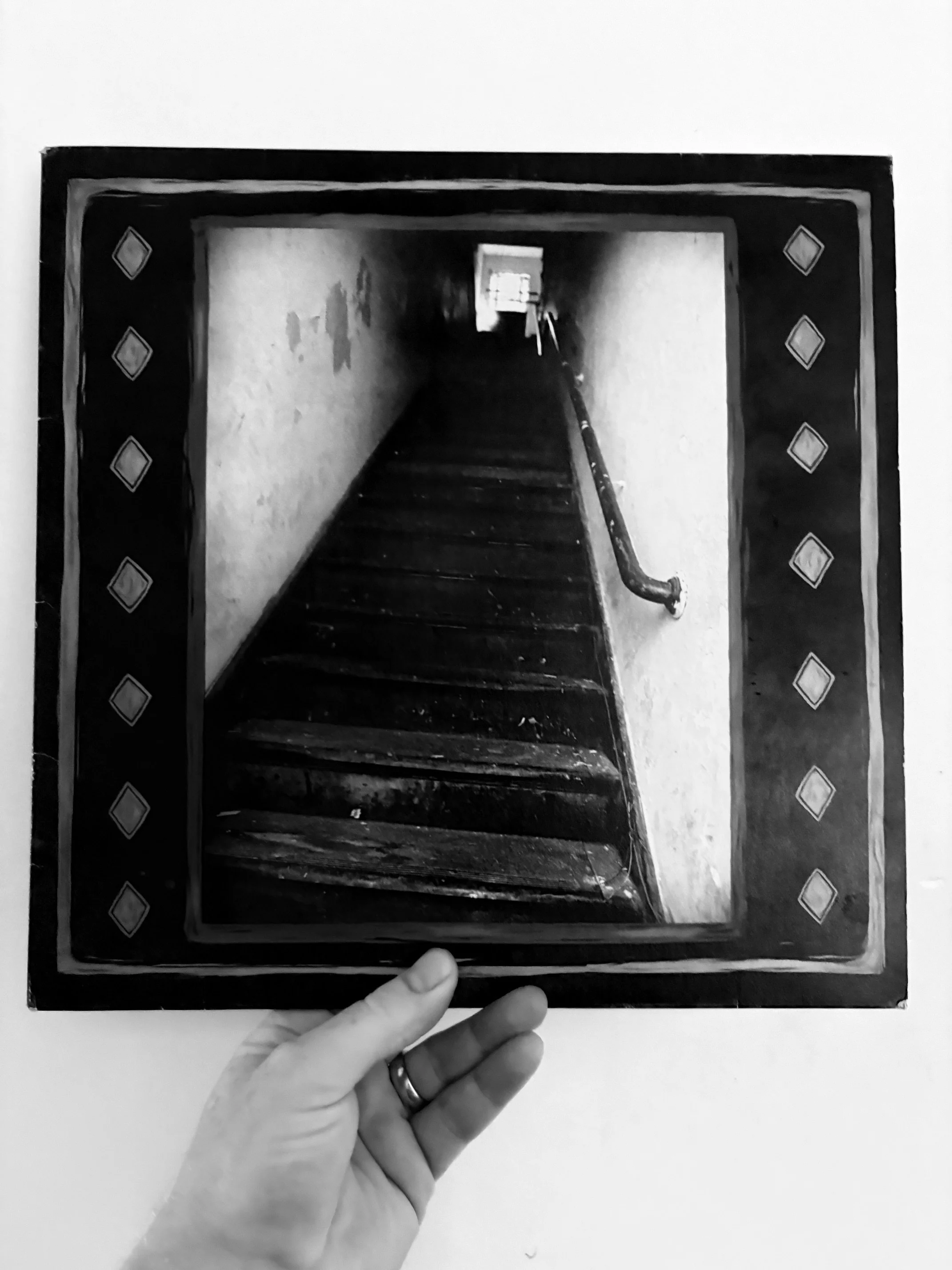
SWELL — 41
The Quietest Masterpiece of the Early ’90s
Some albums arrive in your life in ways that feel almost accidental, as if they simply wandered into your orbit and made themselves at home. Swell’s 41 was like that for me. Back in the early ’90s, when the gravitational pull of MTV was still strong enough to shape a teenager’s musical universe, the channel acted as both gatekeeper and benevolent guide, feeding us an endless cycle of the era’s most famous songs while also, if you stayed up late enough, offering something stranger, quieter, more intriguing.
That show was Alternative Nation hosted by the impossibly cool Toby Aimes. It was a portal of college radio, basement recordings, bands whose names barely registered in the NME but which felt, in those late hours, other worldly. It was there I first heard “Forget About Jesus” by a band I’d never encountered before: Swell. Amid the blizzard of grunge, metal, hip‑hop and flannel‑soaked angst, something about its drifting rhythm and understated melancholy stood out.
Living in a small Yorkshire town in 1994, getting hold of their album 41 was no simple task. It meant walking to town, sheepishly stumbling into Our Price, flipping through racks that rarely strayed far from the charting mainstream and eventually ordering it on vinyl, a process that felt more like a trial rather shopping experience. Two weeks later a phone call to say it has arrived, then the trek back into town in those well worn Doctor Martens to collect the slab of black plastic and cardboard that I didn’t yet realise would become one of the foundational artefacts of my musical life.
At the time, my listening habits leaned heavily toward the louder end of the spectrum. Long‑haired singers, riffs at unbearable volume so 41 was a different proposition entirely. It was led by the rhythmic acoustic guitar of singer songwriter David Freel, played with the confidence of people who understood the power of restraint, accompanied and enhanced by electric guitars melodies that hovered in the background like ghosts. The stop start drums felt strange as if someone had shifted the rhythm a few degrees off centre just to see what would happen and are a key component to the record’s feel. David Freel’s vocals didn’t roar or strain; they drifted, almost blending into the mix, occasionally soaring slightly to elevate the melancholy.
Every track felt like a small world, self‑contained and quietly luminous. It lacked the polished precision of the era’s big alt‑rock records, but that was precisely the point.
Even now, listening back to my well-worn and slightly dogeared copy, the album retains that same intimate glow, the sense that it was made in rooms you can still imagine, by people unpretentious enough to let the music simply be. It’s casual, warm, loose, intimate and quietly gorgeous. It reminds us that brilliance doesn’t always shout, it sometimes murmurs, drifts, hangs in the air like cigarette smoke or the final notes of a half‑forgotten song.
Whenever someone asks me what my favourite album is, a question I never find easy to answer, 41 is the record that always rises to the surface. Not because it’s the “best” in any objective sense but because it feels inseparable from who I became as a listener. In a world that constantly demands grand statements, 41 was quietly radical: modest, subtle and unbothered by the need to impress.
John Peel once said, “If Pavement are the new Nirvana, then Swell are the new Pavement.” a throwaway line for sure but there’s something true in it. Swell existed in that liminal place between slacker indie, post‑punk hangover and the embryonic textures that groups like The Beta Band would later develop. You can hear the prototype in 41, that low‑key swagger, the half‑smile in the vocals, the memorable drum parts, the sense of a band entirely content to follow their own odd geometry.
Albums don’t always change with us, some stay exactly the same, and we’re the ones who shift around them. 41 is like that. It’s a fixed point and has never been far away from my thoughts.
Which is why it firmly belongs in the Cult Continuum. Not because it was relatively obscure, though it certainly never troubled the charts, but because it lives in that rare space where the people who know it, know it deeply. Time has buried it somewhat under the crush of new releases and shifting scenes but that only makes it more precious.
— Matthew McPartlan, 30 June 2026
It’s Such a Fine Line
by Amy Collins

What’s really turning me on these days is leaf miners.
Before we talk maggots, I will give a brief seedling update: I can’t move for growing veg. The big planters I made from salvaged bedframes are bursting at the seams. My climbers and sunflowers are well taller than me. Sugar snaps that started out in Vegemite jars were second only to rocket to ripen. It was a great day when our Ollie and Emmy could finally pick the fruits of their labour and the kids confirmed that the crunchy green pods were extra delicious precisely because they planted them. Result.
I’ve had two sets of friends over this week and fed them various delights from my garden including brocolli and edible flowers, and our first tomato flowers have already gone to fruit. My devotion certainly hasn’t dropped off since April. I’ve truly got the bug! In fact I deleted my Hinge dating app this week. Not because gardening is taking up all my spare time, though it is a question of maths. One activity is soul nourishing and the other soul destroying. I’m not having anything taking away this buzz.
Anyway. Leaf miners.
First of all, great branding, guys. What a name. When I looked it up, my mind immediately went to the diddy green construction workers, Doozers, with their hard hats, working down in Fraggle Rock. Leaf miners aren’t even green, but they are mining green. That’s what it looks like to me, someone going around hoovering up the green.
As I had to Google this natural wonder myself (Google is absolutely on one lately, unrecognisable—what a faff), I’m going to assume some of you won’t know either. A leaf miner is the larvae stage of various moths, flies and beetles, living inside the leaf and feeding as they go. I’m loathe to call them pests, but The Old Farmer’s Almanac will happily tell you how to get rid of them.
It’s not the grub I’m excited about per se. In fact, you’d need a magnifying glass to see them. It’s the trails, the marks they leave behind. By munching along they create these gorgeous, swirly, organic but stuttery doodles.

Leaf miners are all about that yummy green chlorophyll. When the moth eggs hatch on a pea leaf, the larvae burrow in between the leaf layers and start making a path. Everything in that middle layer is food. Imagine wriggling through a sleeping bag filled with buffet scran, the only way out being to eat your way through it. Sounds great, if not claustrophobic.
As they move, they erase. When I first noticed that it looked like someone had been at my veg with a Tippex pen, I got curious.
I’ve written about my love of accidental, ephemeral art before, and I happen to have a soft spot for overlooked and slightly maligned creatures, your pigeons, rats, and of course slugs of this world. So, this really got the juices going.
While I’m here, I have to mention THE greatest thing about NOW TV finally getting HBO Max. Animals. The Duplass Brothers-produced animation where New York rats, pigeons, bedbugs etc. all just crack on with their lives. Relationships, crises, existential dread. E.g. A queen ant learns what her colony really think of her. Pshhh comedy genius!
Anyway. I digress.
Leaf miner tunnels. That idea of a line being less about intentional drawing and more about movement resonated with me. Something happening over time and leaving a trace behind, like desire lines.
Apart from taking photos of the squiggly leaves I didn’t think much more of it until I was in London recently, to see Super Furry Animals. I ended up in the Tate Modern and stumbled across a Richard Long exhibition. It was a bit of a timewarp. He and Andy Goldsworthy were a big focus of mine back when I was studying art in 2003 and now we were reunited. I’d been fascinated by the impermanence of land art then, the idea that just walking through a landscape or arranging a few stones could leave a trace that counted as art. Once you took a photo of it (optional) and left it there in nature, it would obviously change, be eroded further or even be grown over. We will never know.
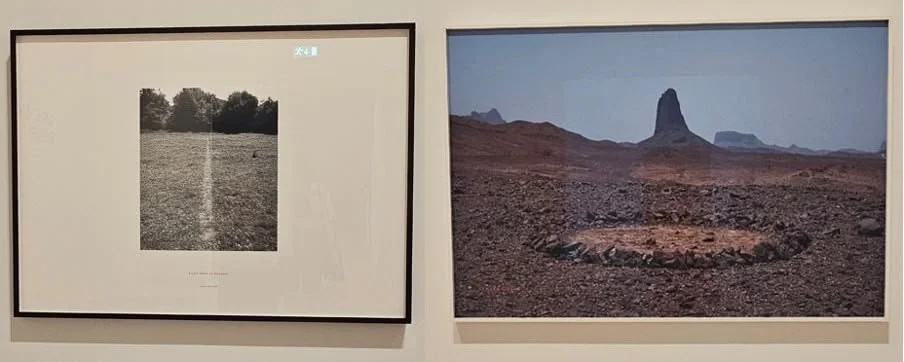
A Line Made By Walking & Sahara Circle - Richard Long - Tate
In his work Long is walking, pouring, repeating, doing something simple and letting it leave a mark. Not so much a picture of anything, more just evidence that it happened.
He has a gallery piece that I did not see this time around but remember well, White Water Line. It’s just a long, pale line snaking through a floor space, river-like. I wrote about this while studying back in the day. Looking at it again via the Tate site reminds me of a well‑mined leaf.
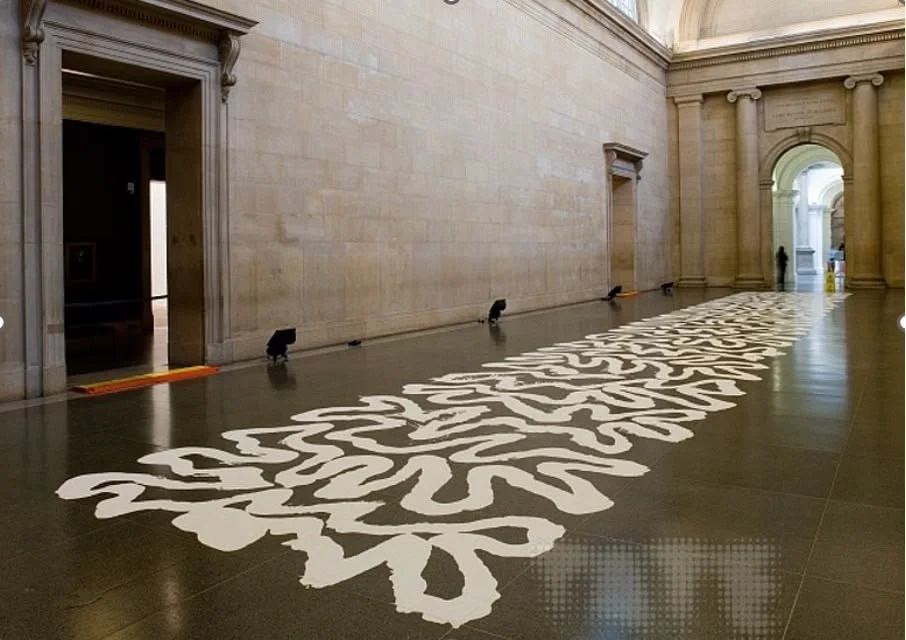
White Water Line - Richard Long – Tate
And then, at some point, the whole thing just… stops. The line ends. The larvae has eaten its way as far as it needs to and breaks through the surface of the leaf, released out into the world. It drops off, disappears, goes on to become whatever it’s meant to become, and all that’s left is a tiny piece of art that will end up in the belly of a slug or the compost, until even the trace is gone.
—
Amy Collins has recently deleted all her dating apps having concluded that a relationship with a leaf-mining larva is significantly more soul-nourishing and far less likely to involve a "faff" with a confusing interface. She operates on the theory that the only honest way to navigate the modern world is to eat your way through it, ideally while encased in a high-fidelity green sleeping bag.
Heeding
by Victoria Raftery
We didn't say lessons will be learned back in my day; they were just lessons
Now heeding: that was a verb we all heeded
The word kirpan: not heard that word before. When we played our Christmas word-games did the word kirpan come up?
When we pulled our Christmas crackers and punned and joked to the max, Gran and Aunty Vi snoring while the rest of us washed-up?
One of us did. One of us warned of the threat. But that was a long time ago, she's long dead and we all thought she was nuts
I deadhead my annuals: begonia, petunia, marigolds…bloody slugs
Lessons will be learned; our hearts go out to the family; there will be an inquiry…
I take my secateurs to the neck of my latest victims; goodbye daffodils, goodbye tulips
It's easy to decapitate plants
All you need is a sharp knife or a machete
—
The tulips came off cleanly. The daffodils came off cleanly. The begonias, Victoria Raftery notes in her garden book, will require a second visit. Nobody in the household asks what she is doing in the garden with the secateurs. Nobody, over the years, has ever asked.
The Gen Alpha Lexicography
by Maya Chen
25: 'Mid'
Etymology: From Middle English mid, a shortening of middle (centre, midpoint), from Old English midd. Survived as a compound prefix (midnight, midsummer, midriff) and as the first half of various hyphenated formations, but had largely retired from standalone adjectival use by 1700. Recently revived, around 2020, by adolescents as a single-syllable verdict on cultural products, deployed with finality and admitting no qualification.
I made what I thought was a reasonably good roast chicken on Sunday. My daughter ate the chicken. She also ate two roast potatoes, some carrots, an entire Yorkshire pudding and most of the gravy. At the end of the meal, having cleaned her plate to a polish that the dishwasher could only aspire to, she put her knife and fork down and said, "that was mid, Mum."
I asked her to clarify. She was patient with me. "Mid," she said. "Like, fine. Not bad. Just mid."
I took the plates to the sink and considered, for the eight or nine seconds it takes to scrape remanants off a plate into a bin, the relationship between an empty plate and a one-word review of the meal it had once been.
The grammar of mid is interesting. Other verdict words require modification, the "quite good", "actually amazing", "really terrible" of ordinary English. Mid stands alone. It will not be qualified. "It was mid" admits no degree. There is no "very mid" or "almost mid" or "borderline mid". The thing is mid or it is not. The category is binary in a way that even the strictest qualitative researcher would consider unsuited to most subjects.
Crucially, mid is also descriptive rather than dismissive. Or at least it presents itself as descriptive. The child saying "that's mid" is not insulting your roast chicken, your music recommendation or your birthday present. They are simply, in the way an honest reviewer might, reporting that the experience fell within a specific zone of the quality distribution, one that does not warrant the energy of further comment. The neutrality is the cruelty. A bad meal can be re-attempted. A mid meal has been judged and the judgment is final.
What 'mid' tells me, after twenty-four previous entries of trying to understand the way my children process culture, is that an entire generation has organised its experience around a single principle: most things are not, on balance, worth the bandwidth. The principle is not articulated. It does not really need to be. It runs underneath everything they say about music, films, social media accounts, dinner, holidays, weather, school assemblies and the people who teach them maths. The default verdict is mid. This has been the case for several years now. The category of things to which the verdict applies has, in recent months, expanded into territory I had not previously considered subjects of verdict at all.
There is, in all of this, a covert defence mechanism that I should probably leave alone but cannot. To declare most things mid is to inoculate yourself against the possibility of being disappointed by them. The expectation has been pre-managed. The bandwidth has not been allocated. If the thing turns out to be brilliant, it is a surprise. If it turns out to be merely fine, it has met expectations. Either way, the child wins.
I am, of course, not winning. My roast chicken was, in my best objective estimation, considerably better than mid. The application of the word to it represents either an error of taste or a deliberate provocation, and after twenty-four entries I am no longer entirely sure which.
Next time: 'Goated' - the highest possible accolade in a generation that has decided most things are mid.
—
Maya Chen commissioned an oil-on-canvas portrait of the rejected chicken here, exactly to scale, in the style of late-period Lucian Freud. The painter charges by the feather. The frame, eighteenth-century gilt, weighs more than the original meal. She will hang the piece in the kitchen, opposite the chair her daughter has occupied since 2018. Her son, who has reviewed the early sketches, has informed her that the project is "kind of unhinged, Mum, but in a way I can respect." She has noted this response.
Beat Surrender
by Karl Whitney
Bands are like pets: they live shorter lives than we do. The arc of a band’s existence provides a good way to think about mortality, false starts and endings, epiphanies both true and false. When a band breaks up it can feel like a miniature death. The Jam’s life was brief: five years of records between 1977 and 1982. When they went they were mourned. Periodic calls for their resurrection were ignored by their lead singer Paul Weller.
I wanted to listen to The Jam while thinking about my uncle Kevin, who died at the end of May. At the funeral, the music of Paul Weller and The Jam featured heavily, reflecting Kevin’s taste. Helping to choose music for the ceremony reminded me of the kinds of decisions my family made when my dad died: The Byrds; Simon and Garfunkel.
What is it about death that makes one listen to music more keenly? There’s a sense of urgency and a rare clarity. Is it about the person who’s gone – or about the lost connection between you? Eventually, after the gathering of the funeral, listening to music becomes an act of remembering that’s typically performed alone.
I hoped to consider this while listening to The Jam’s Greatest Hits, which, as far as I can recall, I bought in Golden Discs in Dublin’s ILAC Centre very early on in my music-buying career, when my uncles’ taste shaped my own considerably. Even still I can reach for albums by Elvis Costello, The Beautiful South, R.E.M. and The Stone Roses and each will remind me of one of my uncles.
But how closely would I listen to a CD that I had only heard sporadically over the years? In fact, there had been over a decade during which I didn’t have it with me at all. It turned out that I would listen pretty closely, and it’s only a mild exaggeration to say that it was as if I was hearing it for the first time. (‘WE DON’T PAY ENOUGH ATTENTION TO THE TEXTURES OF LIFE’, I scribbled on an A4 pad.)
My uncle Kevin had the reputation of having been a great footballer as a young man. It gave him an aura. We had kicked a ball around together outside my family’s house, and I watched for signs of his skill. Sure enough, they were still there: the spins and feints; the curled finishes. He had accompanied me to the music shop to help me buy my first guitar. I had looked up to him, and, when I heard of his death, I grieved.
When I took the Greatest Hits from a stack of CDs I was in that peculiar frame of mind which seeks to imbue every lyric, every small occurrence with a symbolic weight. As the final track, the joyful, melancholy epitaph for the band, ‘Beat Surrender,’ faded out, I considered what I might write about this conscious wrapping-up of the band’s legacy, this good death.
But I must have accidentally put the CD player on repeat, because, at the end, ‘Beat Surrender’ faded out and was followed, not by the silence I expected – one that was necessary for contemplating the demise of a great band and, more generally, mortality itself – but by a return to the furious, wiry riff of ‘In the City’. It was as if the songs refused to go quietly into the dark. So I thought instead about an eternal return, of a life that can be played again and again until we get it right – if, that is, we ever can.
—
Karl Whitney has, most evenings, been arriving at the same passage in the same book without having, so far as he can tell, moved the bookmark. The passage is on page 202. He does not know what is on 203. On the mantelpiece, a photograph of a footballer nobody in the family recognises turns, each morning, ninety degrees clockwise. A pizza he does not remember making sits on the countertop, cooling at approximately half the accepted rate. In the front room, The Jam are on the last chord of 'The Bitterest Pill' and have been for some time.
The Fortnight
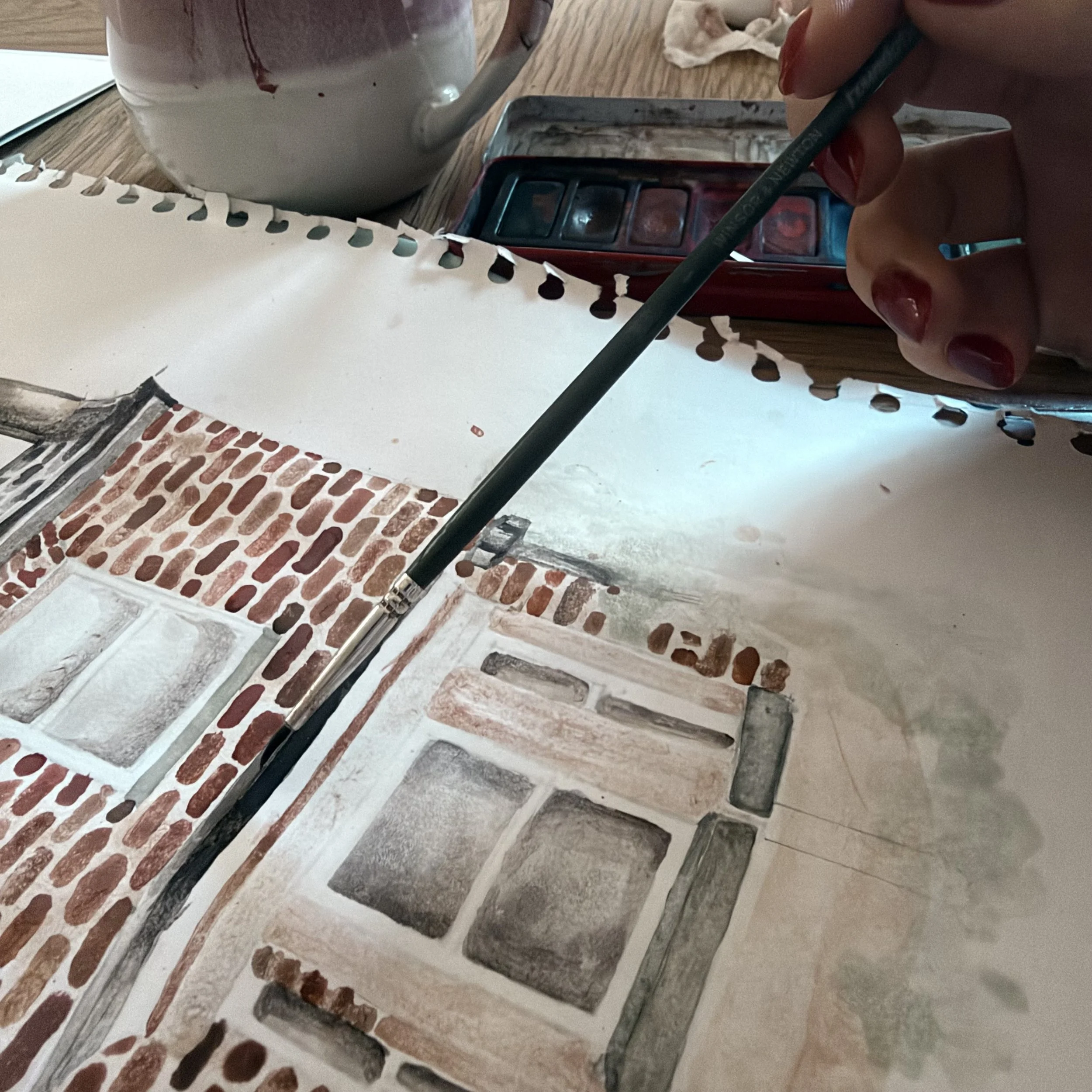
Martha Painting Houses
Did You Ever / Sage Darley
FIP Radio, just before the first email of the day.
Days Of Us / Tom Misch with Kaidi Akinnibi
Radio Paradise, all the windows open, the world behaving.
Etyd / José González
Radio Paradise. Held on the coffee to hear the ending.
Poco a poco / Aure
FIP Radio, evening, one hand on a tea towel.
Green Dragon / Maya Hawke
Discover Weekly. It got one right.
Are You with Me Now? / Cate Le Bon
M62 east. Thursday. Liverpool at the end of the heat.
Juno / Throwing Muses
Coffee Shop. The barista on the aux, and better at it than most.
If Only My Heart Could Speak / Cody Fry
Radio Paradise. When ironing became briefly ceremonial.
Bless Y'r Soul / Kris Dane
M62 west, midnight, just an album and the vents.
Une longue journée de travail / Gatien with Suzanne Belaubre
FIP Radio. The Monday already stacking up behind the door.
There Is No Greater Love / Norah Jane with MOR.LOV
Office, one of those beautiful afternoons when nobody rang.
Dreams I've Had / tofusmell
Past midnight. A long email, edited, unsent.
Memory Lane / Penny Arcade
On a run, at the point where the legs stop objecting.
American Dream / Ondara
Headphones on. Somewhere Lee Dixon was talking.