
Science & Magic | 31
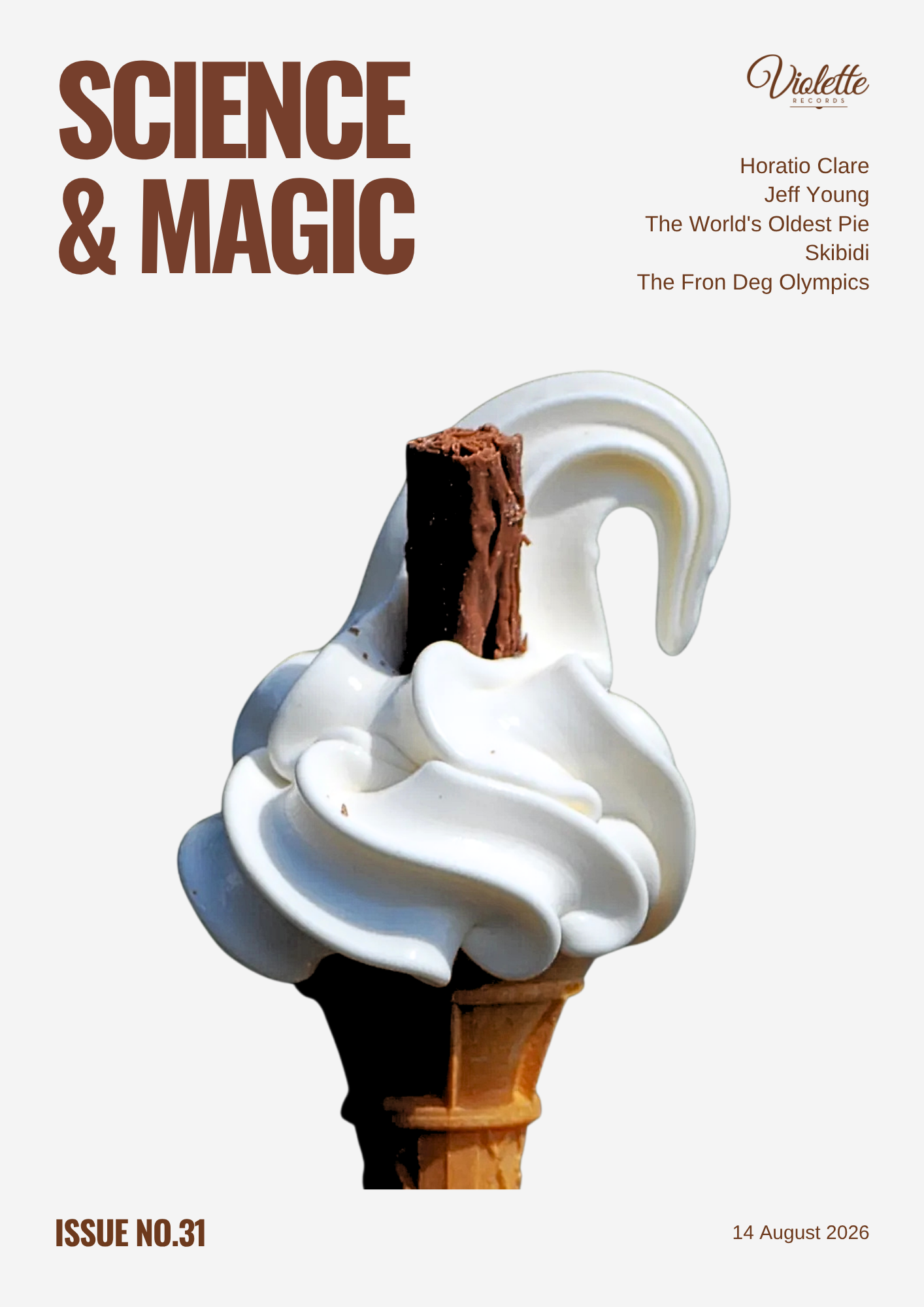
It always starts with Greensleeves, coming up our street at the speed of a man with absolutely no intention of waiting. Then the two questions. Does anyone want anything from the ice cream van? And then, fatally, what? Four brothers and sisters, and a list that jumped and changed its mind at least twice before it was finally settled. A screwball. No, a Mivvi. No, an Orange Maid, wait, unless he has Jubblys, in which case a Jubbly. By the time the decisions were fixed and final and I am sprinting out of the front door, the van had usually already gone round the corner to do the next street, and the final stage of the ritual is a flat sprint after a moving vehicle jangling Greensleeves, with added doppler effect, at full pelt again. I arrive incapable of speech.
The full family order survived the sprint half the time. But the smell inside the ice cream van survived everything, and it was that smell I was thinking about the other day.
You’ll likely remember the sensation: standing on your tiptoes, gripping the metal ledge and trying to see over a counter that was about four inches higher than your eye line. And then that smell hit you. It was a very specific aroma - a mix of diesel fumes, industrial-strength cold, ball-sweat and a thick, cloying sweetness that felt like it had been trapped in there since 1974.
I’ve never been able to figure out the exact chemistry of it, but it smelled like sickly gift and a dusty promise.
And a lot of frantic arithmetic. Whether the random coins my mum had emptied out of the change section of her purse would cover an order I was by then breathlessly reciting to a man with a queue behind me that looked like the cast and extras from Bless This House. Hoping to God they would.
My love for all the stuff he sold started early, mostly because it was a rare event. Growing up in a large family, my mum was far too smart to ever drop a Walls Vienetta into the freezer. She knew the reality of that situation in a house with so many mouths. A luxury item like that wouldn't just be eaten, it would literally vaporise. The victim of a brutal heist before the box was even cold.
So I spent my childhood obsessing over the accessible end of the icy menu. The Dracula lolly that turned your tongue a bruised, permanent red. The Walls Feast with that rock-hard, mysterious core that felt like it might actually be wood. Or the Mr. Freeze, which was basically just frozen chemicals in a plastic sleeve designed to slice the corners of your mouth.
I loved them all then, as I still do now…
I’m older now but I haven't really moved on. When I’m on holiday, I have a biological need to eat my own body weight in Calippos. I’m still just that kid standing on the pavement, clutching a few coins and looking at the faded stickers on the side of a Bedford CF like they were sacred texts, because they were.
I’m thinking it’s all going to sound a bit self-absorbed to wallow in the nostalgia of the ice cream vans, so I’m going to have to figure some smart angle onit. Maybe something about the honesty and beauty of things that are designed to disappear? How you can't hoard an ice cream. And you can't archive it or "optimise" it for later. You just have to stand there in the sun and deal with it before it hits your shoes. There, that’ll do.
Welcome to the latest edition. We’re still here but we’re all out of paper napkins.
Matt
PS. We're taking the rest of the summer off to pursue a collective breakdown in private. Jeff has kindly offered to drive us all to Kirkhill-on-Sea in the Science & Magic minibus, a vehicle that has all the structural integrity of a damp Digestive and smells vaguely of 1982. Jeff reckons he knows a "shortcut" that involves navigating by the alignment of high-altitude birds, in conjunction with a map he found inside an old copy of Internationale Situationniste.
We’ll be back on 11 September, by which time it’ll be raining and nobody will want a Mivvi anyway. Except me.
Ten Questions
by Horatio Clare
Horatio Clare writes about crossings.
Whether that’s a swallow's from South Africa to a barn in Wales in A Single Swallow. A container ship's, in Down to the Sea in Ships. His own, in Heavy Light, into psychosis and sectioning and out the other side. And now the Channel, in We Came by Sea: Stories of a Greater Britain, shortlisted for last year's Nero non-fiction prize and turning out to be a book less about the boats than about the volunteers in Calais and the lifeboat crews who go out to meet them.
He’s a broadcaster and lectures in non-fiction at the University of Manchester, presents Is Psychiatry Working? on Radio 4 and lives in West Yorkshire with his family.
We asked him to choose ten questions from the archive. He sent back ten short essays, one of which will even teach you the harmonica.

Horatio Clare
● What song is permanently fused to a specific place or holiday – to the point where hearing it transports you instantly?
I was working on a tourist barge on the river Rhone one long hot summer when I was a student. We had a few days between charters and all the crew left except me and the mechanic. The barge was huge and luxurious and all ours. We were moored south of Avignon and every day was heat and cypress trees twisting in the distance, and every night was hot and starry. I was listening to Joni Mitchell's Blue obsessively, and the song 'River' riddled a channel right through my soul. Whenever I hear it, I am back on that barge, watching the horizons of the Midi shimmering.
● What song instantly takes you back to your school disco?
R.E.M. - 'It's the End of the World as We Know It (And I Feel Fine)'. I went to an international school in Wales for sixth form and the music taste was mad and diverse, and the dancing was wild. We had pogoing punks, Goths who danced like herons, a Saint Helenan who moved like Michael Jackson, Botswanans, Bulgarians, Aussies, Swedes – and plenty of views on what was worth listening to. We all loved this one, though. You can dance to it in any style you like as long as it's hectic.
● What song became the anthem of your first teenage friendship group, played endlessly during that one unforgettable summer?
The Stone Roses, 'Waterfall'. Three of us had been expelled from school but allowed back to take our GCSEs. For some reason we were banned from leaving the school grounds or wearing anything but our uniforms, and the summer of 1989 was bright, and everyone was young and defiant and straining for action and love affairs. And then this tape turned up, and everyone copied it, and everyone listened to it non stop. There was a lot of fantastic music around – The Cure, Inspiral Carpets, the Happy Mondays, we played The Clash non stop, the Wedding Present, Bowie, the Pixies – but the Roses were something else, and that song in particular is genius. The fact you couldn't hear half the words made it even better: it was a pure flow of longing and beauty, somehow defiant, somehow grubby, somehow majestic, all beautiful. It was us.
● What's the first record you saved up to buy with your own money?
We tended to buy cassettes because they were cheap and you could play them on your walkman when you were supposed to be working, but the first vinyl I bought was The Stone Roses - 'Made of Stone'. That blue and white John Squire cover in his Pollock style. I saw it in Woolworths (long gone) in Abergavenny (still there) and grabbed it one second before another lad. I still remember the look on his face, and I felt awful, but what a prize.
● What was the first song you ever learned to play on an instrument (even badly)?
The Beatles, 'Love Me Do' - I had a harmonica. It was the perfect instrument: you either sucked or blew, and it made very impressive noises. Even for a completely hopeless git, 'Love Me Do' offered the chance to be a musician. It goes like this: Suck, blow, suck blow-blow-blow... See?
● What album got you through your toughest time?
J.S. Bach, Cello Suites. I was at university when I first met depression. We didn't have any language for mental health: anxiety was not a thing and I had never heard of depression. All I knew was that I wanted to die. I thought I was going mad. The floor seemed to have fallen out of the world and taken my soul with it. None of the music I loved could help, but then my father gave me the cello suites, and somehow they got me through. They seem to place you at a certain distance and angle to life. They promise and gesture to something eternal and beautiful and kind, and when nothing else could help, they did. They still do.
● What song served as the backdrop to your first genuine heartbreak, and troubles you to hear now?
Tom Waits, 'Martha'. I was in New York, in love with an artist, and she had a compilation of Tom's songs. She lived in Greenwich Village and we were mostly nocturnal, going to the deli in the middle of the night, and we turned heads, partly because she was black and I was white and that was unusual in Manhattan then. It was the most intense and vivid time. We were young night hawks in the diner. When the hot clouds caught on the tops of the skyscrapers and burst, you could imagine Small Change being rained on with his own .38 in Washington Square. We kissed on fire escapes, made sculptures out of pasta and watched the night snagging on the conical water towers on the rooftops. She became a famous artist and we are still friends now, and it was an impossible love, damned by the very things which made it so longing - our youth, and the distance between Heathrow and JFK. But it was luminous and it was wonderful, and that song, still...
● What song or album makes you want to create?
I wrote my first book, Running for the Hills, mostly late at night, in a basement room in London, where I had a job at the BBC. Every night after work I rushed home and wrote for as long as I could, listening to Blood on the Tracks on repeat, volume down low. Or rather, I heard it, rather than listened to it, because I knew every note, so it wasn't distracting, but I think something of it is in the writing of Running.
● What album reminds you of someone you've lost?
The Waterboys - This Is the Sea. One of my great friends from that sixth form in Wales died much too young. He was very funny and clever and extremely mischievous and very tall and loud and German, and he loved music, belting it out and laughing his manic cackle. He especially loved the Waterboys, and whenever I hear them, there he is, grinning, so full of love and joy of life which he expressed in teasing and comic mockery. I don't believe the line between life and death is an impenetrable barrier. I think love moves across it in both directions. And I think that is one of the powers and promises of music. However much we know, whatever our certainties, there will always be truths and wonders much bigger and more powerful than our perceptions, and music and beauty are their signatures.
● What song do you associate with a major world event or news story?
A piece of music, rather than a song. After 9/11 Samuel Barber's Adagio for Strings, which my generation associated with the film Platoon, was everywhere. Because of that association it seemed like an elegy for an America which had somehow gone wrong, done wrong, and was now wronged in return, and suffering terribly. It seemed like an elegy for the promise of the West, too – the sadness and agony of it pointing to all the West had done to rest of the world, and the terrible things it was about to do, in Iraq, and in Afghanistan, and all the way to Gaza, which perpetrated by Israel, but which America and the nations of the west allowed, and allow.
At the other end of the scale is Beethoven's ‘Ode to Joy’, the theme tune of the European Union. I associate it with my first son's small childhood; we used to listen to it and bounce around on the sofa, and then came Brexit. The lovely thing is, I believe that in his lifetime, Britain will rejoin the EU. We all know any other course is nonsense, and although nonsense can be horribly dominant and warping, it never, ever lasts. The road to joy can be a long one, but we have each other and we have music to keep us company...
Magnetic North
by Jeff Young
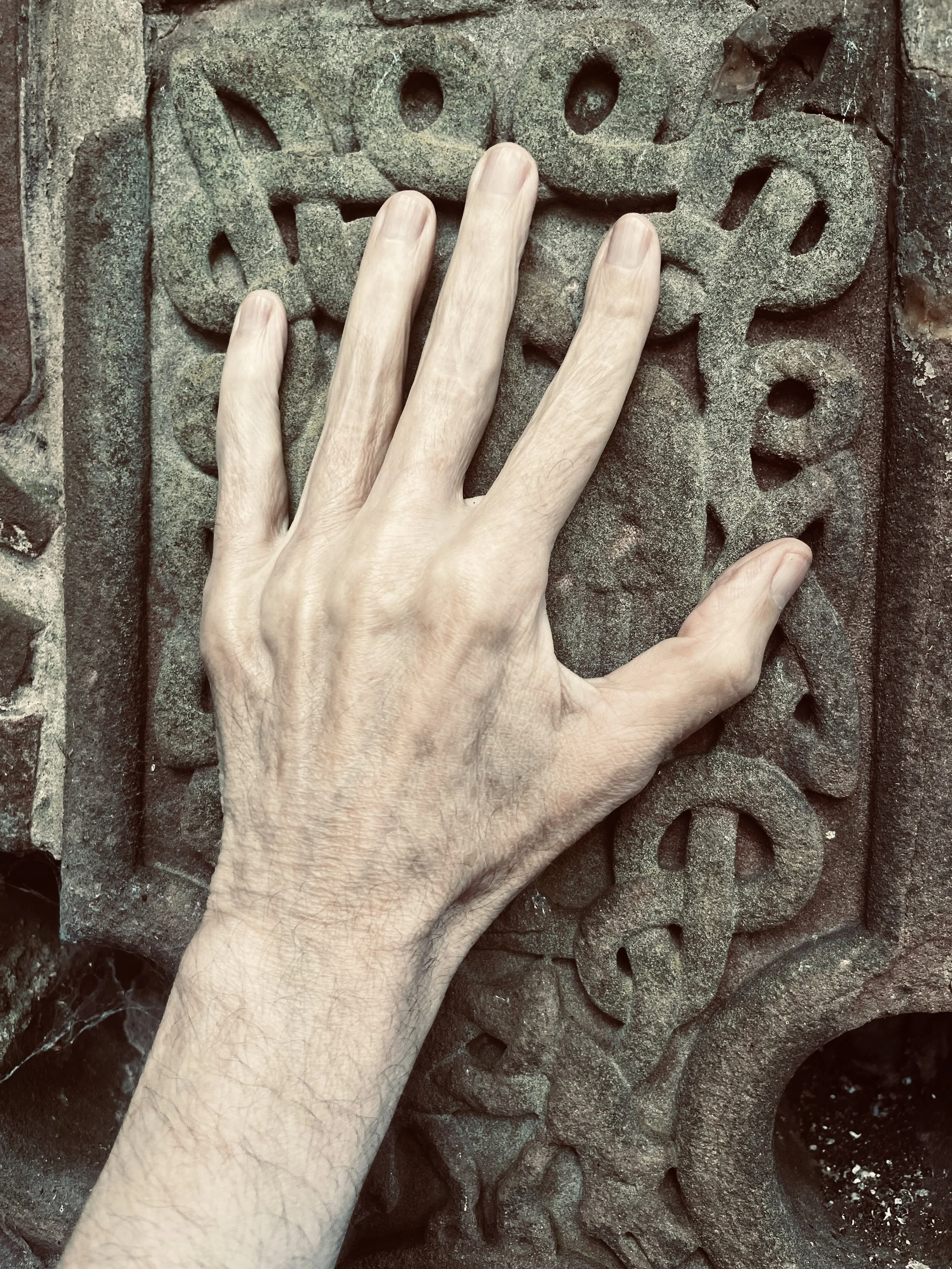
31 : My Left Hand
In Priory Woods I cup my hands together to catch a trapped Cinnabar moth, threading my fingers to make a gentle cage of bones. Inside the bone cage the moth flutters like a paper heart. After a moment or two I open the cage and the moth flies free across the dying grass. A year ago, I wouldn’t have been able to make a cage of my hands. Seven years ago, my left hand stopped working – one minute it was a working hand, next minute it was a locked nothing, like rusted metal, completely useless, fused like welded scrap.
I became fascinated (obsessed) by hands, always looking at peoples’ hands, at photographs of hands: Alfred Stieglitz’s photograph of Georgia O’Keefe’s hands, like strange insect-birds. Samuel Beckett’s hands cradling specs and cigar or knotted into gnarled clumps between his knees. A photo of him where his hands stretch a ribbon of film, bony wrists and fingers, delicate and elegant. The hands of women in Gwen John paintings, the hands of troubled souls in shadowed rooms. A hauntingly strange photograph of Joseph Cornell, his hand holding a bottle in front of his face, the bottle containing a metal grasshopper. I looked at the hands of praying mourners at a funeral. The hands of old women tidying their hair. The choreography of bird-like hands. The memory of my hand’s movement haunted the lifeless hand. The ghost of my own hand.
The more focused I became on my left hand – the more anguished I became - the more I hid it away. I’d hide it in my pocket or tuck it under my right arm to protect it. Safe from pain, safe from scrutiny. As the months passed by it became more and more twisted and wasted, painful. Its skin became wrinkle free, pale and waxy, dead. I couldn’t separate my fingers. I couldn’t thread my fingers together, couldn’t make a church or a cage.
I spent a lot of time in hospitals looking at my hand while other people looked at my hand. What is a hand if it doesn’t work as a hand should work? When you can’t hold a fork or an apple, can’t type, can’t tie a shoelace or button your shirt, can’t slice a potato, can’t hold a child’s hand...
A few years ago, I wrote an essay called ‘My Father’s Hands’ for Echtrai journal which contained this meditation:
‘It occurs to me that my father’s hands are also a place – they are a centre of meaning, small events, the shaping of small details in time. All the stories he has lived are mapped onto his hands in injuries and scars, in the ink ingrained in skin, the liver spots and wrinkles. The architecture and movement, the shapes they make in air, the falling into position, the hands at rest...’
And in my book Ghost Town I wrote these words about his hands:
‘And often in the night the chimney birds would come. You could hear them fluttering in the boarded-up fireplace. Then he would withdraw his hand and in the nest of his fingers there would be one, sometimes two, naked birds, scraggy bundles of bird bones, twisting, beaks agape, coated in ash and dust.’
I think of hands, I think of moths, I think of ghosts, I think of birds.
After six years of having no left hand – or having a ghost hand - I met a physiotherapist who spent fifteen months working with me to fix my hand, to reimagine my hand, to bring some movement back into my rusted metal fingers, to get me to talk with my hands again.
My hand has returned to me. It feels like a bird. In my memory, in my dreams, birds are always turning into hands and hands are always turning into birds.
— Jeff Young, 12 August 2026
—
Jeff Young has recently begun delicate, telepathic negotiations with his own shadow, having concluded that his left hand spent the last seven years living a second life in a parallel dimension. He believes that fingers are "flightless wings" waiting for the correct atmospheric pressure to redeploy. Jeff is currently investigating whether it’s possible to catch a memory in a "cage of bones" and is building a scale model of a 19th-century infirmary out of nothing but Sellotape and bird-song. He refuses to wear gloves, fearing they act as a "silencer" for the stories his skin is trying to tell.
The Paphides Principle
Pete's has a theory that the surest defence against being goaded into a futile rage is to be very busy with something small, absorbing and of absolutely no importance whatsoever. He’s chosen to demonstrate this rather than argue it, at some length, using a vintage toy fire engine.
New Shiny Object is Fujiya & Miyagi's new album and it arrives on 30 October. 'Lowest Common Denominator' is the first song from it, announced this week. They're from Brighton, and Pete has questions for everybody who has yet failed to notice them.
This one reached him at Departure Gate 681, between a security scanner and a delayed flight to Bordeaux.
Fujiya & Miyagi - 'Lowest Common Denominator'
The Sony Fontopia MDR-E232 Earphones – and more specifically, the case in which they came – were a design classic, a perfectly circular yin and yang of form and function. I loved them; and between 1984 and sometime around the mid 2000s, maybe you loved them too. The earphones came in their own little clam-like case. You placed them in their designated holes, snapped the unit shut, placed your forefinger on the rotary winding window on the upper face of the unit and wound in the lead – thus precluding an irksome spot of detangling when you next needed to listen to say, So Good by Mica Paris, New York by Lou Reed, We Too Are One by Eurythmics or Missing...Presumed Having a Good Time by the Notting Hillbillies [feel free to replace any of these with other Walkman-era big hitters]. But sadly, Sony stopped making them around 25 years ago.
Sure, I have a pair of Bluetooth earphones, but if I'm pulling a six-hour writing shift in a cafe, my batteries are going to last about as long as one of Morrissey's managers. So I always make a point of carrying my trusty Flare Audio Jet 3 Titanium earphones, procured at least five years ago but still going strong. Unfortunately though, my Flare Audio Jet 3s don't come with a handy rotary-action storage clam, so I've had to create one of my own.
How have I done this? Well, 3D printers are great for this sort of thing. At least, I expect they probably are. But I have enough trouble getting a normal printer to work, so that's not an option for me. That's why I've invented the Whizzwheels Fire Engine Pizza Topper Earphone Jar.
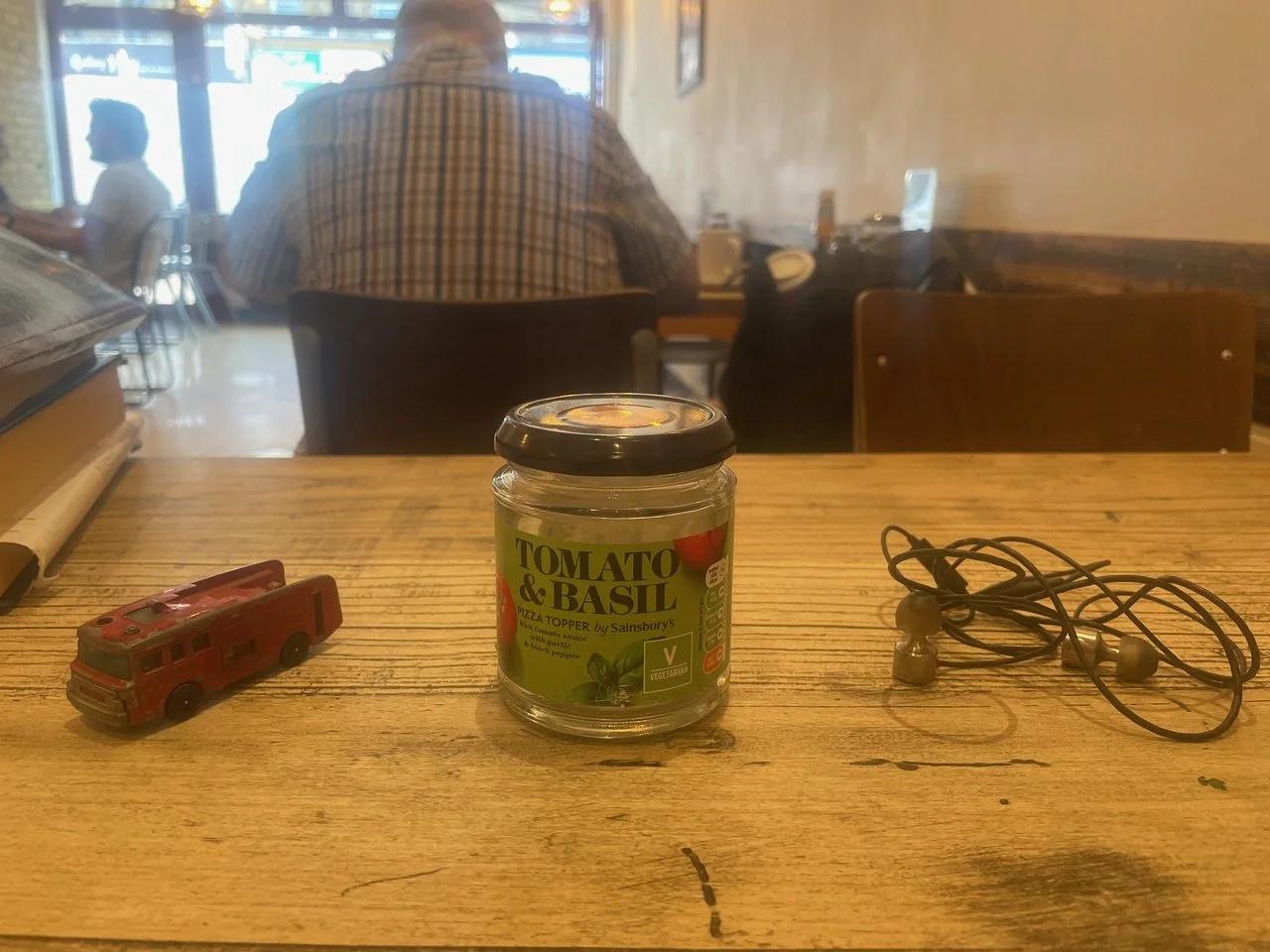
And you can also enjoy tangle-free storage for your earphones if you have these three items handy:
A die-cast Corgi fire engine from their early-to-mid-70s Whizzwheels range that you used to play with between the ages of around four and six.
A small empty jar (washed, obviously) of Sainsbury's Tomato & Basil Pizza Topper that your daughter and her boyfriend bought the other week when they decided to make pizza
A pair of Flare Audio Jet 3 Titanium earphones (RRP £49.95) You can probably use other cars from the Corgi Whizzwheels range, but I find that the slightly larger dimensions of the fire engine with its assorted nubbly bits are perfect for winding the Flare earphones and helping to keep everything exactly in place once you've inserted it in the jar and screwed the lid shut. Right now, as I write this, I'm seated at Departure Gate 681 at Gatwick waiting for the delayed 8.25am easyJet flight to Bordeaux to start boarding. Removing my laptop from my suitcase and Whizzwheels Fire Engine Pizza Topper Earphone Jar, I turned to my wife and said, "I'm surprised that the people operating the security scanners didn't want to know why I keep a small fire engine in a jar." Without looking up from her book, she said, "You know, I suspect there are a lot of things they see and then ask themselves, 'Do I really want to start pulling at that thread?'"
You can probably use other cars from the Corgi Whizzwheels range, but I find that the slightly larger dimensions of the fire engine with its assorted nubbly bits are perfect for winding the Flare earphones and helping to keep everything exactly in place once you've inserted it in the jar and screwed the lid shut.
Right now, as I write this, I'm seated at Departure Gate 681 at Gatwick waiting for the delayed 8.25am easyJet flight to Bordeaux to start boarding. Removing my laptop from my suitcase and Whizzwheels Fire Engine Pizza Topper Earphone Jar, I turned to my wife and said, "I'm surprised that the people operating the security scanners didn't want to know why I keep a small fire engine in a jar."
Without looking up from her book, she said, "You know, I suspect there are a lot of things they see and then ask themselves, 'Do I really want to start pulling at that thread?'"
While I wait for the gate to open, this gives me a chance to tell you about the return of Brighton's Fujiya & Miyagi who, this week, serve notice of their imminent new album New Shiny Object with a song from that record. It's a continuing source of total bafflement to me that Fujiya & Miyagi aren't revered as low-key national treasures in this country. It's not unlikely that you've never heard Fujiya & Miyagi because most people haven't. What do they sound like? Well, the two 21st-century artists to whom they've most often been compared are LCD Soundsystem and Hot Chip. I guess the former's 'Losing My Edge' shares certain characteristics with F&M – and both groups were commissioned by Nike to put together running soundtracks – LCD with their six-part composition 45:33 and F&M with a 43-minute mix entitled Different Blades from the Same Pair of Scissors. But I'd say they have way more in common with Hot Chip: the push and pull between their love of electronic music and a more traditional band set-up. There's also the fact that both have frontmen who sing in their spoken accents. If Fujiya & Miyagi don't feel some measure of confusion when comparing Hot Chip's success to their own lack of it, then I can only boggle at their zen acceptance of their cosmic lot.
But there are other things going on too. Cathode ray spectres of the young ESG, Prince, Neu!, New Order and Kraftwerk flicker in and out of view but the machine Fujiya & Miyagi have built for them is entirely their own invention. Much of that is down to the authorial voice of frontman David Best – that of a well-meaning, progressive man of a certain age who, whilst not wanting to go back to an imagined golden era, is struggling to figure out whether the future has any sort of use for people like him. And in the event that it doesn't, would it be OK if he just carries on anyway? The newly issued 'Lowest Common Denominator' is abundant in all the qualities I've just described. It is, to borrow a title from Kevin Ayers, a song for insane times. I think it's a song about a situation in which we all find ourselves. Goaded by malign forces into angry engagement that will ultimately achieve nothing other than boost the business model of some of the worst human beings of this or, indeed, any era. Succumb and you're part of the problem, so do something useful instead. Departure Gate 681 is now open. I wrap my earphone cord around its fire engine and pop it back in its jar. Not a second wasted. It's great to have you back, guys.
— Pete Paphides, 13 August 2026
A Time For Fire
by Angie Woolfall
'These walls will be here
Long after you've gone'....
The estate agents' eyes shone
As the viewers laughed
But a silent unease was felt by all
Unable to avoid impermanence
Its whispering call
Sending a sense of every brief candle
That here had ever lived
Whose sparks could have illuminated
The darkest of corners
Whose passions may have burnt this house to the ground
But who may have flickered politely
Playing down
The dying embers of their own light
Flames that should have raged never asking if they were too bright
Lights
Now snuffed out
Dreams long gone from sight
While these
Permanent structures
Their unapologetic features
Skyscraping brick towers
Safe as houses
Standing proud
Their strong shoulders
Have held up the years over
Sitting stacked
Stoical red bricks
Back to back
Anticipating
Each inevitable new arrival
Vans filled with boxes of hope
And brand new wicks
Thinking they too have all the time to blaze
But may find that they softly flick
A faint shadow
Not a bonfire build upon
These walls that will be here
Long after they too
Have gone.
—
Angie Woolferhampton has recently begun a series of nocturnal inspections of Liverpool’s terraced streets, convinced that the mortar between the bricks is a form of industrial-grade solidified grief. She believes that every house has a "thermal memory" of the people who were too polite to set it on fire and she spends her mornings attempting to measure the exact temperature of flickering hope before it turns to ash. She told me yesterday of her investigations to determine whether it’s possible to ignite a permanent structure using only the rhythmic friction of a well-aimed poem. She was last seen trying to explain the concept of impermanence to an estate agent, insisting that his "shining eyes" were merely a reflection of the bonfire that hasn't happened yet. But it will soon. Hopefully.
A Song for Pluto
by Donna Enticknap
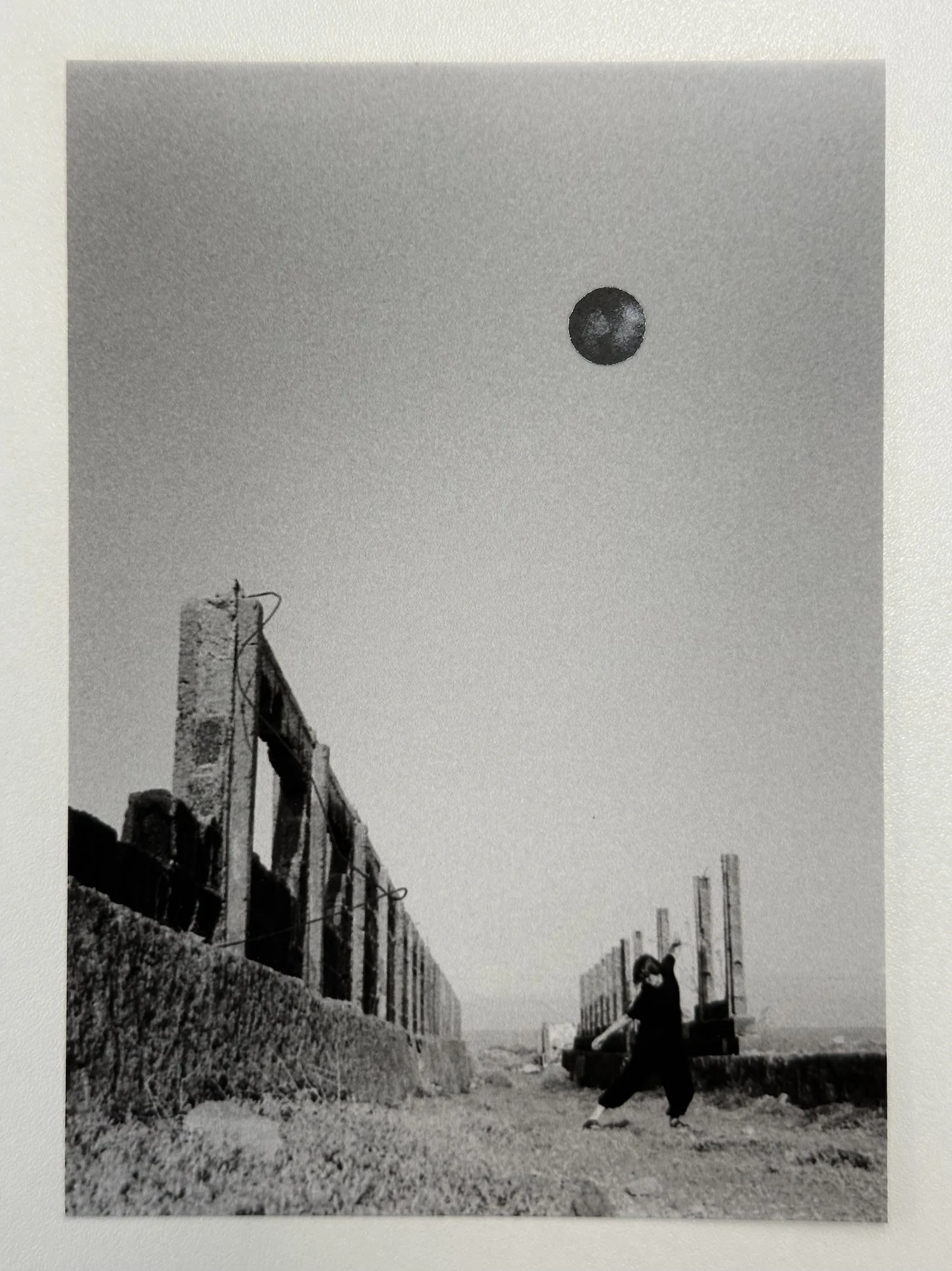
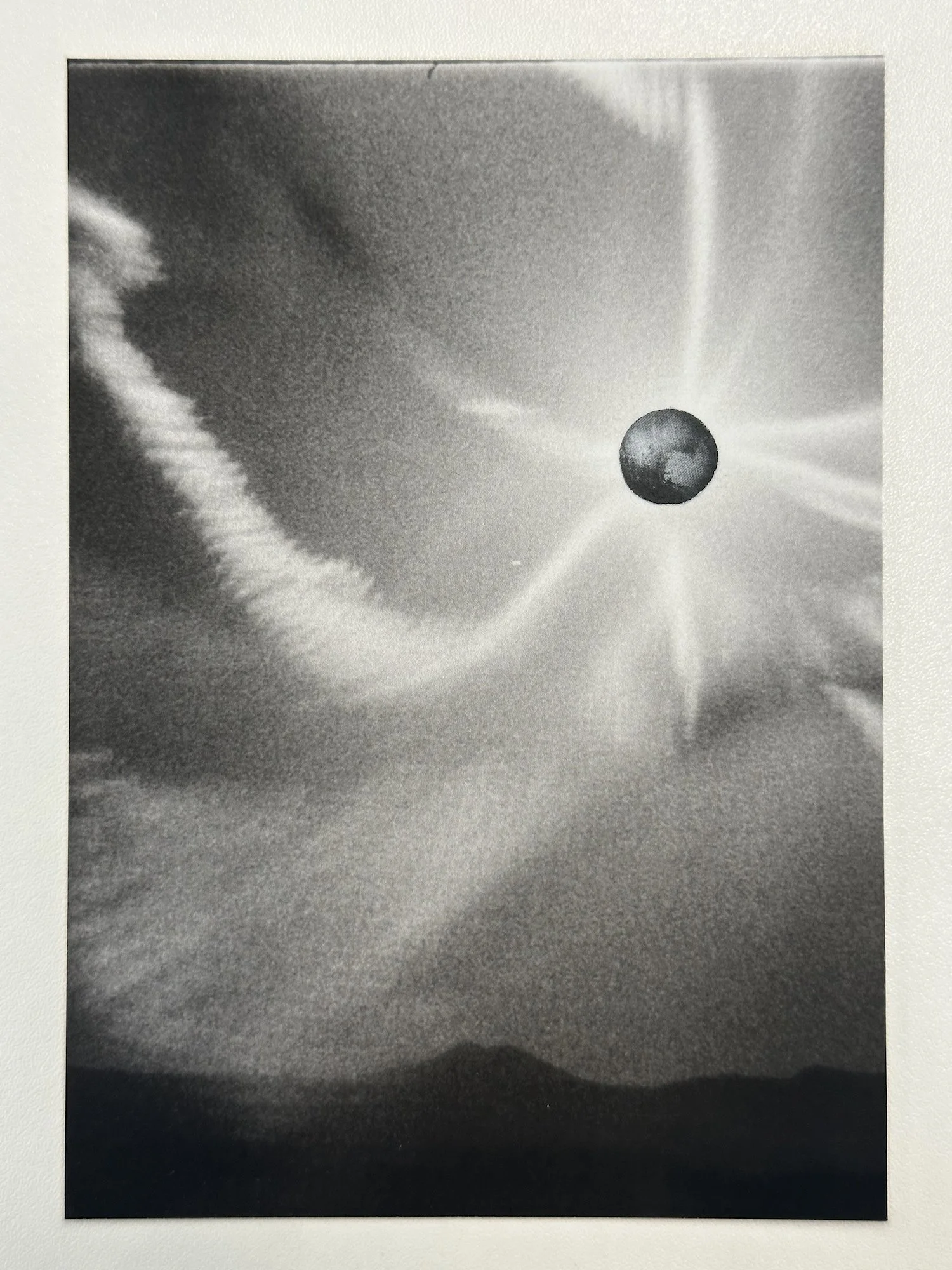
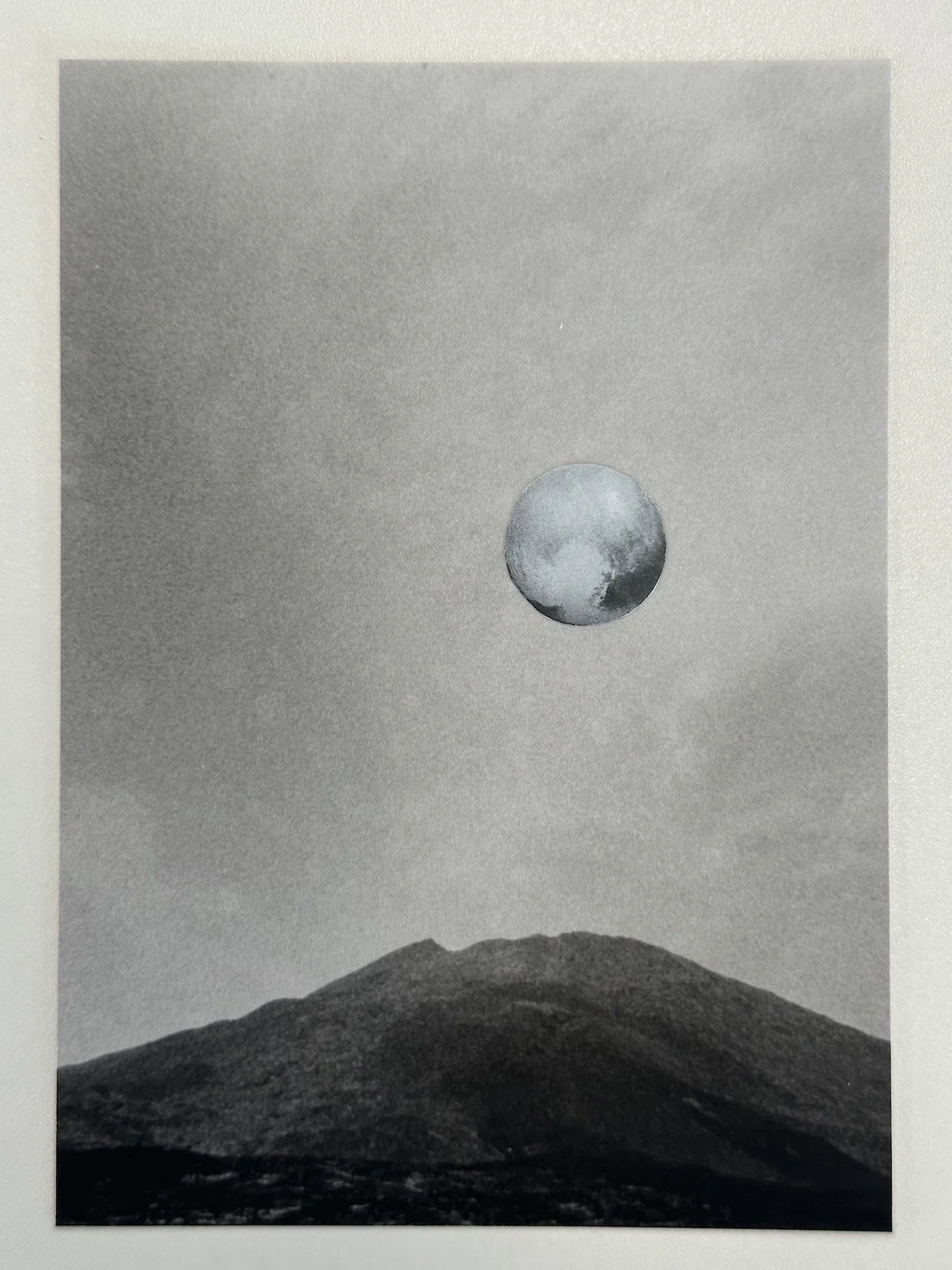
A dance as a song, to imagine Pluto.
Below Teide, Guía de Isora, Tenerife 29.06.26
—
Donna Enticknap has been going out at first light to dance in car parks. There’s one behind a leisure centre she has used eleven times, chosen for its flatness and the absence of witnesses. The attendant unlocks the barrier early for her and has never once asked what for. He’s worked out that she is training for something. She’s not corrected him, partly out of politeness and partly because the thing she is training for is not due for another nineteen years.
Dead Air Anthologies No. 10
by Matty Loughlin-Day
For the eagle eyed and sharp eared, you might have noticed that there hasn't been an edition of Pirate Radio Shipwrecked around these parts for some time; for those affected, afflicted or angered, my apologies. Life, as it has a habit of doing, has thrown plenty our way, with major upheaval in nearly every domain, taking with it any space for frivolity or nonsense such as making an audio mix that tries to sound like a pirate radio broadcast.
Except, as I have realised over the last few days, as normality threatens to, if not return then at least pay a flying visit, it's not nonsense. Don't get me wrong, in the midst of it all, whilst we were all knee-deep in the mud, I couldn't exactly request that my wife and family grant me half an hour to decide whether or not to start the next show with a recording made in the 80s of the call sign for Radio Slovakia International or whether Radio South Africa's would be more appropriate given the recent passing of the mercurial jazz pianist Abdullah Ibrahim, but as the dust begins to settle on a very turbulent period, the ensuing calmness reveals what matters, bringing to the surface what it is that gives life colour and vibrancy.
These are often the first things to go when circumstances demand that you jump into survival mode and do all you can to just get by, so being able to return to them and remind yourself of why they are important is a welcome experience.
In my case, to nobody's surprise here, it is the act of being creative; of making something with the hope that it resonates with others. Bit by bit I have been able to make plans for the next major phase of the band I'm in (The Shipbuilders, do give us a listen, we're very good), which in itself is a huge positive; for a while, as I have documented in previous essays, I had feared that this part of me was about to be consumed by Real Adult Life and all its associated drudgery, so to be able to make tentative plans for this is as exciting as it is a relief.
Then comes all the other projects and plates I was at one point trying to spin, not least of all, this.
Making these mixes and writing these spiels satisfies and placates the part of me that wants to create and connect. Where that comes from is for another therapist's couch, but the idea that someone – anyone – would feel moved or have their interest piqued by such work is a strong force that pulls me back in every time I think "I'm done". For those unaware, these mixes started when I found an old iPod that had nearly 20 years' worth of music that I had long thought forgotten - oddities, found sound, curios from all over the world, it all came flooding back in an instant. I wanted to share this stuff, to put other people onto it, hence Pirate Radio Shipwrecked.
This feels apt, as during this recent spate of chaos and dislocation, there has been one particular radio experience that briefly kept me sane; another reminder of the beauty of human connection and the marvel of the technology that allows us to do this.
If you've read at least a few of my essays here, or spent a brief moment in my company, you'll likely know that I am forever spellbound by radio, in particular shortwave and other international broadcasts. Admittedly this is a dwindling medium, being slowly replaced by other digital innovations, but there is still plenty of (science and) magic to be found, if you know where to look.
Anyway, every year on the summer solstice there is a BBC radio broadcast beamed out directly to the 44 people based at the scientific base in the Antarctic. It is a half hour segment that consists of recorded messages from friends and family back home and music requests, plus some short chats with people stranded out in the icy wilderness. This year was the first time I was able to tune in live and it was quite the moment. Hosted by Cerys Matthews (who I once tried to give a Shipbuilders CD but got so overawed and tongue-tied, I can't recall if it even left my hand), it was a very moving, very human listen, with the signal coming in fairly strongly, in between bouts of otherworldly beeps and whirrs of interference and static. To know that at that moment there were a group of people huddled round radios in the vast desert at the bottom of the world, hoping to receive these messages on the airwaves was a thrill, verging on the surreal.
Of course this could be done via the internet, of course these sentiments and requests could be delivered via WhatsApp in a nanosecond, but there was something unique and special about knowing that this broadcast was a singular moment in time, impossible to recreate or replay. Once it was over, it was over; after the goodbyes, the broadcast turned to static in an instant and the airwaves were dead again, allowing me to picture and dream of what those souls in the most remote place on Earth were making of it, how they were responding to it.
I doubt I need to convince anyone reading this of my scepticism and horror at the oncoming tidal wave of Artificial Intelligence, but moments like this, on a balmy summer Sunday evening serve as a reminder about the limits of any AI innovation – they can create the technology, the means and the ways, but they can't recreate the soul. This is why this stuff isn't nonsense. It matters. I have to remind myself of this occasionally.
In a long distant more troubled part of my life, I would often sleep with the radio on at a low volume, usually tuned into something like Radio 4, not for its content or in the hope that any rhythmic reverberations would induce a soporific state of mind, but rather, just for the knowing that there was another human on the airwaves at that moment. It soothed me; as long as the bands were open, I wasn't alone.
AI cannot replicate that. I am sure there is an army of tech bros ready to shout me down and convince me to invest in some daft start-up or whatnot, but right now nothing could convince me otherwise. And I am not limiting this to radio, but rather, anything we do to create or connect. A painting you admire, a photo that stops you in your tracks, a poem that moves you, a fortnightly newsletter that lands in your inbox – the mode, the medium or the content doesn't matter, does it? It's the unseen; the human hand, mind and heart that went into it. Science and magic alright.
So yes, being able to see the proverbial for the trees via stuff like this, after a very manic period has helped me greatly, and in choosing the songs and audio for this mix, I didn't put too much thought into it – rather, I just delved into the archive and selected pieces that illustrate the points I've made above. Feeling, not reason. So, there is Mongolian throat singing (of course there is), South African jazz, lost 60s American pure pop, spoken word and much, much more. If it moved me, it went in, so tune in and drop your inhibitions.
Thank you for even paying the slightest bit of attention. I hope to make another mix in time for the next edition, but if not, I'm sure we'll meet on the airwaves again soon.
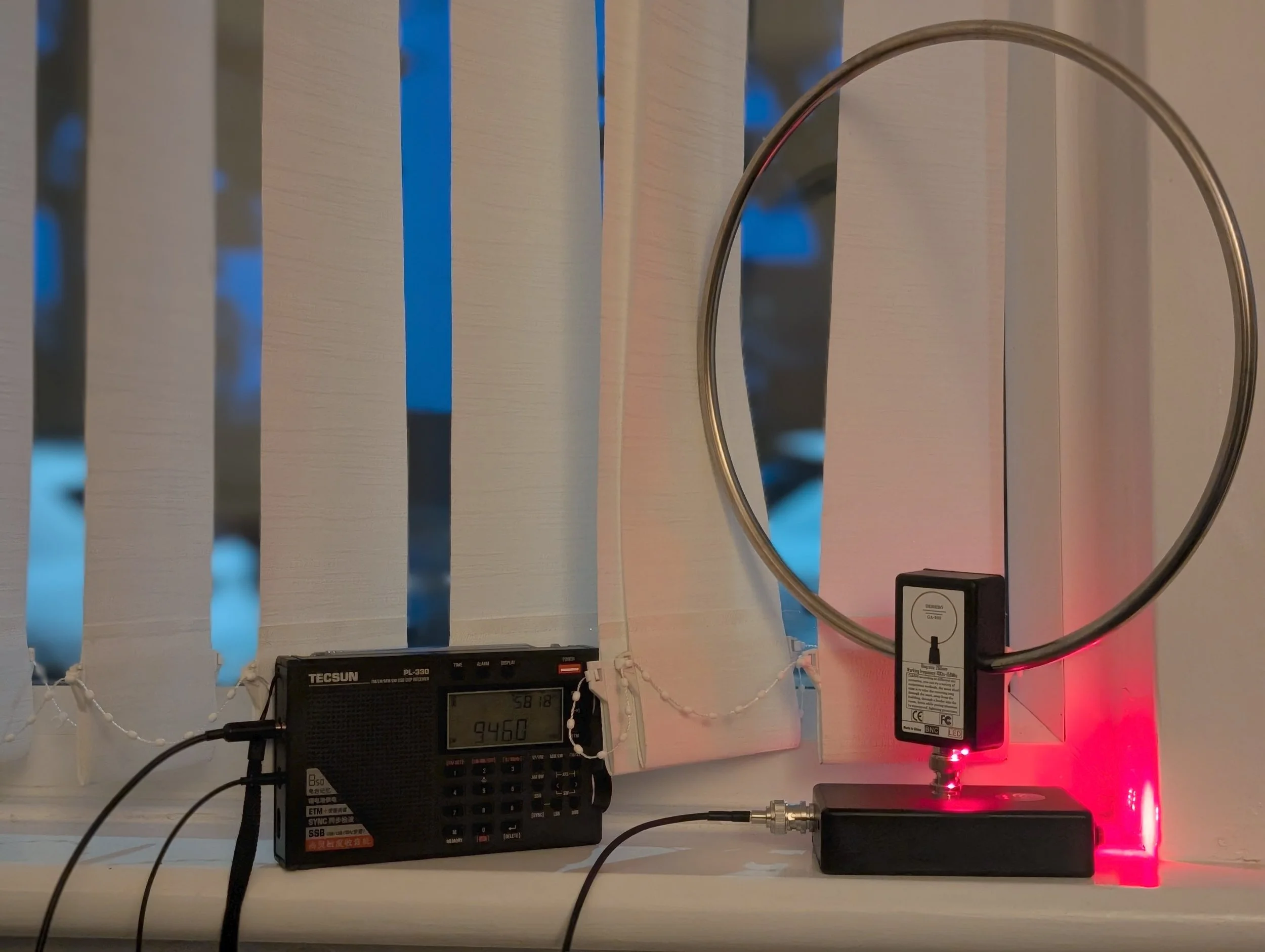
Picking up the Antarctic broadcast from my front room in Waterloo, Merseyside
—
Stanley the French Bulldog has never forgiven Matty, though the offence has never been specified and the two of them still share a sofa most evenings. Something happened in the spring. Stanley now leaves the room when the kettle goes on, which is new, and sits facing the hall until it has boiled. Matty has stopped asking why. He has, without mentioning it, begun boiling it less though.
The Fron Deg Olympics
by Amy Collins
One of the best things about my street is that there are kids playing out all the time.
It's not much cop for them, to be fair. It's a double-parked terraced street with barely enough room to squeeze a wheelie bin through, never mind establish a decent game of kerby. Most entries have those big, moody black gates at either end that only open on bin day, severely limiting opportunities for hiding and exploring.
But the kids make the most of it, creating their own version of what seems to be blocky 1, 2, 3 or role-play games akin to cops and robbers. The cast changes daily, but the main stalwarts are Rex and Dan. They have an open recruitment policy, adopting kids who are staying at their nan's, visiting cousins, or simply don't get out often.
I've got no skin in the game, obviously. I'm not out there playing with them.
In fact, I'm mostly disappointing them. They keep knocking to ask if my niece and nephew can come out. They're still too little. But the sound of children playing outside is comforting, familiar.
Having moved around a fair bit over the years, you really notice when it's absent. A street without children feels eerie and, unfortunately, that's not unusual these days.
Maybe I'm romanticising a bit because my own childhood was built around playing outside. For all I know, these kids are only out because their parents can't bear to have them in the house. But whatever the reason, they seem to be having a ball.
I’m impressed that Rex is showing some fascinating signs of entrepreneurship.
Every so often, he knocks on to sell whatever he's been manufacturing that week. I've bought various treasures over the last couple of years, including stress relieving squishies constructed from washing detergent. Two for a quid, absolute bargain.
His business reminds me of young me selling my handmade friendship bracelets and washing neighbours' cars for a couple of quid. I grew up in a cul-de-sac in North Wales. We lived at 2 Fron Deg, Pantymwyn (not my password before you get any ideas). My very Scouse uncles translated this as "2 Fried Egg and a Pint of Milk" because it was easier to say.
It was a brilliant place for kids. There were loads of us. A proper assortment of ages. We organised kerby tournaments, made dens, invented characters to play. During Wimbledon, we'd take tennis rackets onto the road and transform it into Centre Court. A car passing was an event.
Play would pause while somebody shouted, "Car!"
Then we'd all shuffle aside for ten seconds before reclaiming the tarmac.
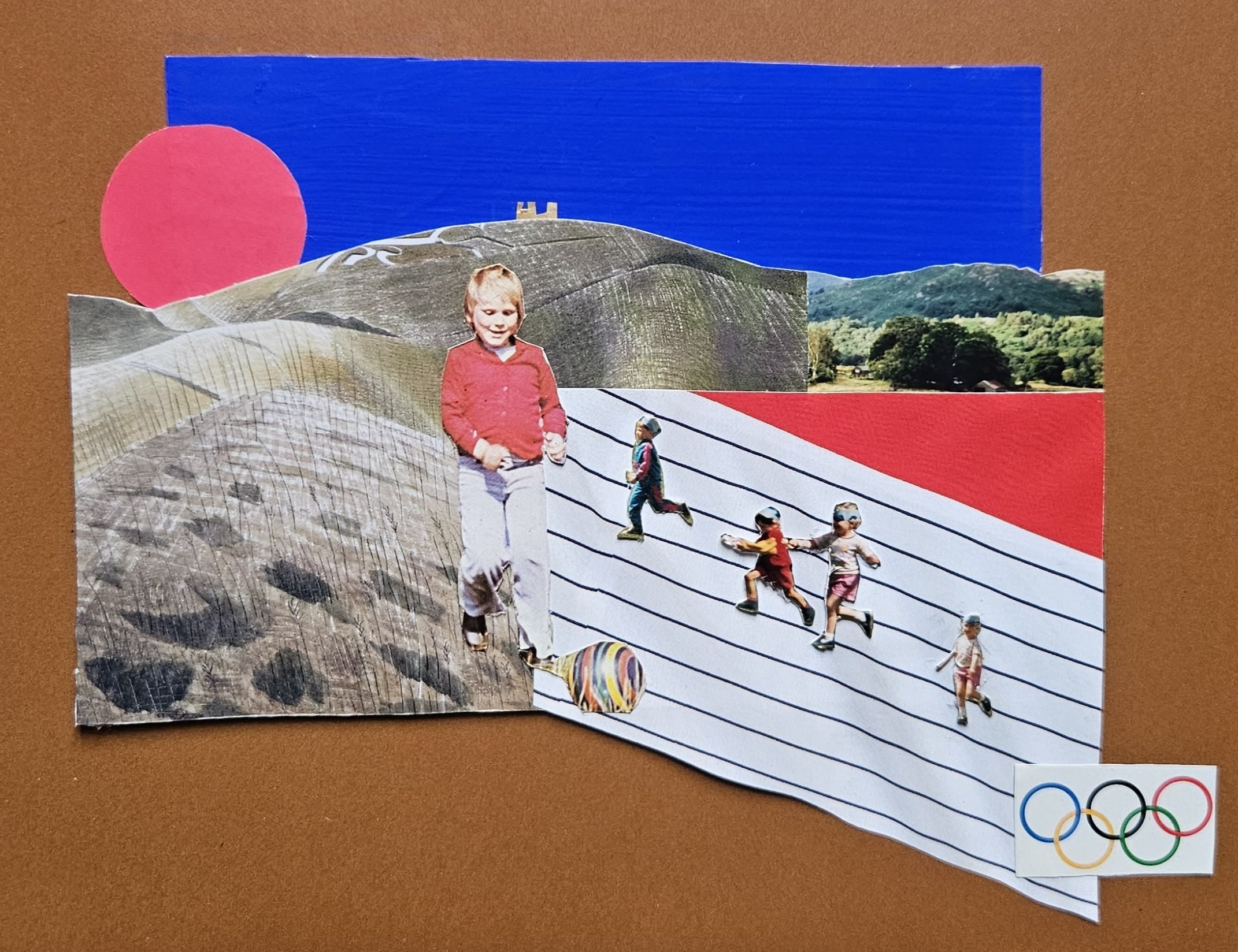
Anyway, there is one year that sticks out in my mind. One summer that trumped all others for playing out. 1994 - the year of The Fron Deg Olympics. I was ten.
We hadn’t had an official summer Olympics since Barcelona, which is perhaps why we staged our own. ‘94 was a hot year. The majority of the summer holidays were spent organising and training for our very localised tournament. I think we even had a committee, with meetings held at Top Patch (a bit of communal grass at the butt end of the cul-de-sac).
To increase participation, we opened out the invite to include kids from nearby streets. The games were split by age groups rather than gender and, although we did have typical track and field like running and long-jump, we also had go-karting (hand-made), kerby, and twizzie contests.
In the corner of Top Patch was a small public footpath running alongside Mrs Parry’s house. It was this path that allowed us to create the loop running track. You just had to make sure you did your overtaking before the narrow path, or you’d be scratched with privet. When you emerge back into the open air there is Mold Golf Club ahead and then you turn right for a cracking view of Moel Famau. Completely lost on us kids. We had more important things to think about than countryside vistas. Like conserving energy for the steep uphill section of the run. Being on a hill was great for the go-karting, a nightmare for running.
The day of the games was quite magical. We had an incredible turn out and barely any fallouts. In my mind we were out for hours but in reality, it was probably done and dusted by lunch time. I think this memory stuck with me because we'd built something ourselves. Not just the go-karts and the podium, but the whole thing. We'd had an idea, argued about it, organised it and somehow pulled it off. I really wish I could remember what we used as medals.
What I do remember is the feeling of anticipation and then accomplishment. Sunny days. The smell of cut grass. Endless energy. The certainty that what we were doing was important.
Maybe that's why I enjoy hearing the kids formulating their plans and arguing on my street now. You never know when you're listening to a committee organising the next Fron Deg Olympics.
—
Amy Collins has written to four people she’s not spoken to since 1996 to ask what the medals for The Fron Deg Olympics were made of. Three have replied. One says bottle tops. Another says milk-bottle lids on ribbon. The third says it never happened and has sent a photograph of a different cul-de-sac to prove it. Amy is treating this as a split decision. Bottle tops and milk bottle lids she can live with. The other thing she’s not having at all. A fifth letter went out on Tuesday, to a man who moved to Shrewsbury in 1998.
Other People’s Windows
by Clare Archibald
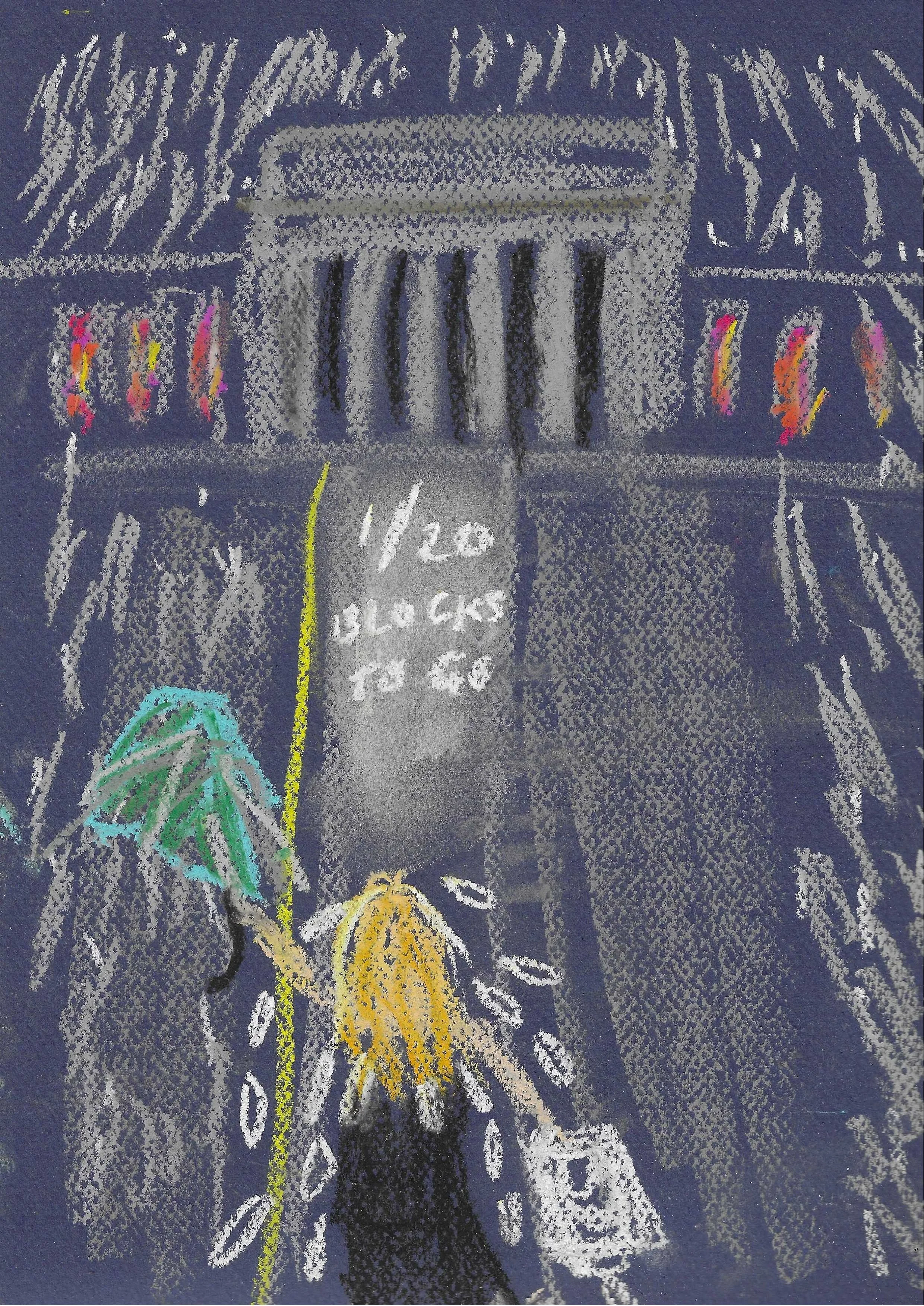
Self Portrait : One Block to Go Philadelphia Train Station
Clare Archibald had just one day in Philadelphia and it rained on all of it. Faced with that, she gave herself three options: go Foucauldian, go Lynchian or go cosmic.
She’s a Scottish writer and artist working across text, image, sound and place, whose body of work on expected neonatal death and the UK baby ashes scandal has been acquired by the Wellcome Collection.
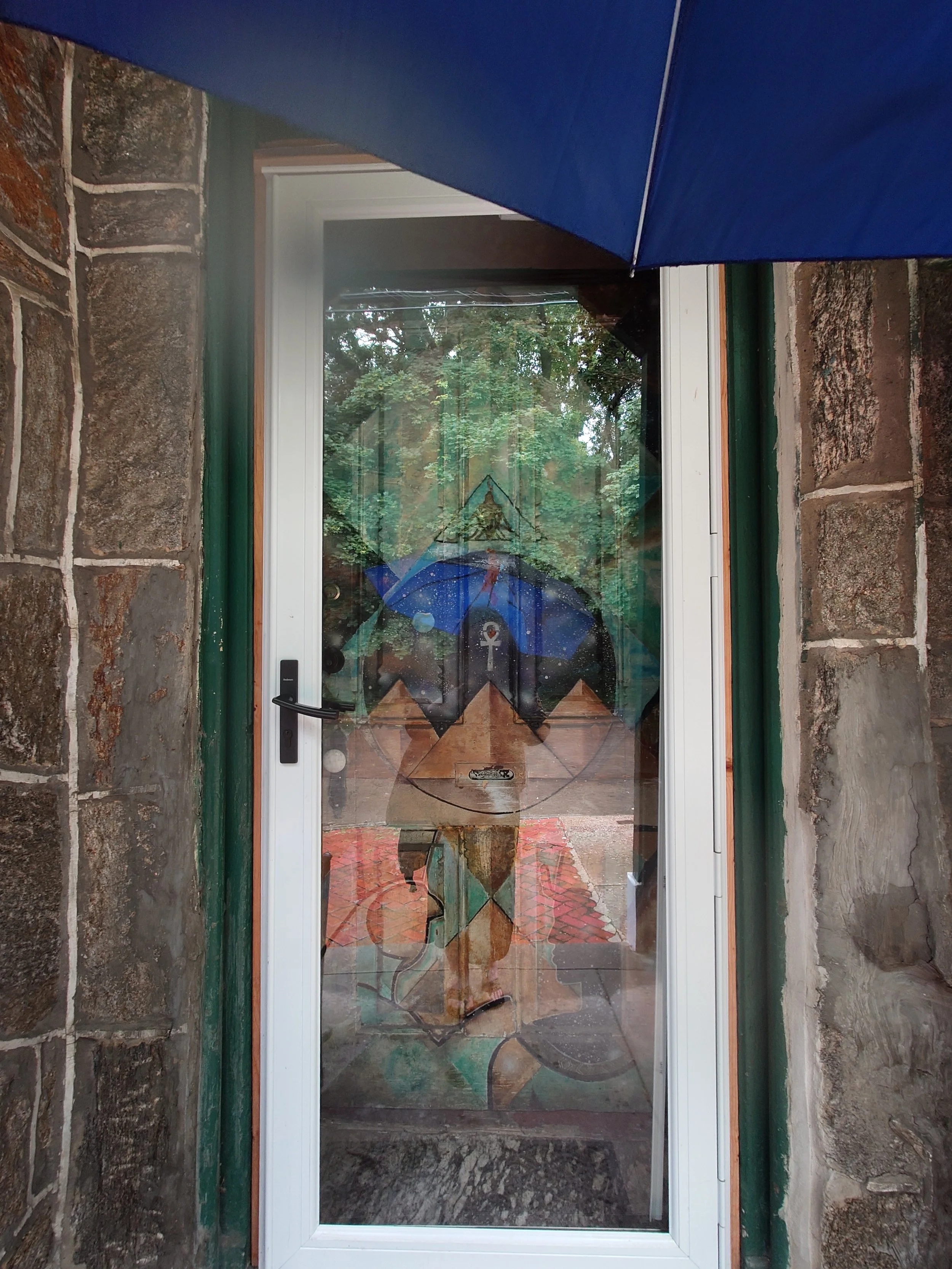
Other People's Windows has been her own corner here since Issue 29: one photograph pulled from an archive of hundreds, paired with whatever that particular window turns out to ask of her.
This one is a self-portrait an ocean past Burntisland (one word pronounced as two, don’t forget). She told us at the outset that the editions wouldn't stay in one place - and it appears that the windows have started looking back.
—
Clare Archibald has been carrying the same umbrella since a wedding in Kirkcaldy in 2017, on the understanding that it belongs to someone else. She’s made three attempts to return it. The bride has twice denied ownership and once suggested, with some force, that Clare keep it. So the umbrella goes out most days and has never once been opened, just in case its owner is watching.
Tales of Kirkhill
by Rob Schofield
Kirkhill is everywhere and nowhere. It’s real and it’s not. You’ll recognise Kirkhill, its streets and boulevards, hopes and dreams. It’s close to the centre of Liverpool, but you won’t find it on any map. The locals will feel familiar, as will the pubs and cafés, nail bars and gyms, libraries and places of worship; but if all of this is new to you, strap in and be ready to hear about the people and places that make up a community. These are the stories of the extraordinary everyday people who call Kirkhill home.
A Kirkhill Tragedy
Outside of the emergency services and the priest who found him, Brian Harrison’s neighbours on Edward Street were the first to hear that he had died by suicide. At number twenty-seven, Frankie Marquez relayed the news to her mother, who shared the details with her father, shortly after he had come in from work.
‘Shocking, is what it is,’ said Maggie. ‘An old man like that.’
Emilio put down his pen. He was working on a quote for built-in bookcases in a townhouse on Beaumont Crescent. Alcoves on either side of a chimney breast, the job was straightforward, unlike the client. A solicitor with a flair for mixing courtesy with impatience. He turned to his wife. ‘How did Francesca find this out?’
‘She went to school with the policewoman on Brian’s gate.’
‘Two years ago, his wife,’ said Emilio.
‘Alma. She was lovely.’
‘Him too’
‘He’d taken off his shoes and lined them up at the bottom of the stairs. Always so neat and tidy. Why would he do that to himself?’
‘Maybe he was lonely.’
‘But he’s got family.’
‘Must have had his reasons.’
‘You wouldn’t have thought he’d have it in him to tie at knot at his age.’
‘Sailors don’t forget,’ said Emilio. He’d swapped tales with Brian a few times.
‘He was in his eighties.’
‘You find the strength when you need it,’ said Emilio.
‘I’ve told Frankie to watch what she says around Matty.’
‘We can’t shield him from every bad thing. He’s nearly a man.’
‘He’s delicate, and I don’t want him upsetting.’
But Matty – Matteo to his father – would be upset when he heard. He’d washed Brian’s car until he’d sold it. A fiver each time, and the first money he’d earned for himself.
Kirkhill reacted in much the same way. People reached for the words employed in newspaper headlines, and on the radio and TV. They used them in person, in group chats, and on social media. Like Maggie Marquez, they professed themselves shocked. Brian’s death was shocking. A tragedy. His poor children, and grandchildren. Something like that should not happen in this day and age. Except it did, and it does. His pals at the snooker club shed quiet tears, and drank a toast to their old comrade. The parishioners at The Blessed English Martyrs, so used to seeing Brian in the same bench every Sunday, and at midday mass during the week, said prayers for his soul, and asked if something could have been done. There had been no signs, they agreed. When a person is determined, they whispered, leaving the sentence to finish itself.
But there had been signs for those whose job it is to recognise them. One Sunday, a month from the day that Frankie Marquez would bump into an old schoolmate four doors up from her family home, Brian Harrison’s priest shifted in his seat towards the back of the altar. He closed his eyes and wondered what the congregation thought of him, sitting in the carved wooden chair with its threadbare red cushion. A low-rent Caesar? A weary emperor, keen to dismiss the citizens? A middle-aged cleric, doing his best for his flock and failing as often than not? He thought of Evelyn, his spendthrift sister, and her twin boys, forever bringing trouble to his door, and opened his eyes to the rows of expectant faces. Keen, no doubt, to get home to bacon butties, the garden, the football, to remove their Sunday best and relax. The pub would be calling some, and why not? An outbreak of coughing drew his eyes to the left-hand side, where he noticed that Brian Harrison wasn’t in his usual bench. He sometimes came with one of his kids and the grandchildren. On these occasions, they would arrive late, and gather at the back of church. Today the Harrisons were nowhere to be seen. Brian had once said he’d have to lose a leg to miss mass, and the priest had replied, half-joking, that knowing Brian, he’d crawl on his hands and knee before that happened. When his wife had been ill, at the hospital and later, in the hospice, Brian had made it to church on Sundays at least. As a widower, he had been known to sit in church for hours, in the bench where he had sat with Alma, seeking comfort amidst the torture of grief.
On the road outside the church, cigarette smoke drifted from men standing next to cars. Not far from the huge wooden doors, a cloud of fruity vapour billowed from behind the war memorial. Freddie Quirk, from the snooker club, shuffled towards the priest, drawing him close. There had been some bad news from the doctor, and Brian had not taken it well. ‘He wouldn’t say what it was, Father. We haven’t seen him since.’ Eileen Bird reported seeing Brian crying into a nurse’s shoulder at the Fitzgerald health centre. It wasn’t right, a gentleman like Mr Harrison in tears in a busy waiting room. Eileen tugged on the priest’s cuff. ‘You need to check he’s okay, Father.’ Why not go themselves? They’re scared, the priest told himself, superstitious about illness and death. For a priest, by their reckoning, it was part of the job.
He passed Emilio Marquez’s van as he made his way up Edward Street. A mallet and chisel floated either side of a golden circle, inside which the words Master Carpenter revealed the van owner’s métier. Below the circle, a telephone number, an email address, and a promise that no job was too big or small. The vehicle was showroom clean, despite its age. That was something Emilio had in common with Brian Harrison, who dressed as if for inspection, his hair Brylcreemed and his shoes polished, as the saying goes, to within an inch of their lives. As he opened the gate and walked into Brian’s small front garden, the priest remembered both men had been sailors. The older man had set out from Liverpool, the younger, as a ship’s carpenter, from Valencia. Emilio had fallen in love and settled in Kirkhill, applying his trade on land, and moving his family to Edward Street not long after Brian had retired.
The curtains were drawn in the bay to the side of the front door. The priest felt a twinge of panic, but relaxed when the drapery twitched. He stretched forward and rapped a knuckle on the glass.
‘Brian,’ he shouted, ‘it’s me, Father.’ His reflection squinted. ‘I won’t keep you for long.’
He had time to remove his collar before the lock rattled, a chain jangled, and a bolt gave way with reluctance. A pale face appeared in the gap between door and frame. Unsupported by Brylcreem, Brian’s hair was thin and unruly. Whiskers sprouted along a jawline that had fallen out with the razor. The door opened further, revealing an old man in an ancient dressing gown, below which pyjama bottoms and worn suede slippers protruded. Braced by a walking stick in his right hand, Brian smiled a sheepish apology.
‘Sorry Father,’ he said. ‘I’m a bit, er…’ He moved his stick to one side, inviting the priest to enter.
‘Should I leave you be?’ the priest asked.
Brian shook his head, releasing a wad of hair that settled in front of his left eye. ‘You’ll only come back…’
‘I will.’
‘…and there’s something I ought to tell you.’ He said this to the floor, his eyes refusing to meet the priest’s inquisitive look. ‘First on the right.’
‘I remember.’ The priest stepped into the hall. It had been six months, a year at most, but he recalled the basics: an oval mirror, two gold-framed paintings of ships, a plastic runner as far as the foot of the stairs. A set of coat hooks and a telephone on a small shelf. A flashing red number four indicated unanswered messages, a state of affairs with which the priest was familiar. He carried on into the lounge, straight to the window to throw open the curtains. As he turned around to take in the room, he saw a cigarette teetering on the edge of an ashtray on the side of Brian’s armchair, around which newspapers, books and assorted paperwork had formed a cordon. Several plates, on which potatoes, carrots and peas languished in dull gravy, fought for space on a low glass-topped table. Underneath the glass and visible in the gaps between the plates, the priest recognised a display of nautical knots, each one with a brass nameplate.
Brian shuffled into the room and leaned over to extinguish the cigarette. ‘Hmm,’ he said. ‘It’s a bit of a mess in here.’
‘Since when did you smoke?’ the priest asked.
‘Before your time,’ said Brian. ‘Used to love it, so I thought I’d give it another go.’ As if on cue, he banged a fist on his chest to stifle a splutter.
‘You’re eighty what and starting on the fags again. What good will that do you?’
‘Eighty-two. And you’re a doctor now, are you Father, as well as a priest? Because if you are…’
‘It doesn’t take a doctor to know that smoking will kill you. How’s your dining room? Shall I make a brew, and we can have it at the table?’
‘I don’t go in there much. But go on, then, we can sit at the table. There’s no milk, mind.’
The priest carried two mugs of black tea into the second room on the right, now his left, coming from the kitchen at the end of the hall. Brian had taken a seat at the far end of the table, where he was holding a silver photo frame like a prayer book. He put it to one side when his drink arrived, and slid a coaster towards the priest, who settled opposite his host. A pile of maritime themed place mats and coasters took up the space between them. More photo frames cluttered the surfaces of a sideboard and Welsh dresser: monochrome images from a wedding day; faded colour snapshots from family holidays; graduation photos; and babies and toddlers, including one where the priest stood at a font, half a clam shell in one hand, dousing a newborn’s head. What the priest noticed most of all, however, was the number of photographs of Brian’s late wife.
Brian raised his mug to his lips, and paused to look at the photo in the silver frame. ‘She took a good photo.’
‘Was it you, taking all of these?’ The priest swept his hand towards the dresser.
‘Most of them. I was quite keen on cameras.’
‘I can see.’
‘Not so much, now. I can’t see the point.’
‘What about your grandchildren?’
‘It’s all mobile phones now. From the moment they’re born until the moment…Anyway, they don’t need me and my camera.’
‘I’m sure that’s not the case.’
‘They’ve got their own lives to lead.’ Brian held the photo out to face the priest. ‘Our silver wedding,’ he said. ‘We had the do in the church hall.’
‘Before my time.’
‘That’s right. It was Father Murphy then. That man liked a whiskey.’
‘We all have our vices.’
‘Alma would have it ready as soon as she saw him on the path. He was quite partial to my Jameson. Speaking of which…?’ He struggled to his feet, made his way to the sideboard, and held his hand over a bottle hiding behind the photographs.
‘Not for me.’
‘Shame. I won’t drink alone.’ His hand lingered over the photographs until he chose a small white frame and waved it towards the priest. ‘Her mother died young. She brought up her brother and sisters while their father was at the gasworks.’
‘Alma?’
‘Who else? She did the same while I was at sea.’
‘That’s how it was, Brian.’
‘And then the grandkids.’
‘You played your part.’
‘I suppose. But I was never any good at that.’
‘You’re being too hard on yourself. It’s obvious the little ones adore you.’
Brian kissed the photograph, put it back on the sideboard, and returned to his seat. He put his head in his hands and let out a long, rattling breath. ‘There’s a shadow,’ he said to the table.
‘A what?’
‘On my lung.’ He lifted his head and traced a circle around his heart.
‘A shadow? Brian…’
‘I had a cough I couldn’t shift. They sent me for scans.’
‘What did they say?’
Brian looked up. ‘Still waiting to hear. It takes a couple of weeks.’
‘So, we can hope?’
Brian shook his head. ‘They’ll want to cut it out. That’s what they do.’
‘But that’s good. If it comes to that.’
‘I’m eighty-two, remember. They cut you open, and it spreads.’
‘I don’t know if it’s like that these days.’
‘Yes it is.’ Brian got to his feet and pointed towards the photographs. ‘It’s what they did to her. Two years it took her to go. I don’t have the strength.’
The priest rose and walked over to Brian. He put his hand on his shoulder. ‘It might turn out to be nothing.’
Brian moved backwards, shaking his head and mumbling. ‘No, no, no.’
‘You don’t have to do this alone,’ said the priest. ‘God will help us.’ It’s what he was supposed to say, and he said it with the kind of conviction that comes with practice.
‘Will he, Father? Look at what happened to Alma. Was that part of his plan?’
The priest took two steps backwards and joined his hands over his lap. Brian steadied himself with his stick, his eyes fixed on the man in front of him. The priest blinked first.
‘What about your children? They’ll be with you, whatever happens.’
‘They went through enough with their mother. I won’t put them through it a second time.’
‘But you can’t make that decision for them.’
‘Says who? God? Feels to me like he’s gone missing. He doesn’t get a say in this.’
‘You can’t keep it from them, Brian.’
‘Well, that’s my choice, Father. And you…’ Brian aimed a crooked finger at the priest, ‘…do not have my permission to repeat this to anyone. You of all people should know how to keep something to yourself.’
Invoking the sanctity of the confessional should have been enough to keep the priest in line. But what if, in the course of a casual conversation, certain hints were dropped, albeit by mistake? As far as the priest was aware, Brian’s kids and grandchildren had moved away from Kirkhill. The children didn’t attend the church school, and he wasn’t about to bump into any of the grownups while he was walking the neighbourhood. He might see them in mass, but that would be with Brian. He’d have to try again if the old man came back to a weekday service, or if he opened his door to him, which was fifty-fifty at best. In the end, the priest sniffed out an opportunity at Blessed English Martyrs primary, where he asked the headteacher, during a meeting about introducing the pupils to the senior members of the community, if there was anyone still around who had taught Brian and Alma’s children. It was an innocent request, he imagined, a throwaway remark, which hit a dead end – or so he thought – until the head mentioned his unusual question to a parent who had been at school with John, Brian’s eldest. Later, when the priest had all the time in the world to review what he had and had not done, he would muse upon how connected we remain in a world which would have us otherwise. If only, he would further reflect, he had had the courage to break Brian’s confidentiality clause.
He was staring at a microwave, counting the seconds as two eggs scrambled in a mug, when he heard ringing from his office. He opened the oven door and watched his meal deflate. He trudged out of the kitchen and into the hall. In his office, he located the phone under a pile of bills.
‘Father? It’s John Harrison.’
‘John?’ The priest twisted his wrist where he had spotted a splash of egg on his cuff.
‘Brian’s lad.’
‘Ah.’ Only a splash. The shirt would do for tomorrow.
‘I heard you were asking after us.’
‘I was wondering when you’d last seen your dad.’
‘Has something happened?’
This was the moment, and the priest let it pass. Brian was entitled to privacy, and dignity, while his kids deserved the truth. The priest went with his gut. ‘I popped in a few days ago and I was wondering when you’d last been over.’
‘We’ve had a lot on,’ said John, his tone defensive and strained. ‘He phoned last week saying not to come to Sunday mass. Said he didn’t feel up to it. Are you telling me there’s something to worry about?’
‘I think he could do with some company.’
John ended the call with a mumbled, sarcastic thanks. The priest returned to the kitchen. He spooned the eggs into the bin, toasted two slices of bread, and filled the kettle. There was a jar of homemade jam at the back of a cupboard, a gift from a parishioner who grew strawberries in hanging baskets. The milk was on the turn, and he’d defied an old sailor who was determined to suffer alone.
The following Thursday, Brian Harrison returned to church for midday mass. Dressed as well as ever, his hair was slicked back, and his blazer buttons winked at the sunbeams piercing the holes in the stained-glass window. After the service, he waited for the priest at the sacristy door. When the priest appeared, Brian was all smiles, despite his rattling chest. He waved his stick at the priest.
‘I wasn’t happy with you getting hold of our John,’ he said, ‘but I’m sorry I put you in an awkward position.’
‘He would have been in touch at some point, Brian. Or one of the others,’ the priest replied.
‘Clare and Martin,’ said Brian.
The priest nodded, remembering the names too late. ‘It wasn’t an easy decision. And all I asked was for him to check on his dad.’
Brian leaned on his stick and blew into his cheeks. ‘I knew you’d have thought it through.’ He paused for a moment to thump his chest. ‘You know what they say,’ he continued, ‘life’s too short to hold a grudge.’
‘I’m glad you feel that way,’ the priest replied.
‘You’re welcome at Edward Street any time,’ said Brian. ‘I’ve tidied up. Can’t be living like that, can I?’
‘I’ll bring biscuits,’ said the priest. ‘Any preference?’
‘Don’t waste your money on me,’ said Brian. He looked away, towards the exit. ‘I can’t hang around. The shopping won’t do itself.’
Bacon, sausages, spuds? A few tins? The priest didn’t speculate much on Brian’s list. His concern was how John had taken his father’s news; and this was another moment when he ought to have inquired. Instead, he waved Brian on his way. There would be another person with another problem around the corner, and who’s to say the priest didn’t have one or two of his own?
Problems is the answer the priest gave when asked why two weeks had elapsed before he returned to Edward Street. Three of his congregation – that he knew of – were in two hospitals in town. He visited the pair in the Braddock – different wards on the same floor – but didn’t make it to the Royal in time, and thereafter had a bereaved family to visit. On the home front, his sister was in debt to her landlord again, and since other liabilities (he was a regular at several branches of UBet, and had online accounts with two national bookmakers) had reduced his ability to help out with her arrears, he was in delicate negotiations with his superiors about moving her and the twins into the rectory. This was proving a difficult sell to Bishop Hillary Cochrane, a man who preferred rules, protocol and ‘how things look’ to empathy and charity. The priest had been on his way to see Brian when he was called to the school to mediate in a dispute between parents of a bully and the bullied; and on it went.
The next time he saw Brian was in church, when the Harrison clan trooped in on Whit Sunday. Viewed from the pulpit, Brian seemed content among his children and grandchildren, belting out hymns with little sign of chest or breathing problems. Afterwards, the priest had seen Brian playing peekaboo behind a gravestone with a toddler. He’d saluted to the priest as he had got into a car, and John – he guessed it was John, and confirmed this later on – had given him a thumbs-up. All must be well, the priest thought; and perhaps this was what made it easier to pop over to Edward Street a few days later, with a packet of Garibaldi biscuits. He knocked on the door, relieved to see a window open in the bay and Brian’s nets riffling in the breeze. The door opened before the priest had had a chance to gather his thoughts.
‘Afternoon, Father,’ said Brian. ‘What’s that you’ve got there?’
‘Garibaldis.’
Brian chuckled. ‘I told you not to bother. Alma loved them, but I find them a bit dry. Anyway, I’ve got something better. Come on in.’
The living room bore no trace of the chaos witnessed on the priest’s previous visit. The ashtray, empty and gleaming, had been moved to the mantelpiece. A packet of cigarettes stood guard.
‘Can’t let go?’ He pointed at the cigarettes.
‘I might have one last one, for old times’ sake.’
‘You’d be better off not.’
‘Give it a rest, Father. It’s not the ciggies that’ll kill me; and anyway, look around you. I’ve got everything shipshape.’
‘Good to see you’ve got things under control.’
‘I have that. Now, will you make us some tea? There’s milk this time, and I’ve been to Dooley’s for bread pudding. That stuff knocks spots off your Garibaldis.’
Dooley’s bread pudding held close to mythical status in Kirkhill. You had to get there early, or be a favoured customer, to guarantee a slice or two. It was the same with their meat and potato pies. To locals of a certain vintage, a pie and a pudding was the lunch, or tea, of champions. As he waited for the kettle to boil, the priest opened the paper bag next to the breadbin, and inhaled. A secret spice mix (according to legend), lemon, butter, fruit, and burnt sugar. A condemned man could choose worse. The smell was intoxicating, and evocative, so much so that the priest did not hear the tap, tap of Brian’s stick on the hall runner.
‘You’ve not snaffled it?’
‘You caught me in time. I can’t remember when I last had this.’
‘Me neither. I don’t get over there much.’
‘I’ll be going back soon.’
‘Good for you. Remember me to Anthea when you do. She’s got that place running like clockwork.’
‘I will. Is it still her and her brothers-in-law?’
Brian nodded. ‘There’s someone who’s beaten widowhood.’
‘You just have to get on with things. One foot and all that.’
‘She’s younger than me by a good twenty years.’
‘The principle still stands. You’re doing okay, Brian.’
‘I suppose it looks like that, now I’ve cleaned up in here.’
‘Just a blip. Things will work out. You looked happy with the kids, after mass.’
‘They’re treasures, all of them.’
‘Speaking of which, how did they take it?’
‘The kids will be fine,’ said Brian. He opened a cupboard door and removed two small plates, on which he placed the paper bag from Dooley’s. ‘I’ll keep these safe while you bring the drinks through.’
The priest filled the pot, and sat at a small table while the tea brewed. Brian looked well, he was getting out and about, and the house was as it should be. Sometimes things worked out with the slightest of nudges. You couldn’t describe a brief phone call as a full-blown intervention. He poured the tea and carried the mugs out of the kitchen.
Brian rested his mug on the arm of his chair. ‘Sit down,’ he told the priest, ‘and have a look at them.’ He pointed at two Jiffy bags on the middle cushion of the couch. ‘I went to the bank while I was out.’
The priest surmised it was Brian’s handwriting on the envelopes, his script neat and formal. One was addressed to The School; and the other bore the priest’s name. Each one was stuffed with ten- and twenty-pound notes. You’d have to count to be sure, but it was hundreds, maybe thousands in total. Notes were so thin these days.
‘What’s this?’ the priest asked, although this was nothing new. Envelopes were left at church, pushed through the rectory letterbox, and handed over on the street. Not as often nowadays, but it happened. Brian’s generation were the usual benefactors.
‘I’ve got more than I need,’ Brian replied.
‘What about your family?’
‘They’re all set up; and they’ll be well provided for. Sandy Fenton will see to that.’
‘The solicitor?’
‘Brian nodded. Like I said, everything is in order. He’ll see them right when the time comes. This lot…’ he pointed at the envelopes now sitting in the priest’s lap, ‘…I had squirrelled away. Two thousand in each one.’
‘Two thousand? When the time comes? What’s this one with my name?’
‘That’s up to you,’ said Brian. You can do whatever you want with it. You must know some people who need it. Or a group. Everywhere I look there’s people in need.’
There were any number of families in the parish he could help out; he could give it to the food bank; it could bring clean water to a village that had none; and closer to home, there was his sister. On the other hand, he should make Brian take it back. The time would come when he needed care, adaptations, a nursing home. You wouldn’t want to rely on the council.
‘No arguments, Father,’ Brian continued. ‘And you can’t say anything to the children. No exceptions this time. Let’s eat this bloody cake.’
The priest called in at the school on the way home to deliver the first envelope. The donation was anonymous, he told the secretary, and the head teacher, who also asked if he had had any luck with the Harrisons. This shook him for a moment, but she hadn’t joined any dots. ‘All good on that front,’ was his reply.
The second envelope went into the parish safe, on top of a cheque book and a mystery set of keys. It was there when John Harrison telephoned three days after the priest and Brian had salivated over Dooley’s bread pudding. The priest was at his desk, working on a sermon while ignoring his financial problems.
‘English Martyrs.’
‘John Harrison, Father.’
‘John. Everything okay? How’s your dad?’
‘I can’t get an answer.’
‘He’ll be out doing something.’
‘I’ve been trying all day. The thing is, we’re away.’
‘All of you?’
‘All of us that could get over there. Would you go check on him?’
‘Me?’
‘There’s no one else. It’s only around the corner. I wouldn’t ask.’
It’s what people say – ‘I wouldn’t ask’ – and it’s not something you can refuse. The priest mentioned a few errands, and wondered if he could catch the afternoon races on the way.
John Harrison never asked about the two-and-a-half-hour gap between his telephone call and the priest arriving at his father’s house. When he got there, forty pounds lighter due to a photo finish that hadn’t gone his way, the priest found two envelopes taped to the door. The handwriting was familiar, one was addressed to John and the family, the other to him again. He pocketed them as he knocked at the door, which eased open on his second, frantic knock. Brian’s polished shoes were sitting at the foot of the stairs, three or four steps from his feet, which were in mid-air above a dining chair on its side. The firefighters responded first, and the one in charge remarked upon the effort it must have taken, ‘at his age,’ to climb on the chair. The priest had already wondered how Brian had tested if the banister would hold his weight. Nobody questioned aloud where an ex-seaman in his eighties had got hold of such a strong, heavy rope, or where he had learned to tie the knot. The police wanted the letters, but allowed the priest to read the one addressed to him before they took it away, what with him being a man of the cloth.
I know you will do the right thing, Father. You are a good man and a good priest. There are those who will say I shouldn’t lie next to Alma, but I know you will pray for forgiveness for an old man who didn’t have the courage to suffer, and who wanted to be with his wife. Don’t grieve for this old sailor. It was my choice to go overboard.
As it happened, the priest heard no objections about holding Brian’s funeral in the church. After the burial, John took him to one side. His eyes red, he blew his nose and lit a cigarette.
‘There was a letter from the hospital. I had to call them up to tell them… Did you know about that?’
‘He insisted I say nothing. I’m sorry.’
John tossed the cigarette away. It landed, alight, at the foot of a mossy, forgotten memorial. ‘It was nothing.’
The priest looked away from the smoking cigarette and at John. ‘What was nothing?’
John tried a smile, but his face gave way. ‘Whatever he thought it was, it was negative. Old age, they said. Treatable with tablets.’
—
Rob Schofield holds Kirkhill in his head at full size. Every window is lit or unlit. The tide is in or out, the bins go out on a Tuesday, and Dooley's sells out of bread pudding by half past ten whether or not anybody is reading. Somebody is dying on a street he has not named yet and will not reach for another two books and there is nothing he can do for them in the meantime because he cannot write faster than the town lives.
The Turks Head
by Dan Melling
The Turks Head in St. Helens is home to the world’s oldest pie. The pub is half-timbered in mock Tudor style and retains its traditional multi-room layout. Records show there was an alehouse in the vicinity from as early as 1715, but the current structure was built in the 1870s to provide a place to socialise for the workers of the glass and chemical factories that shot up around St. Helens during the Industrial Revolution. The pie was found beneath a floorboard when the pub was renovated in 2017. Based on crust shape and the level of petrification, it is thought to originally date from the 1930s. I am here to see the pie.
The bartender serves me quickly. I ask about the pie and she looks at me quizzically. The world’s oldest pie? I say. She points to the menu and says Steak and kidney? I am slightly perturbed, thinking perhaps I have the wrong pub. How could somebody who works alongside the world’s oldest pie be unaware of it? I collect my drink and have a walk around the pub to get a feel for its layout. As I return to the room labelled ‘Lounge’, a bar-room regular appears silently beside me. Are you looking for the pie? he says. Thank God.
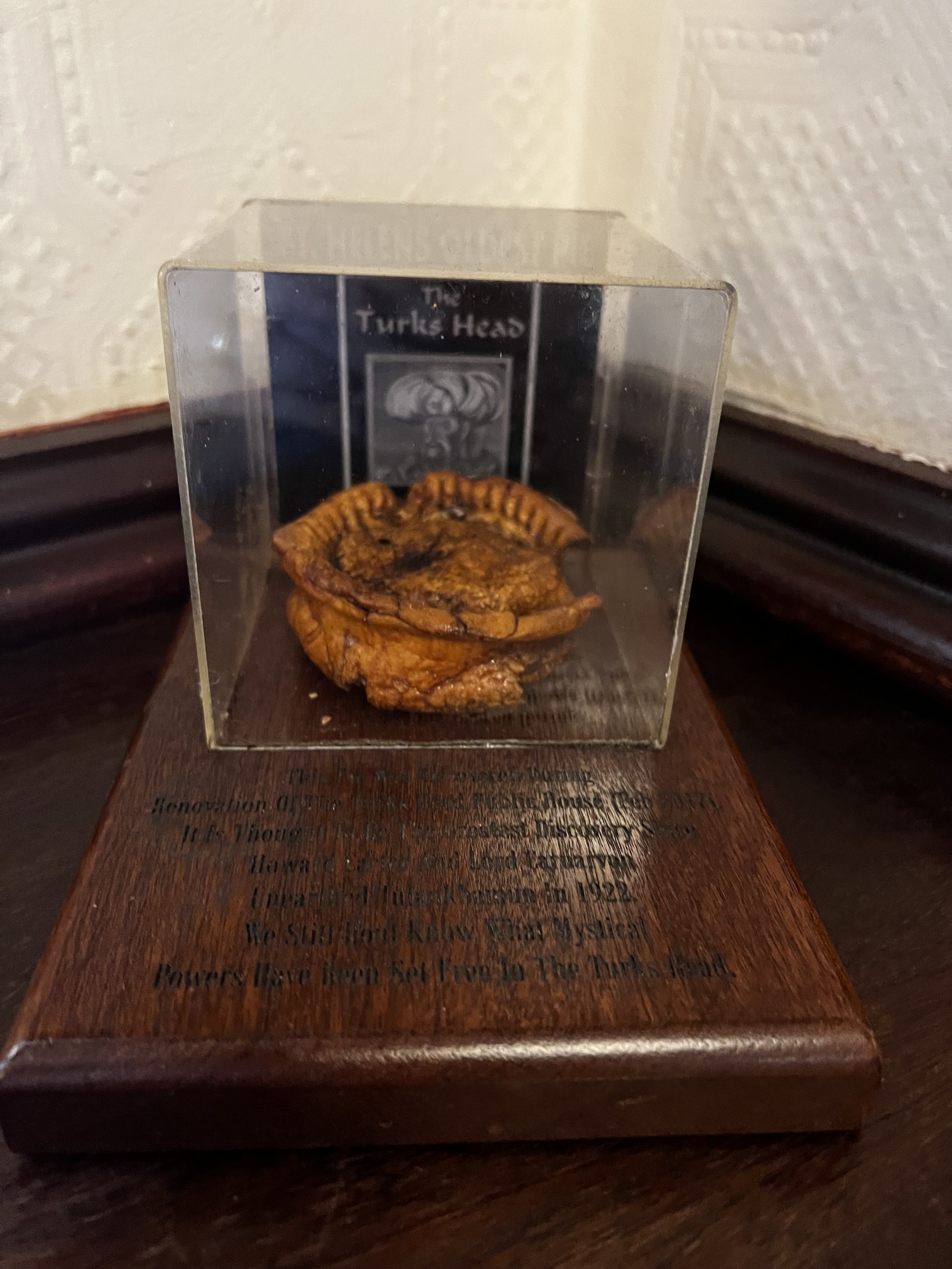
I follow the regular around to a wall covered in Victorian-looking glass bottles of gin and scotch and beer. There is a large open fire; bookshelves sagging with old tomes. Round the corner, he says. On the convex inside of a pillar sits an unassuming Perspex box with a wooden plaque explaining the finding of the pie. Inside, the pie looks varnished, almost shiny. The crimps around the crust are still clear. It is beautiful. I sit in a plump leather booth beside it.
The pie speaks quietly and starts mid-sentence. …to see you, it says. Not wanting to waste the pie’s time, I ask my first question.
DM: They claim you are the world’s oldest pie, but when exactly were you baked?
PIE: The thing you must understand is that linearity of time is a feature – a limitation – of your human consciousness. I am a pie. My consciousness is different to yours. We do not experience reality in the same way. My baking; their finding me under the floorboard; each moment of my petrification: it’s all happening simultaneously. All time is happening in all places, but you lack the ability to see it. I am a pie. I have no eyes. You have evolved sight enough to hunt, to pick mushrooms. My needs are not the same.
DM: Can you tell me about your baking?
PIE: I have never cooled. I am never warm. I am always petrified. My crust never crisped. I experience all moments of composition and decomposition at once. You see a brief sliver of my being, but I am rotted to dust.
DM: In that case, can you see the future? Are you an oracular pie?
PIE: The future doesn’t appear to me in a way that would benefit you. I see all futures. I see all pasts. Ones you experienced or will experience, but also those that never happened or will never. Where you feel an unplaceable emptiness, I see the should-have-been presents whose absences you sense. I could tell you the future, but it would be one at random from an infinite pool of potential futures.
DM: Can you tell me what you see now?
PIE: There is no now. I see stubbled fields and windmills; chemical effluence; factories with smoke billowing like belly fat. Behind the bar sit wounded roundhead soldiers nursing musket wounds. The sky is thick with smoke from the Town Hall burning. Firedamp explosions vibrate and tickle the air. Pit collapse. Stephenson’s Rocket. A stream of workers troop in from Pilkington’s Glass Factory. They drink mild and play dominoes and smell like coal smoke and lubricating oil. Quakers, miners and Rick Astley are stuffed in the Ladies’ bogs. Caustic soda boiler explosions; an arm lost to molten glass; the spasmodic cough of black lung. A future where the Romans never invaded. One where glass was never invented and you drink from coconut halves. A present where industrial chemicals seep back through the topsoil and burn off a police horse’s hoof. Another where Micky Pennington never changed his name to Johnny Vegas, instead he manages the drive-through Greggs on the roundabout. He only drinks vodka soda. All this is happening at once in a migraineous kaleidoscope orgy. I am done.
I return my glass to the bar and leave. I drank a Czech-inspired Pilsner hand-pumped from a cask. The marriage of the two disparate styles of beer didn’t work and made the whole experience a bit strange.
—
Dan Melling can no longer enter a pub in the present tense. He gets all of it at once: the 1890s brickwork, the knock-through, a wet Tuesday, the fire that has not happened yet, a man at the bar who died in 1974 and a man at the bar who is not born. He orders in one century and drinks in another. Only the window in the gents stays put. It’s the same window in all of them.
Heeding
by Victoria Raftery
We didn't say lessons will be learned back in my day; they were just lessons
Now heeding: that was a verb we all heeded
The word kirpan: not heard that word before. When we played our Christmas word-games did the word kirpan come up?
When we pulled our Christmas crackers and punned and joked to the max, Gran and Aunty Vi snoring while the rest of us washed-up?
One of us did; one of us warned of the threat. But that was a long time ago, she's long dead and we all thought she was nuts.
I deadhead my annuals: begonia, petunia, marigolds…bloody slugs
Lessons will be learned; our hearts go out to the family; there will be an inquiry…
I take my secateurs to the neck of my latest victims; goodbye daffodils, goodbye tulips
It's easy to decapitate plants
All you need is a sharp knife or a machete
—
Victoria Raftery has been in dispute with a picture framer in Hazel Grove since March. The frame is for a photograph she has not yet chosen, and the framer, not unreasonably, would like the dimensions. She has explained twice that this is the wrong order to do it in. He has offered to hold the slot. She has asked him to hold the frame instead. Neither of them has raised their voice and neither has moved an inch. Last week he posted her a sample corner, unprompted, which now sits on the mantelpiece beside the Lalique bird and is doing perfectly well on its own.
Fixing A Hole
by Karl Whitney
I’m fixing a hole in the wall. A couple of minutes ago I was drilling a hole, this hole, but then I got carried away and now I’m fixing it. I’m not used to drilling holes in walls, but I decided that it was time to learn how to drill holes in walls, as I’m of an age at which you either drill or don’t drill. If you don’t drill you get someone else to do it, and no one else I know drills so I thought maybe it’s time to drill – and so I did.
Now there’s a hole in the wall, which is more like two conjoined holes in the wall. It needs to be filled. I don’t blame myself solely. I hold the equipment I used at least partly responsible. The drill bit wobbled because it was, possibly, knackered by a job I did earlier in the week, drilling four holes in a wall outside. But inside the flat the walls consist of a different brick that seems to be much harder. Maybe it’s the wall’s fault? Perhaps the responsibility can be divided up a third, a third, a third, like in that Raymond Carver story I once read? Drill, brick and me.
I was surprised at first to see how effective my drilling was. The drill bit slid through the brick like, well, a hot knife through butter. The resulting hole was round and the wall plug fitted perfectly. Then, as time went on, it became clear to me that I had enjoyed some kind of drill-based beginner’s luck. After that, things went less well. Hence the gaping hole in the wall that now needs fixing.
I had long thought that DIY, if unchecked, could become a type of mental illness whose main symptom was destroying one’s own house; that a perfectly good building could be eaten away through endless, unnecessary tinkering. A socially acceptable form of self-hatred. Death by a thousand home improvements. Now, I felt like I was in danger of becoming that which I feared. This hole in the wall, which looked small from a distance, could be the first sign of a downward spiral. I’d keep drilling at that hole and eventually there’d be more hole than wall.
When do you stop? How do you achieve the level of self-awareness to call a halt to a drilling job before it goes awry? I think of the level of absorption that’s necessary to do a task well, whether it’s repairing a bike or writing a paragraph. You dismantle a bike and, in your haste and excitement, can’t remember how to put it back together. You write a sentence, but it’s not the best sentence; you feel you’re capable of better, and you chip away at it and suddenly you look around and the sentence is ruined and you have no idea what you wanted to say in the first place. Perfectionism gets hedonistic, tips into nihilism, and ends up ruining everything. The hole in the wall expands because you didn’t want to stop what you were doing.
These days I try not to act rashly; I try to be more considered. So, having done damage to the wall, I sat on the sofa, staring at the hole and weighing up what I might do next. I had moved into the flat the best part of a year earlier, and this process of drilling holes in the wall was one of the few tasks that remained to be ticked off what once was a long list. Pictures and mirrors leaned against the wall of my bedroom, each cocooned in bubblewrap, as I postponed putting them up for as long as I could. I’m not sure why I delayed: perhaps a reluctance to fully settle in, or a natural tendency towards prevarication. The reality is that I had other things to take care of. Eventually, though, the blank walls were too much and I knew that it was time to buy a drill and hang everything up. It was time for the place to become mine. Few things illustrate that a place belongs to you more than having to repair damage that you’ve done to it. To right the wrong you’ve inflicted you have nothing to offer but Polyfilla.
—
Karl Whitney is still getting another man's post. He forwarded the first nine and has stopped. On the evidence of the envelopes alone, the other man is doing considerably better than this address would suggest: two mild fetish magazine subscriptions, something quarterly and boring from a bank and an invitation to a wedding in Kendal. He’s developed a proprietary interest in how the marriage turns out.
The Gen Alpha Lexicography
by Maya Chen
28: 'Skibidi' (The Word That Agreed To Nothing)
Etymology: From the scat tradition of nonsense syllables deployed for rhythm rather than sense, a lineage running from jazz vocalese to the present day. The modern form arrives by way of 'Skibidi', a dance single released on 5 October 2018 by the Russian rave band Little Big on Antipositive, Pt. 2, whose choreography carried the syllables across the platforms faster than the record travelled on its own. It was fixed in something like its current usage by Skibidi Toilet, an animated series begun in February 2023 by Alexey Gerasimov on the YouTube channel DaFuq!?Boom!, whose early episodes set human-headed toilets singing over a remix of Biser King's 2022 'Dom Dom Yes Yes', itself scat-derived. In August 2025 the Cambridge Dictionary admitted the word in a batch of more than six thousand, and defined it as a term that can mean cool or bad, or can be used with no real meaning as a joke.
My son applied the word to his shoe on Thursday, in the car, and then to his geography teacher, with no discernible change of tone between the two.
I asked whether skibidi was good.
He said it depends.
I asked what it depends on. There was a pause of the sort that’ll cost every parent something and then he explained that it does not depend on anything, that the shoe was skibidi in one way and Mr Doran was skibidi in another and that the difference between those ways was not ever going to survive being explained to me.
Duncan, in the passenger seat, asked nothing at all. Duncan has a first-rate instinct for when a system has no intention of explaining itself.
The technical name for what has happened here is semantic bleaching and it isn’t remotely new. It’s the process by which a word is worn smooth by use until it carries force without carrying content, and English is largely built out of the results. 'Very' descends from the Old French 'verai', meaning true, and now means nothing beyond more. 'Terribly', 'awfully' and 'dreadfully' were once reports of terror, awe and dread, and are now available for use on any sandwich. 'Literally' completed the same journey inside my own lifetime and took a great deal of adult complaining with it.
What distinguishes 'skibidi' is that it required absolutely no erosion. It arrived pre-bleached. It’s never held a meaning it could lose, which makes it in strict terms the most efficient word in the language, with maximum applicability and no semantic overhead whatsoever. So my son can fasten it to footwear and to a member of teaching staff in one breath because there’s nothing inside it to contradict.
The Cambridge dictionary entry is the part I keep going back to. A lexicographical institution, writing in the formal register of a reference work, has put on record that a word may be used with no real meaning as a joke. That’s a surrender document. Adult culture spent two years describing this noise as a generation losing its grip on language and then adult culture looked it up, wrote it down and assigned it a part of speech.
I have no standing to object. I introduce myself as a semiotician of the screen. That phrase has appeared in my professional biography twice, in the reasonably settled knowledge that nobody has ever asked what it means, and I’d struggle to tell them if they did. It applies to anything and it costs nothing to say. The only difference between it and 'skibidi' is that mine has an hourly rate attached.
Next time: 'Six Seven' - two numbers that have agreed to mean something and will not say what.
The Fortnight
Fifteen or so tracks from the past fortnight, each with a line next to it of what lodged in the mind while it played.
These all happened. That’s the only thing they have in common.
If you've ever found that a song kept hold of a Tuesday you would otherwise have lost (and vice versa), you already know how this works.
June Ray / Allan Moon
Up at eight because of the heat rather than the light. The terrace was warm.
Fresh Blood / Eels
Eighty per cent through The Jinx, and in no hurry to find out.
What Am I Gonna Do? / Aldous Harding
Barcelona Sants, platform twelve.
Oom Sha La La / Haley Heynderickx
Back home and out running after nine after all the shade has returned.
Lost & Found / Jorja Smith
Sitges for the day. Sixty-five euros for sunbeds I never sat on.
Madonna / Msaki, Tubatsi Mpho Moloi
A rooftop bar found by going up rather than looking it up.
I Can Change / LCD Soundsystem
Landing back in Manchester.
Ever The Optimist / Trashcan Sinatras
John Douglas.
Going Shopping / The Strokes
A bar in a back street called Les Gens Que J'Aime - found twice but never the same way.
Amber / Maddie Ashman
Casa Milà at the end of a long, hot afternoon.
Edge of the Edge / Panda Bear, Sonic Boom
Park Güell. A steep decision rather than a roving plan.
Down on Love / Sam and Louise Sullivan
More walking than anyone had signed up to.
I'm Not Crazy / Grace Cummings
The heat stopped being weather and became a thing to be discussed hourly.
Is It Now? / Automatic
Sagrada Família. Still not finished.
Wings of Love / liv
On a bike for the first time in a while and it showed.
In Orbit / Roddy Frame
Last night on the terrace over Sant Antoni, working out which of the lights we hadn’t walked past.
Sound / Colorama
Home. The washing machine is on forever.